
Indie Author Academy / Lessons
Author email list versus Patreon: where to build first
Comparing an email list versus Patreon for indie authors: 2026 fee maths, iOS cuts, subscriber ownership, churn risk and why the email list comes first.
Every indie author eventually faces the email list versus Patreon decision: should you put your back-matter links towards a free mailing list paired with direct book sales, or send readers straight to a monthly membership page? Build your owned email list first, every time. An email list converts casual readers into long-term fans at zero upfront friction, costs a predictable flat fee as it grows and gives you a direct storefront with margins above 90 percent before you ever promise monthly membership perks.
Patreon can work well later in a writing career, especially for fast-drafting serial fiction writers or established authors with thousands of loyal readers. Launching it too early creates two problems at once: high percentage fees as of November 2026 (including Apple's iOS cut on in-app sign-ups) and a monthly content treadmill that slows down your next full-length book. The worked arithmetic and roadmap below show exactly how the two models compare.
Why the email list versus Patreon debate trips up new authors
The appeal of Patreon is easy to understand. Publishing a novel takes months of solitary drafting and editing before a single royalty arrives, whereas a membership page promises predictable monthly cash flow while you write. Seeing successful fantasy or romance authors earn thousands each month from early-access chapters makes a subscription tier look like a shortcut to full-time writing.
What those highlight reels hide is where those patrons came from. Almost every healthy author membership is fed by an existing audience built through published books, serial sites or a large email list. Sending a cold reader from the end of your first book straight to a £5 monthly paywall asks for a big leap of trust before you have proven you can deliver books on schedule. Sending that same reader to a free email list with a bonus epilogue or short story removes the payment barrier and lets you reach them again for every launch, bundle and signed edition you publish over the next decade.
When weighing an email list versus Patreon, remember that the two tools sit at different points in a reader's journey. Email is your owned distribution pipe for 100 percent of your audience. Patreon is a monetisation layer for the small fraction of superfans who want ongoing access between releases.
Patreon fees as of November 2026, including the iOS App Store cut
Before committing your reader base to a percentage-fee platform, check every line item taken off the top. According to Patreon pricing as of November 2026, Patreon moved all new creator pages published after 4 August 2025 onto a single flat 10 percent platform fee covering membership income and digital product sales. Creators whose pages have been continuously published on or before 4 August 2025 retain their legacy 8 percent Pro rate unless they unpublish their page.
That 10 percent platform fee is only the first deduction. On top of it sit four additional charges that quietly shrink take-home revenue:
- Payment processing fees on every monthly pledge, typically around 2.9 percent plus $0.30 for standard US card payments (with slightly different percentage and fixed-pence equivalents across UK and international cards).
- Currency conversion fees of roughly 2.5 percent whenever a reader pays in a different currency from your payout currency, which happens constantly for UK indie authors with US and Canadian readers.
- Small payout transfer fees when moving your balance from Patreon into your bank account or PayPal.
- Apple's iOS App Store commission of up to 30 percent on memberships purchased inside the Patreon iOS app unless the reader signs up through a web browser instead.
That iOS rule catches many authors off guard. Either you enable Patreon's automatic iOS price mark-up (forcing iPhone users to pay roughly 43 percent more for the exact same tier, which kills conversion) or you absorb Apple's 30 percent cut out of your own payout. Neither option exists when a reader buys a £4.99 ebook or £12.99 series bundle directly from your own website checkout.
By comparison, selling directly through your own site using Stripe UK pricing costs 1.5 percent plus 20p on standard UK cards as of November 2026 (higher for international and commercial cards), and Stripe US pricing sits at 2.9 percent plus $0.30, with zero retail or platform commission on top when using a flat-fee storefront. Email providers scale on predictable flat subscriber tiers instead of taking 10 percent of your book sales forever; see current published tiers on MailerLite pricing and Kit pricing, or compare them side by side in our breakdown of mailing list tools for authors compared.
Worked arithmetic: 100 paying supporters on Patreon versus direct sales
Percentages stay abstract until you test them on real monthly numbers. The worked example below compares 100 paying readers each spending £5 a month (£500 gross per month, or £6,000 gross per year) across three setups using published UK rates as of November 2026. These numbers are a worked example to illustrate fee drag before income tax or VAT rather than a forecast of earnings.
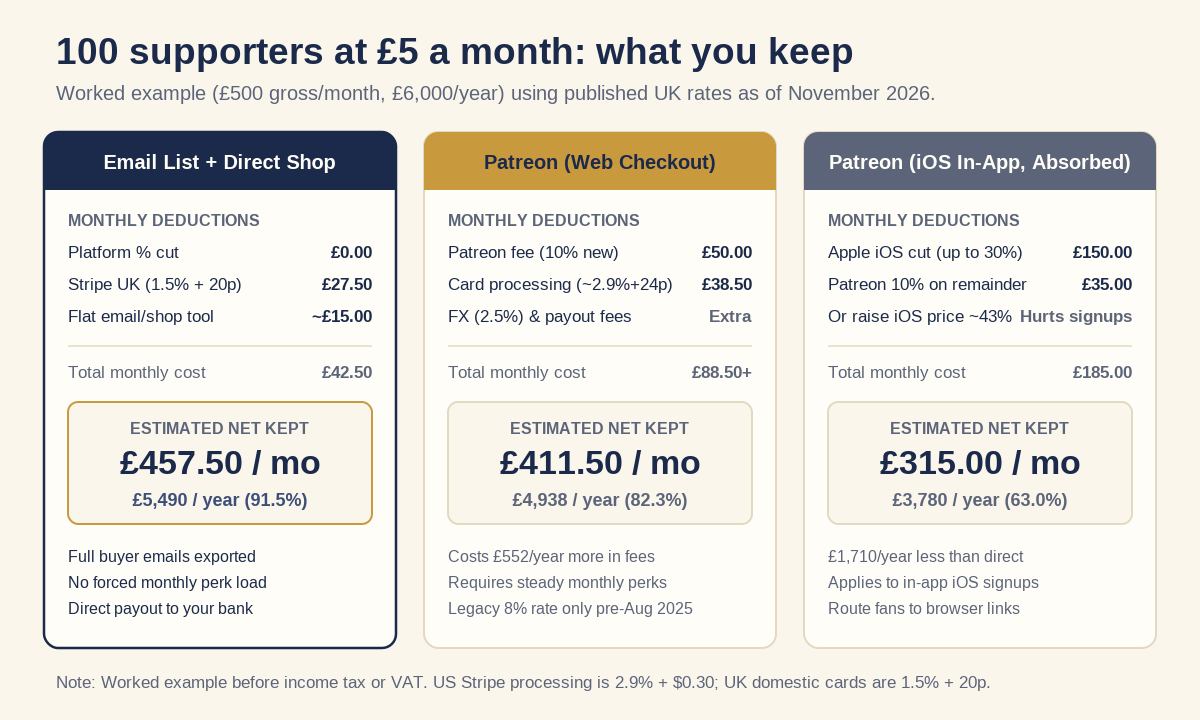
Now walk through the exact sums line by line so you can verify every penny:
| Cost item (100 readers x £5/month) | Email list + direct Stripe UK | Patreon (web, new 10% tier) | Patreon (iOS in-app, cut absorbed) |
|---|---|---|---|
| Gross monthly revenue | £500.00 | £500.00 | £500.00 |
| Apple iOS App Store commission (up to 30%) | £0.00 | £0.00 | £150.00 |
| Platform percentage fee | £0.00 | £50.00 (10%) | £35.00 (10% of £350) |
| Card processing fees | £27.50 (1.5% + 20p) | £38.50 (approx. 2.9% + 24p) | Included in Apple cut |
| Flat email and website software allowance | £15.00 (illustrative flat fee) | £0.00 (optional extra tool) | £0.00 (optional extra tool) |
| Estimated monthly net before FX and tax | £457.50 | £411.50 (before 2.5% FX) | £315.00 |
| Estimated annual net | £5,490.00 | £4,938.00 | £3,780.00 |
Even when every single patron signs up through a desktop web browser and pays in pounds with zero currency conversion, Patreon costs £552 more per year than a flat-fee direct shop at £500 a month. Double that readership to 200 supporters (£1,000 a month) and the annual gap widens past £1,250, because your flat email and website subscription stays almost fixed while Patreon's 10 percent cut climbs with every new fan. Notice also that in real life, direct sales to an email list rarely stay at £5 transactions: selling a £14.99 signed paperback or £12.99 digital trilogy bundle cuts the impact of fixed per-transaction card fees even further. You can inspect how fixed fees behave on single titles in our guide on what you keep on a £4.99 ebook sold direct.
Portability, subscriber ownership and platform risk compared
Fees tell half the story. Ownership tells the other half. When a reader joins your mailing list through a signup form on your own domain, you hold a clean CSV database containing their email address, signup date, tags and purchase history. If your email provider raises its monthly prices or changes its editor next year, you export your CSV on Tuesday afternoon, import it into a new provider on Wednesday morning and keep sending emails without losing a single subscriber.
With Patreon, you can export member email addresses, yet you cannot move their saved payment tokens or recurring subscriptions to a new host. If you decide to leave Patreon, every supporter must cancel their pledge and manually re-enter their debit or credit card details somewhere else. Even with generous notice, authors typically lose 40 percent to 60 percent of recurring billing during a migration simply through reader inertia and expired cards.
There is also policy risk. Payment processors and membership platforms periodically tighten content rules around romance heat levels, dark fiction themes or horror cover imagery. Keeping your primary audience inside an owned email list on your own website insulates your career from sudden rule changes in the same way we advise protecting yourself against store closures in if Amazon closed your KDP account, what you still own.
The content treadmill and monthly churn problem on membership sites
The hidden cost of Patreon never appears on a pricing page: mental load and monthly churn. A book buyer pays £4.99 once, reads your novel at their own pace and owes you nothing until your next release. A monthly patron checks their bank statement twelve times a year and asks whether your tier gave them enough fresh material this month to justify staying subscribed.
Typical creator memberships experience steady monthly churn, often between 5 percent and 12 percent of members leaving each month due to expired cards, tighter household budgets or finished reading binges. If 10 percent of a 100-member Patreon cancels every month, you must recruit 10 brand-new paying patrons every 30 days just to stand still. To keep churn down, many early-stage authors overpromise perks: weekly bonus short stories, monthly Q&A livestreams, physical stickers posted by hand and private Discord moderation.
Within six months, those promises can consume ten hours a week while bringing in £150 a month, leaving less energy for the next novel that would have grown your entire catalogue permanently. An email list imposes no such obligation. Sending one honest, well-written newsletter a month (plus two or three focused launch emails when a book comes out) keeps subscribers warm without stealing your drafting mornings.
The build order: when to stick to email and when a membership pays off
Treat community building as a three-phase sequence so you never add recurring obligations before your reader base is big enough to support them.
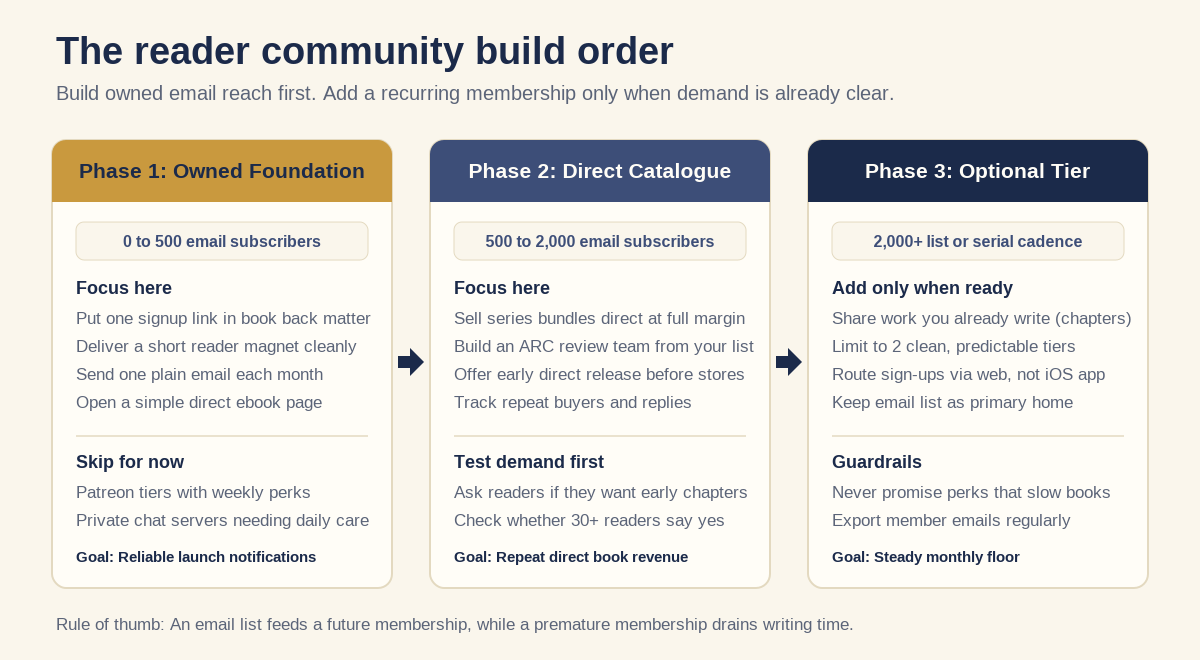
- Phase one (0 to 500 email subscribers): focus entirely on building your list and finishing your next book. Put one crisp invitation in the back matter of every ebook and paperback, offer a short reader magnet and send a consistent monthly letter. Our step-by-step guide on getting your first 100 email subscribers with no ad budget covers the five lowest-effort sources to start with.
- Phase two (500 to 2,000 email subscribers): layer in higher-margin direct sales to the list you already own. Offer early direct access to new releases seven days before retailers, sell multi-book bundles with bonus epilogues and recruit a reliable ARC team from your most responsive readers. Explore how to connect your list and storefront cleanly on our author mailing list and sell ebooks direct pages.
- Phase three (2,000 or more engaged subscribers, or a proven serial fiction schedule): survey your email list before building a membership. Ask plainly whether readers would pay £4 to £6 a month for early chapters or monthly bonus scenes. Launch only if at least 30 to 50 readers reply with clear interest so your first week opens with real momentum instead of an empty room.
Watch your software overheads across phases one and two as well. Stitching together separate website hosting, email marketing, file delivery and storefront tools adds up quickly, as we break down in what the DIY author stack costs a year. If you prefer a single flat-fee setup for your author website, mailing list, direct ebook sales, ARC delivery and press kit, Indie Author Toolchest costs $12.99 a month or $120 a year with a 14-day free trial (no card needed), with direct sales switching on when you subscribe.
How to structure a low-burnout membership once your list is ready
When you do reach phase three and decide to open a Patreon or competing reader membership, design it around work you are already producing so it never derails your publication schedule:
- Limit yourself to two tiers: a simple supporter tier (£3 to £4 a month for behind-the-scenes updates and early cover reveals) and one reader tier (£6 to £8 a month for early-access chapters of the book you are already drafting).
- Skip physical merchandise tiers unless you genuinely enjoy packing envelopes, because international postage and stock tracking erode margins fast.
- Always link directly to your web signup page from your newsletter and website, with a plain note reminding iPhone readers to join in Safari or Chrome rather than the iOS app so neither of you loses up to 30 percent to App Store fees.
- Keep every patron on your main owned email list as well, and back up your member CSV at the end of every quarter.
Start today by checking that your book back matter and website homepage point to one clean email signup page on your own domain. Once that list grows into a responsive readership that buys every release you launch, you will have the leverage to add a membership on your own terms, or skip it altogether and keep 90 percent plus through direct sales.
Questions, answered
Should a debut author start an email list or a Patreon page first?
Start with an owned email list first. Asking brand-new readers to sign up for a free newsletter and bonus scene converts many times higher than asking strangers for a monthly card payment, and your email list becomes the exact audience you will later invite if you ever launch a paid membership.
What fees does Patreon charge new authors as of November 2026?
New creator pages published after 4 August 2025 pay a flat 10 percent platform fee on membership revenue and digital product sales, plus payment processing fees, around 2.5 percent on cross-currency pledges and small payout fees. Creators who published continuously on or before 4 August 2025 keep their legacy 8 percent Pro rate unless they unpublish their page.
How does Apple's iOS App Store fee affect Patreon authors?
When a reader subscribes inside Patreon's iOS app, Apple takes up to a 30 percent App Store commission unless the author routes sign-ups through a web browser link. Patreon lets creators either mark up iOS tier prices automatically so the reader pays the difference or absorb the cut out of creator earnings, both of which create friction compared with a normal web checkout.
Can I export my subscribers' email addresses if I leave Patreon?
Patreon lets you export a CSV list of active and former members with their email addresses, though you cannot transfer recurring billing cards to another platform. If you leave, every paying patron has to re-enter payment details on your new checkout, which typically causes a large drop in recurring pledges.
How many email subscribers do I need before a paid membership makes financial sense?
In practice, roughly 1 percent to 3 percent of an engaged author mailing list will join a modest monthly membership tier. Waiting until you have at least 1,000 to 2,000 active readers, or a high-cadence serial fiction schedule with proven demand, ensures the monthly income justifies the extra administration and bonus content.