
Amazon Ads drops estimated KENP royalties: what to do
Amazon Ads removed estimated KENP royalties on 11 November 2026 and now estimates qualified borrows. What changed and how to work out your own page royalty.
Amazon Ads no longer shows estimated KENP royalties in its reports. The Support Center page on Kindle Edition Normalized Pages (KENP) metrics, updated on 11 November 2026, now says: "Estimated KENP royalties metrics are no longer available in Reporting." In its place are two new metrics, Kindle Unlimited qualified borrows and Estimated Kindle Unlimited royalties, which value borrows instead of pages.
What KDP pays you has not changed. You still earn from the KDP Select Global Fund for each page a subscriber reads for the first time. What has changed is the number your ad dashboard puts beside your spend, so if you judge campaigns on that number, check how you work out your return before you change any bids.
What changed in Amazon Ads reporting on 11 November 2026
We read the Amazon Ads help page on 16 November 2026. It lists three groups of metrics for Kindle Unlimited, and says they are available only to KDP authors and only on Sponsored Products, Sponsored Brands, Display, Streaming TV, DVA+ and full-funnel campaigns.
- KENP read stays. It is the estimated number of pages read by Kindle Unlimited customers that Amazon attributes to your ads, split into reads from clicks and reads from views, and into promoted books and "halo" books.
- Kindle Unlimited qualified borrows is new. Amazon defines it as the number of times a Kindle Unlimited user downloaded a book and read enough pages to qualify for a royalty payment, attributed to an ad interaction.
- Estimated Kindle Unlimited royalties is new. It is an estimate of royalties for those qualified borrows, with click, view, promoted and halo versions, and a converted-currency version of each.
- Estimated KENP royalties has gone. This was the metric that turned ad-attributed pages read into a money figure.
The page also says your actual royalties may differ from the estimate and tells you to check your KDP author reports for what you earned. That instruction is the most useful line on the page.
What a qualified borrow is, and what Amazon has not said
A qualified borrow is a download by a subscriber who then read "enough pages to qualify for a royalty payment". Amazon does not say how many pages that is. It does not say whether the threshold is a fixed number of pages or a share of the book, and it does not say how the new royalty estimate turns a borrow into money.
That matters because KDP's own help page, Royalties in Kindle+, describes no borrow threshold at all. It says you are paid "for the first time a subscriber reads or listens to a given page in your book", and that your share of the fund depends on your share of total pages read or listened to. On KDP's description, a reader who opens your book and reads ten pages earns you ten pages of royalties. The ads page now counts a borrow only once some threshold is reached, and values the borrow, so the two systems are measuring different things.
The ads page also still says "Kindle Unlimited" throughout. Amazon renamed the subscription Kindle+ on 21 October 2026 and added audiobook listening in the US, which we covered in what changed for indie authors in October 2026. The ads page does not mention listening, so we cannot tell you whether Kindle+ pages listened are counted in either new metric.
Why the new estimate can differ from what KDP pays
Expect the ads estimate and your KDP report to disagree, for four reasons that are all stated or implied on Amazon's own pages.
- Different units. KDP pays by page. The new ads estimate is built on qualified borrows. A campaign that brings lots of readers who sample a chapter and stop may show pages in KDP but few qualified borrows in the ads console.
- Attribution windows. The ads page credits reading to your ad when a customer reads the advertised book "up to 14 days after they click the ad". It gives no window for views. Pages read on day 20 still pay you, but they will not appear against the campaign.
- Halo books. Some of the pages and borrows shown are for "highly relevant books that were not directly promoted". Amazon does not define "highly relevant". If you run ads on book one of a series, read-through into book two may show up here, or it may not.
- Timing. Pages are dated to the day they were read, and pages read on offline devices can take a week to arrive, so recent days in the ads console keep moving. KDP says monthly KENP figures are finalised near the 15th of the following month.
None of this means the new figure is wrong. It means it is an estimate built a different way from your payment, and you should treat it as a quick signal and keep your own sum alongside it.
How to work out estimated KENP royalties yourself
You can rebuild the old number in a spreadsheet, because the ads console still reports KENP read. The sum is pages read from your ads multiplied by a per-page rate.
Amazon does not publish a per-page rate. It announces the size of the KDP Select Global Fund each month on the KDP Community forum. Written Word Media keeps a running table of fund sizes and US per-page payouts, worked out from authors' reported royalties, and that is the figure most authors use. As of 16 November 2026 its latest figure is for September 2026: $0.005365 a page in the US. Across January to September 2026 its US figure ran from $0.004202 in January to that September high, with July the second-lowest month at $0.004221.
| Month (2026) | US rate per page | Global Fund |
|---|---|---|
| April | $0.004820 | $64.3 million |
| May | $0.004888 | $66.9 million |
| June | $0.004615 | $63.6 million |
| July | $0.004221 | $67.6 million |
| August | $0.005170 | $66 million |
| September | $0.005365 | $65.9 million |
Source: Written Word Media's KDP Global Fund tracker, read on 16 November 2026. The rate is a US figure. Other marketplaces pay different rates, and KDP's help page says the share of the fund given to each country depends on exchange rates, reading behaviour and local subscription prices. Our Kindle Unlimited per-page rate report explains how the monthly figure moves.
The October 2026 fund was not yet in the tracker when we checked. The KDP Select page was showing total KDP Select author earnings of $71.1 million for October 2026, and that total includes the All Stars bonus, so it is larger than the fund itself.
A worked example with real arithmetic
This is an illustrative campaign, not a benchmark. Say you spend $50 in a month promoting a $4.99 ebook in the US store. The ads console shows six ebook sales and 4,000 KENP read from clicks on your promoted book.
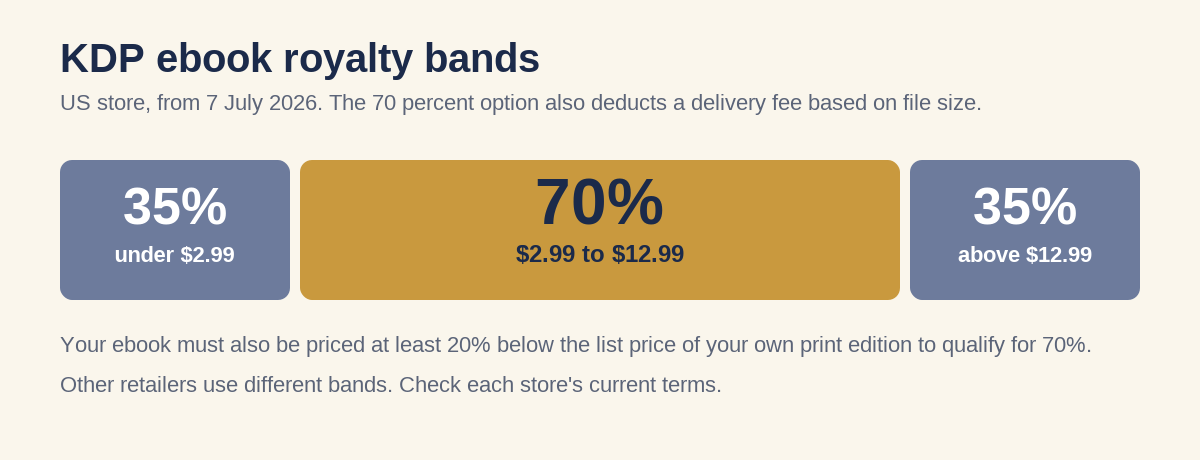
- Each sale on the 70% option, with a 1 MB file and KDP's $0.15 delivery fee, earns $3.39. Six sales earn $20.33.
- At the September 2026 rate, 4,000 pages earn 4,000 x $0.005365 = $21.46.
- Your royalties from the ads are $20.33 + $21.46 = $41.79.
- Divide by spend: $41.79 / $50 = $0.84 back for each $1 spent.
Now run the same pages at the July rate. 4,000 x $0.004221 = $16.88, the total falls to $37.21, and the return falls to $0.74 for each $1. The same campaign looks ten cents better or worse per dollar depending only on which month's rate you use, so state the rate beside the result in your sheet and update it when the month's figure is announced.
Use the current month's actual pages read and the latest announced rate, then correct the row once KDP finalises the month. Our book sales and return on investment sheet has the columns for this, and what to expect from your first £100 or $100 on Amazon Ads explains why a return under $1 is common while you are still learning.
What to do this week if you run Amazon Ads
- Open your saved reports and custom columns in the Amazon Ads console. Any view that used Estimated KENP royalties needs that column replaced with the new metrics.
- Add KENP read from clicks, KENP read from views, Kindle Unlimited qualified borrows and Estimated Kindle Unlimited royalties. Keep the promoted and halo splits if you advertise a series.
- Add a column to your own sheet that multiplies KENP read by the latest per-page rate, and note which month's rate you used.
- Run both figures side by side for at least one full month. Compare each with the KDP KENP report after it is finalised near the 15th of the following month.
- Hold off changing bids or pausing campaigns on the new estimate alone until you have that month of comparison. A campaign that looks worse overnight may only look worse because the measure changed.
- If you keep a record of past months, export it now. Amazon has not said whether historical Estimated KENP royalties figures are still available anywhere in Reporting.
Does this change how much Kindle Unlimited pays you?
No. The change is to Amazon Ads reporting, which estimates the effect of your campaigns. KDP's help page, read on 16 November 2026, still says you are paid for the first time a subscriber reads or listens to a page, from a fund Amazon reviews and announces each month. Your actual Kindle+ earnings appear in the KENP report and Prior Months' Royalties in KDP Reports.
If you are weighing whether to keep a book in KDP Select at all, our guide to whether Kindle Unlimited is worth it for your book sets out the trade with exclusivity.
What we could not verify
Amazon's page does not give the date the old metric was removed, the reason, the page threshold for a qualified borrow, how the new royalty estimate is calculated, the attribution window for views, or whether Kindle+ audiobook listening is included. PPC Land's report on the change, published on 12 November 2026, lists the same open questions. If Amazon answers any of them, the sensible move is to compare its method with your own page-based sum before relying on it.
Model your exact borrow payout and maximum profitable CPC bid with our free Kindle Unlimited (KENP) royalty and break-even ad calculator.
Questions, answered
Where did estimated KENP royalties go in Amazon Ads?
Amazon removed the metric from Reporting. Its KENP metrics help page, updated on 11 November 2026, says estimated KENP royalties metrics are no longer available. KENP read is still reported, and two new metrics, Kindle Unlimited qualified borrows and Estimated Kindle Unlimited royalties, have been added.
What is a Kindle Unlimited qualified borrow?
Amazon Ads defines it as a download by a Kindle Unlimited user who then read enough pages to qualify for a royalty payment, attributed to an ad interaction. Amazon does not say how many pages that is. KDP's own help page describes payment per page read for the first time, with no borrow threshold.
Has the Kindle Unlimited per-page payment changed?
No. The change is to Amazon Ads reporting only. KDP still pays from the KDP Select Global Fund for the first time a subscriber reads or listens to each page, and your actual earnings are in the KENP report in KDP Reports.
How do I calculate KENP royalties from my ads myself?
Multiply the KENP read figure in your ads report by the latest per-page rate. Written Word Media's tracker puts the September 2026 US rate at $0.005365, so 4,000 pages would earn about $21.46. Correct the figure once KDP finalises the month near the 15th.
Why does the ads estimate not match my KDP report?
The ads console counts only reading within 14 days of an ad click, plus some view-based and halo reading, and the new estimate values borrows rather than pages. KDP counts every page read for the first time, however the reader found the book, so the KDP total is usually higher.