
Indie Author Academy / Resources
Track book sales and return on investment: a simple sheet
How to track book sales: what to record, where to find it in KDP and other reports, a sheet to copy, and formulas for ROI, break-even copies and ACOS.
To track book sales properly you need five numbers each month: copies sold per format and store, the royalty you earned, the royalty you were actually paid, what you spent on the book, and what you spent on advertising. Put them in one spreadsheet, one row per month per sales channel, and you can work out return on investment, break-even copies and advertising cost of sales with three short formulas.
This guide shows where each number lives, a layout you can copy, the formulas with a worked example, and how long UK and US authors have to keep the records. Every sales figure in the worked example is invented for illustration. Nothing here is a benchmark or a prediction of what a book will earn.
What should you track when you track book sales?
Track two kinds of number: results and costs. Results are units sold, royalties earned and royalties paid. Costs are the one-off costs of making the book (editing, cover, formatting, proof copies, ISBNs) and the running costs of selling it (advertising, software subscriptions, giveaway copies, postage on direct orders).
Keep earned and paid separate, because they differ by weeks or months. KDP, for example, reports a sale in the month it happens but pays it later, and the exchange rate used for a royalty report is not always the one used when the money lands. If you only record what reaches your bank, you will always be a quarter behind your own book.
Where to find each number
Each source reports a different slice, and none of them agree to the penny, so record the source name next to every figure.
KDP reports
KDP Help describes six reports you will use (KDP Help, reports, read 13 November 2026).
| KDP report | What it shows | When it is final |
|---|---|---|
| Dashboard | Today's estimated royalties, orders and KENP pages read, with top formats and marketplaces | Estimates only, refreshed every 15 minutes |
| Month-to-Date | Unit sales and KENP reads for the current or prior month | Monthly KENP is finalised near the 15th of the next month |
| Prior Months' Royalties | Royalties by month, downloadable | Updated near the 15th of each month |
| Orders | Processed orders across formats, comparing up to 10 books | Ebooks about 24 hours, print a few days |
| KENP | Royalties for pages read by borrowers | Updated near the 15th, may change until finalised |
| Payments | Payments by sales period, filterable by marketplace and status | Updated 60 days after the end of the month the sale was reported |
KDP's help page says the Dashboard and Royalties Estimator are estimates, and that for actual amounts you should use Prior Months' Royalties and Payments. It also says Prior Months' Royalties converts at the exchange rate on the last day of each month, so record the currency with every row.
Other retailers and distributors
Every store and distributor has its own report, and the rule is the same: use the monthly statement, not the live chart. Draft2Digital's own support page says its charts "should never be used for accounting purposes" and that only the final month-end figures from the vendor stores can be used (Draft2Digital support, read 13 November 2026). Kobo Writing Life's help centre points authors to the monthly reports in the Payment Information section of its portal, but that page could not be opened on the day it was checked, so check it for the report and payment dates.
Direct sales and Amazon Ads
Direct sales are reported by whoever takes the payment: your payment provider, shop software or storefront. Export the raw orders each month and keep the provider's fee on its own line. Amazon Ads has its own console. KDP Help says the Ads account shows sales attributed to clicks within 14 days, while KDP shows all sales of your books, so the two totals will never match (KDP Help, advertising reports).
A spreadsheet layout you can copy
Use two sheets. The first holds income, one row per month, channel and format. The second holds costs, one row per receipt.
Sheet 1: income. The rows below use invented numbers.
| Month | Channel | Format | Units | Sales value | Royalty earned | Royalty paid | Currency | Source |
|---|---|---|---|---|---|---|---|---|
| 2026-03 | KDP UK | Ebook | 40 | 159.60 | 106.00 | 106.00 | GBP | Prior Months' Royalties |
| 2026-03 | KDP UK | Paperback | 12 | 107.88 | 24.00 | 24.00 | GBP | Prior Months' Royalties |
| 2026-03 | Direct | Ebook | 6 | 29.94 | 28.50 | 28.50 | GBP | Shop export |
Sheet 2: costs.
| Date | Supplier | What for | Type | Amount | Receipt saved |
|---|---|---|---|---|---|
| 2026-01-15 | Editor | Copyedit | Production | 600.00 | Yes |
| 2026-02-02 | Designer | Cover | Production | 300.00 | Yes |
| 2026-03-01 | Amazon Ads | Campaign, March | Advertising | 200.00 | Yes |
Add one summary row per month with SUMIFS formulas that total income, costs and advertising, so you never retype a number. If you are a UK sole trader, give the Type column the same category names as your Self Assessment return so the figures drop straight in later.
How to calculate return on investment on a book
Return on investment is profit divided by what you put in, expressed as a percentage.
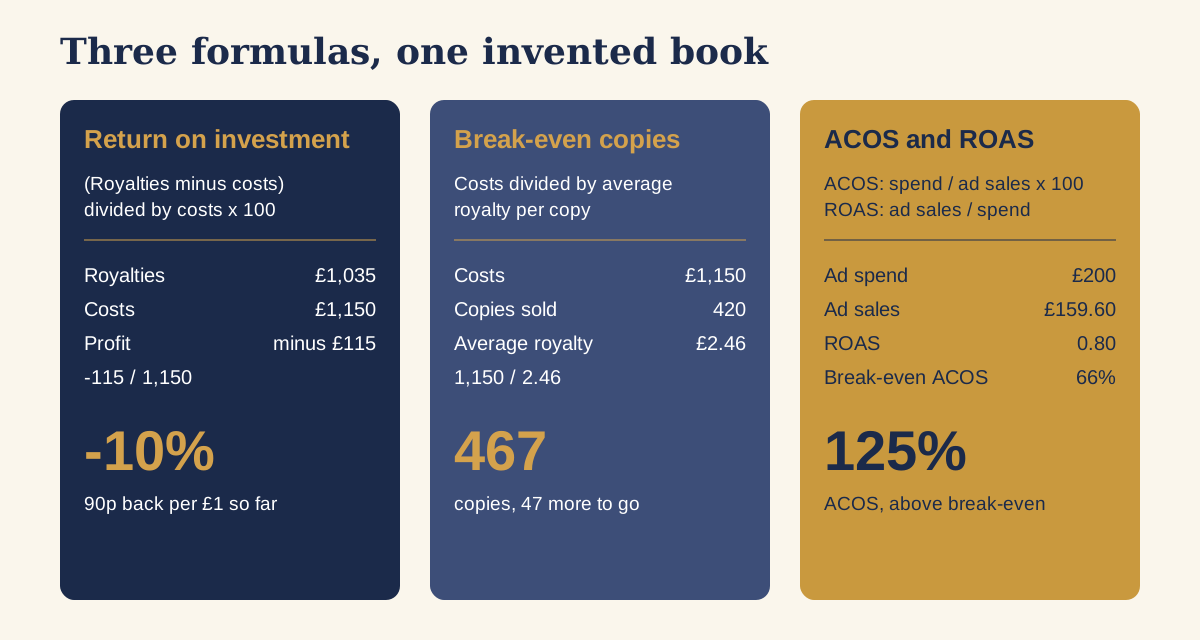
ROI = (royalties received minus total costs) divided by total costs, multiplied by 100.
Take an invented book. Costs: editing £600, cover £300, advertising £200 and proof copies £50, a total of £1,150. Over its first year it sold 300 ebooks at a royalty of £2.65 and 120 paperbacks at £2.00. Royalties are £795 plus £240, which is £1,035.
Profit is £1,035 minus £1,150, which is minus £115. ROI is minus £115 divided by £1,150, which is minus 10%. The book has returned 90p for every £1 spent so far. Decide in advance what period you are measuring, because a book that is minus 10% at twelve months may be positive at twenty-four.
How many copies do you need to break even?
Break-even copies = total costs divided by average royalty per copy.
Using only ebooks at £2.65, the book above needs £1,150 divided by £2.65, which is 433.96, so 434 copies. With the real mix of formats, the average royalty is £1,035 divided by 420 copies, which is £2.46. Break-even is then £1,150 divided by £2.46, about 467 copies, so 47 more than the 420 already sold.
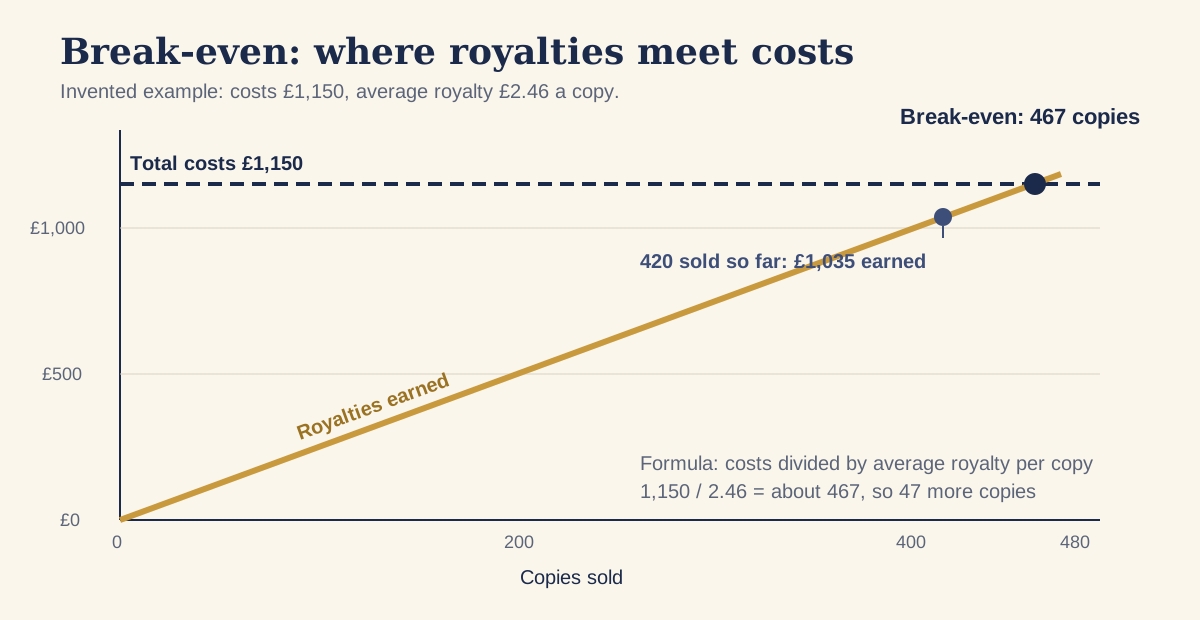
If sales are slower than your break-even plan, the diagnosis guide to why a book is not selling shows which stage to check first. Update the costs figure whenever you spend more. A second advertising campaign moves the break-even point further out, and the spreadsheet should show you by how many copies.
Advertising cost of sales and return on ad spend
Amazon Ads defines advertising cost of sales as ad spend divided by ad revenue, multiplied by 100, and its example is $50 spent for $100 of sales, an ACOS of 50%. It defines return on ad spend as the inverse, ad revenue divided by ad spend, which is 2 in the same example (Amazon Ads guide to ACOS, read 13 November 2026). Amazon's guide says your ACOS needs to be lower than your profit margin to stay profitable.
For a book, the profit margin is royalty divided by price, because Amazon counts the full sale price as revenue. Our guide to your first £100 on Amazon Ads covers the setup. Here is the arithmetic with invented numbers:
- Ad spend £200, producing 40 ebook sales at £3.99, so Amazon-reported sales of £159.60.
- ACOS = 200 divided by 159.60, multiplied by 100, which is 125%.
- Return on ad spend = 159.60 divided by 200, which is 0.80.
- Break-even ACOS = £2.65 royalty divided by £3.99 price, which is 66%.
- Royalty from those 40 sales is £106, so the ads lost £94 on their own sales.
An ACOS of 125% against a break-even of 66% means a loss on the first sales. That can still be a fair price for learning, or for pulling in readers who go on to buy book two. A series with later volumes or pages read in Kindle Unlimited earns beyond the first sale, but the campaign report will not show all of that, so record it separately.
A monthly tracking routine that takes under an hour
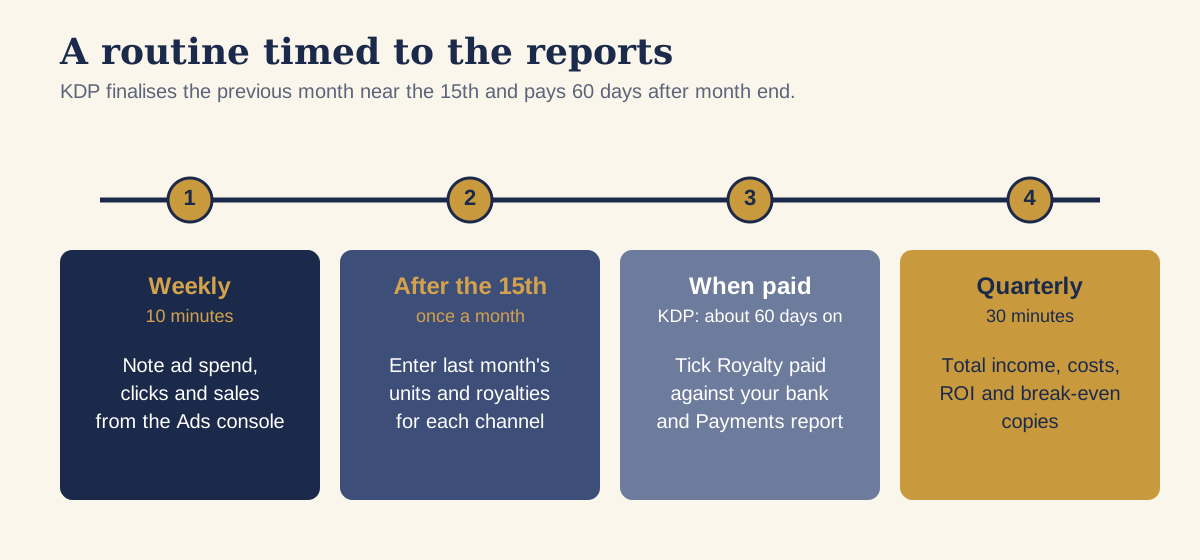
The timing of the reports sets the routine. KDP finalises the previous month's royalties and KENP around the 15th, so the month-end task waits until then.
- Weekly, ten minutes: note ad spend, clicks and sales from the Ads console, remembering that sales can take up to 14 days to appear.
- After the 15th: download Prior Months' Royalties and enter last month's units and royalties for each channel.
- When money arrives: tick the Royalty paid column against your bank, using the Payments report, which is updated 60 days after the end of the sales month.
- Every quarter: total income, costs, ROI and break-even copies, and decide whether any spending is worth repeating.
- Every year: save a copy of the sheet, the downloaded reports and your receipts in one dated folder.
What the Indie Author Toolchest reports
If you sell direct through the Indie Author Toolchest, its Analytics dashboard shows revenue, payment fees, your share, the amount paid out and the amount outstanding, tracked separately for each currency. It also offers CSV exports of raw sales and a statement-style export, a monthly order table, and revenue and new-subscriber charts for the last 12 months. It covers direct sales and your mailing list only, so Amazon and other store figures still go into your own sheet.
How long to keep your records
In the UK, GOV.UK says sole traders must keep records for at least 5 years after the 31 January submission deadline of the relevant tax year. Its example is a 2022 to 2023 return filed online by 31 January 2024, with records kept until at least the end of January 2029. Returns filed more than 4 years late need records kept for 15 months after sending (GOV.UK, how long to keep your records, read 13 November 2026).
The same guidance sets cash basis as the default from the 2024 to 2025 tax year, which means you record income when you receive it, not when the sale happened (GOV.UK, business records). That is why the Royalty paid column matters. If your turnover is over the Making Tax Digital threshold you will also need digital records, covered in our article on Making Tax Digital for self-published authors.
In the US, the IRS says the default is 3 years, rising to 6 years if you left out more than 25% of the gross income on your return, and indefinitely if you did not file or filed a fraudulent return (IRS, how long should I keep records). In either country, a longer period costs you nothing, so keep the spreadsheet and the downloaded reports for the longer one, and ask an accountant about your own situation.
Questions, answered
What is the best way to track book sales across several stores?
Use one spreadsheet with one row per month, channel and format, and take the figures from each store's monthly statement rather than its live chart. Record the currency and the source next to every row.
How do I calculate return on investment for a book?
Subtract total costs from royalties received, divide by total costs and multiply by 100. A result below zero means the book has not yet earned back what you spent.
How do I work out how many copies I need to break even?
Divide your total costs by the average royalty per copy. If costs are £1,150 and the average royalty is £2.46, you need about 467 copies.
What is a good ACOS for a book?
Amazon Ads says there is no single good figure and that your ACOS should be lower than your profit margin. For a book, divide your royalty by the price to find the break-even ACOS.
How long do I need to keep my sales records?
GOV.UK says UK sole traders should keep records for at least 5 years after the 31 January submission deadline of the tax year. The IRS default is 3 years, with longer periods in some cases, so check your own situation.
Run it all from one place
Author page, direct sales, reader list, review copies and press kit, built from one ASIN. Free for 14 days, no card.
Start your free trial