
Indie Author Academy / Lessons
Five indie publishing trends for 2027 and traps to skip
Five durable indie publishing trends heading into 2027, from direct sales and owned lists to stack consolidation, plus costly marketing traps to skip.
Five durable indie publishing trends are shaping how self-published authors earn heading into 2027: growing adoption of direct-to-reader sales and collectible editions, heavier reliance on owned email lists as social reach fragments, stricter platform upload and anti-spam rules, consolidation of bloated software stacks, and rising reader demand for unmistakable human-authored trust signals. Equally important is skipping the expensive traps, such as vanity awards, unverified BookTok promo gigs and five-app software stacks bought before Book 2 exists.
As of November 2026, indie publishing commentary moves fast, and half of what trends on social feeds every week disappears by spring. The practical test is simple: invest in shifts that strengthen assets you own, and skip shiny tactics designed mainly to extract fees from hopeful writers. Below is a ranked look at the five trends worth planning around and three budget traps to leave untouched.
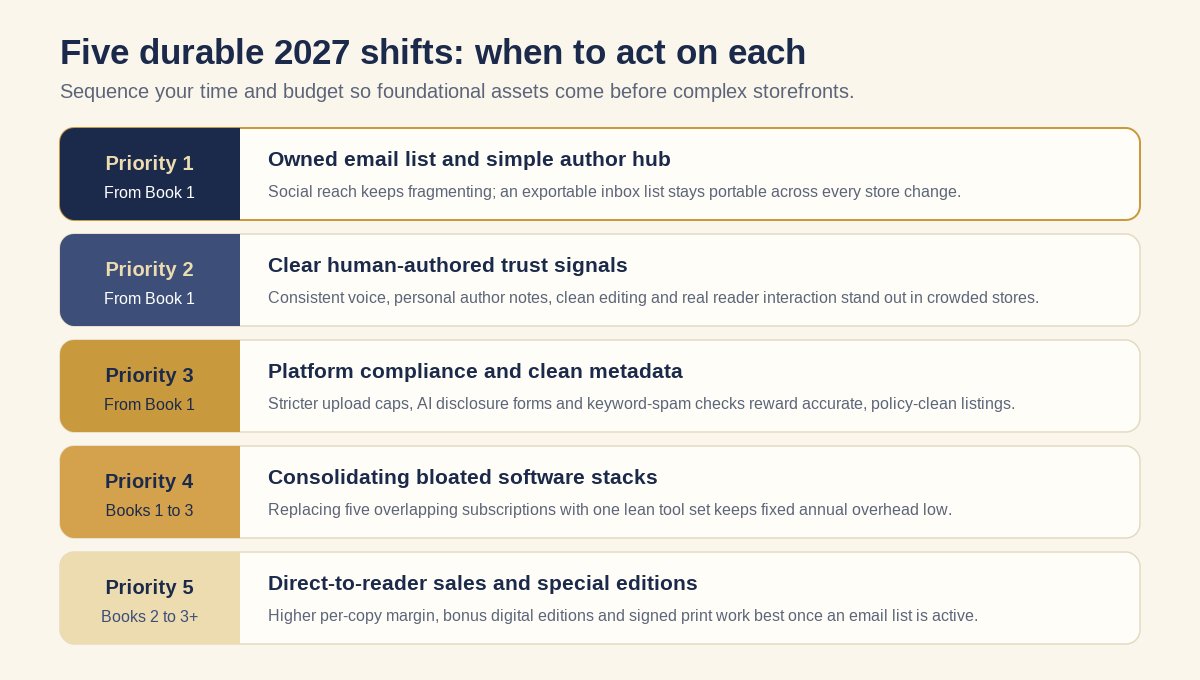
How to tell durable indie publishing trends from short-term hype
Every year brings a wave of urgent predictions claiming that one new app, ad format or artificial shortcut will rewrite book sales overnight. Most fade within twelve months because they depend on temporary loopholes rather than reader behaviour.
Durable indie publishing trends share three traits. First, they follow clear economic incentives for platforms or readers, such as stores tightening spam filters to protect search results or authors keeping higher margins on direct sales. Second, they show up consistently in independent industry research from bodies like the Alliance of Independent Authors. Third, acting on them leaves you with a stronger catalogue, lower fixed costs, or direct contact with your readers even if a social platform vanishes tomorrow.
Trend 1: direct-to-reader sales and collectible editions
Selling ebooks, bundles and signed or special print editions direct from an author's own website has moved from an experiment for top earners to a mainstream secondary channel. The margin case is straightforward: instead of surrendering 30% to 65% of list price to a retail platform, a direct digital sale lets you keep the list price minus standard payment processing fees and applicable sales tax.
As of November 2026, Stripe's UK pricing starts at 1.5% plus 20p for standard domestic UK cards, with higher percentages for international or commercial cards. On a £4.99 direct ebook sale to a UK reader, payment processing takes roughly 27p, leaving far more net margin per copy than a 70% retail royalty while also giving you the customer's email address with permission to announce Book 2.
Direct sales also pair well with collectible hardcovers, bonus epilogues and early-access editions for loyal fans, while retail distribution through Amazon KDP and wide print networks like IngramSpark's global distribution network continues handling cold marketplace discovery. Keep the sequencing sensible: build your list and at least two to three connected books first, and check exclusivity rules in our guide on KDP Select versus going wide per book before listing ebooks on your own store.
Trend 2: owned email lists outlasting declining social reach
Organic reach across major social networks has grown harder to predict as feeds shift further towards algorithmic entertainment and paid placements. Authors who built launch plans around free Facebook groups or single-platform viral clips have watched engagement fluctuate wildly without warning.
Heading into 2027, an exportable email list remains the single most resilient marketing channel an indie author can build. Because subscribers opt in deliberately for your genre and books, email bypasses feed throttling and carries straight across every new release, price drop and format launch. Pairing a dedicated author hub with a focused reader magnet ensures every retail sale and social click has a chance to join a list you control. If you have not set up a home base yet, review whether you need an author website to see the minimum pages worth building.
Trend 3: tighter platform upload limits and anti-spam rules
Digital bookstores have responded to a flood of low-effort automated uploads with tighter compliance rules. As of November 2026, major retailers enforce stricter daily upload caps, mandatory AI-generated content disclosure questions, tighter trademark and subtitle-stuffing enforcement, and faster automated account reviews when metadata violates guidelines.
For genuine indie authors writing original books, stricter policing is broadly good news if you keep your own house spotless. Avoid stuffing keywords into subtitles, never buy review-swap services, use properly licensed cover imagery, answer AI disclosure prompts accurately, and keep clean backup copies of all manuscripts, ISBN records and rights agreements. Treat retailer compliance as routine business hygiene so an avoidable metadata mistake never locks your catalogue.
Trend 4: consolidating bloated multi-app software stacks
Over the past decade, indie authors were told to bolt together five separate paid tools: a website builder, an email service provider, a reader-magnet delivery app, an ARC distribution service, and an ecommerce storefront. Each tool looked cheap during a launch trial, yet tiered subscriber pricing and annual renewals quietly compounded.
As of November 2026, published tiers on standalone email platforms such as MailerLite and Kit step up as your subscriber count grows, before you add domain hosting, web templates, delivery tools and checkout plugins. Our full breakdown of what the DIY author stack costs a year adds up those recurring bills alongside the hidden hours lost fixing broken integrations.
Heading into 2027, cost-conscious indies are trimming overlapping apps in favour of simpler, consolidated setups that hold overhead flat while their list expands. You can compare common standalone tools side by side on our author tool comparisons page, or check the Indie Author Toolchest, which puts an author website, mailing list, ARC distribution and direct ebook sales (switching on when you subscribe) under one $12.99 a month or $120 a year subscription, starting with a 14-day free trial requiring no card.
Trend 5: visible human-authored trust signals
As readers grow wary of generic, rushed content flooding search results and retail recommendations, clear human craftsmanship has become a genuine competitive advantage. Readers do not need angry manifestos on your product page; they look for quiet, unmistakable cues that a real person cared deeply about the book.
Practical human trust signals include clean copy-editing, a distinctive voice consistent between your blurb, Look Inside sample and email newsletter, a warm personal author note at the back of the book, accurate genre tropes, and genuine replies when readers write back to your newsletter. Over multiple releases, that trust turns casual bargain hunters into full-price day-one pre-order buyers.
Small touches reinforce that trust across every touchpoint. Include a straightforward author photograph and a plain biography on your website, list your real editor or cover designer in your acknowledgements where appropriate, and keep your release promises realistic rather than rushing rough drafts to market. Readers quickly learn which names deliver reliable emotional payoff and which names cut corners.
Three expensive marketing traps to skip in 2027
Alongside real shifts, a thriving cottage industry sells expensive shortcuts to anxious indie authors. Three traps drain thousands of pounds from debut budgets every year with little measurable return:
- Paid vanity awards and seal packages that charge £75 to £300 per category entry, award dozens of overlapping medals every quarter, and carry almost zero recognition among actual bookstore shoppers.
- Unverified BookTok or social media promotion gigs pitched via cold direct messages or gig marketplaces, where sellers promise tens of thousands of views using click farms or off-genre audiences that generate zero qualified book clicks.
- Overbuilt five-app software stacks and custom web redesigns bought before Book 2 is written, locking in £500 or more of annual fixed costs when your money would work far harder funding professional editing and cover design for the next title.
A fourth quiet trap sits inside premature paid advertising: pouring £20 a day into pay-per-click ads for a single standalone novel before fixing the cover thumbnail, checking the Look Inside sample, or verifying that the blurb matches current subgenre expectations. Paid traffic amplifies whatever conversion rate your book page already achieves. Sending cold clicks to a weak product page empties a budget faster than any vanity seal.
If an agency or freelance marketer contacts you out of the blue promising guaranteed bestseller badges or viral sales spikes, walk away immediately. Read our guide on hiring a book marketer and avoiding scams before handing over a card number.
Worked example: reallocating £600 from hype traps to owned assets
To see how sharply budget choices change your first-year position, compare two ways of spending the exact same £600 self-publishing marketing budget. Treat the prices below as an illustrative worked example using typical UK/US supplier ranges as of November 2026 rather than fixed quotes.
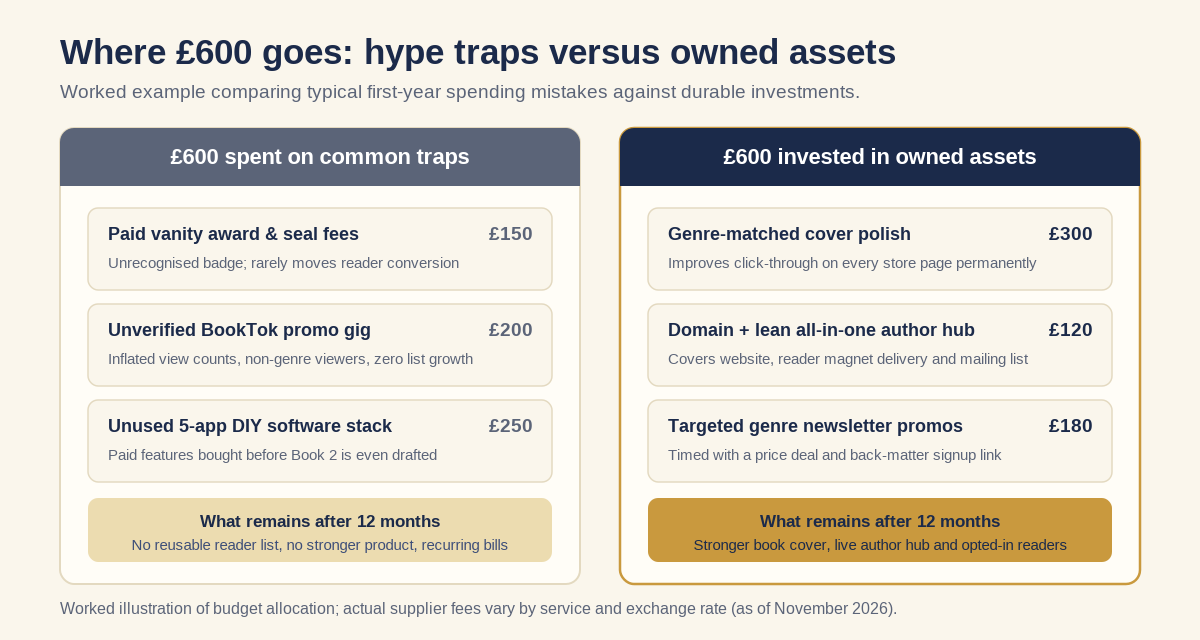
| Budget category (worked example) | Trap budget (£600) | Owned-asset budget (£600) |
|---|---|---|
| Product packaging | £150 on vanity award entry fees | £300 on genre-matched cover polish |
| Software and web hub | £250 on unused 5-app DIY subscriptions | £120 on domain plus lean all-in-one hub |
| Reader acquisition | £200 on unverified BookTok promo gig | £180 on vetted genre newsletter promos |
| Reusable assets remaining after 12 months | Unrecognised badge, expired apps, no list | Stronger cover, live hub, opted-in readers |
Notice how differently the two budgets behave in year two. Every pound in the left-hand column evaporates once the invoice clears, leaving the author starting from scratch on Book 2 with higher recurring software bills. In the right-hand column, the stronger cover keeps lifting conversion on every retail store indefinitely, the author hub keeps collecting back-matter signups at low flat overhead, and the vetted newsletter promotion puts genuine genre readers onto an email list you can message again on every future launch.
Before committing funds to any new trend or tool in 2027, run your full production and marketing numbers through our self-publishing cost calculator. Ask one blunt question about every line item: if I pay for this today, will it leave me with a better book, a larger owned email list, or lower ongoing overhead twelve months from now? Keep what passes that test and skip the rest.
Questions, answered
Which indie publishing trend matters most for a debut author heading into 2027?
Building an owned email list and a clean, genre-accurate book package matters most for a debut author. Direct stores and special print editions work far better once you have at least two to three connected books and an active group of subscribers waiting for your next release.
Are paid indie book awards worth entering in 2027?
Most paid vanity awards with high entry fees and little public recognition rarely generate enough extra sales to cover their cost. Before paying any contest fee, check whether actual readers in your genre recognise the award and whether independent organisations such as ALLi rate the contest favourably.
Why are indie authors consolidating their software subscriptions?
Running separate paid subscriptions for website hosting, email marketing, reader-magnet delivery, ARC management and direct sales often costs £400 to £900 or more per year before a catalogue earns steady royalties. Consolidating onto one lean stack cuts fixed overhead and reduces broken integrations.
How can self-published authors show human-authored trust signals without sounding defensive?
Focus on authentic editorial polish, a consistent author voice across your books and newsletters, candid notes about your research or creative process, and transparent disclosure where platforms request it. Readers respond to warmth, reliability and clear craftsmanship far more than loud slogans.
Should every indie author open a direct-to-reader storefront right away?
No, wait until you have a mailing list or a connected series capable of sending warm traffic to your shop. Opening a standalone store with zero audience creates monthly overhead without organic marketplace discovery to feed it.