
Indie Author Academy / Lessons
Book marketing services: cost, scams and how to vet one
Book marketing services cost from hundreds to thousands of dollars. See what each kind sells, how to spot predatory offers and which questions to ask first.
Yes, you can hire someone to run your book marketing, and a whole market of book marketing services exists to sell you that. Prices on the largest author marketplace run from hundreds to thousands of dollars, and nobody can promise you sales in return. The same market holds operators who cold-contact authors and charge fees up front. Below: what you can buy, what it costs, how to vet a seller, and when to do it yourself.
The short version is to hire only for a defined task, pay against a written scope, and never pay anyone who contacted you first. If you would rather start with the free methods, our no-budget marketing plan sets them out in order.
Can you hire someone to do all your book marketing?
You can hire people for every part of it: a strategy, an email list and its sequences, advertising, publicity, social media and launch support. What you cannot buy is the result. Nobody controls whether readers click, buy or review, and a marketer who guarantees a bestseller or a sales figure is promising something outside their power.
The sensible way to think about hiring is that you are paying for time and skill on a task, in the way you pay an editor or a cover designer. Our cost of self-publishing article treats marketing as a line that is optional, and that is how it should stay until you know what you are buying.
What kinds of book marketing services exist?
Sellers fall into a handful of groups, and the group matters more than the brand name. The table sets out what each one does and the question to put to it first.
| Kind of service | What you get | First question to ask |
|---|---|---|
| Marketing strategist or consultant | A plan for your book, channels to use, sometimes coaching | Who carries out the plan, and by when? |
| Email marketing specialist | List set-up, welcome sequence, newsletter copy | Does the list and the account stay in my name? |
| Advertising manager | Runs ads on Amazon, Facebook or other platforms | Do I pay the platform directly, and can I see the account? |
| Publicist | Pitches media, podcasts and reviewers | Which outlets have you placed authors in, and can I contact those authors? |
| Launch or promotion package | A bundle of listings, newsletter slots and social posts | What exactly is listed, and where will I see proof? |
| Full-service or "author services" company | Publishing plus marketing add-ons | What do I own at the end, and what does each add-on cost separately? |
The last group deserves extra care. Writer Beware, the scam-watching committee of the Science Fiction and Fantasy Writers Association, lists publicity, paid reviews and add-on services among the areas where it sees authors being overcharged, and it names vanity and hybrid publishers that hide fees as a separate concern. Marketing add-ons sold by a company that also published your book are the easiest place for a price to drift upwards.
What does book marketing cost?
Prices vary so widely that most figures you will find online have no method behind them, and we do not quote them. One marketplace does publish its numbers. As of November 2026, Reedsy's book marketing page lists guide prices for 2026 projects: $1,300 to $2,500 for a marketing strategy (310+ projects), $900 to $2,000 for email marketing (90+ projects) and $500 to $1,000 a month for advertising (100+ projects). The page says marketers give tailored quotes after reviewing sample pages, so your own price may differ.
Reedsy sells access to those marketers, so treat the ranges as a guide to one marketplace and not as the price of the whole market. Advertising fees are also the manager's fee only: the money spent on the ads themselves is separate, and it should come out of an account you own.
A break-even example
A labelled illustration shows why the price matters. Suppose you spend $2,000 on a marketing engagement and your ebook sells at $2.99, which earns a 70% royalty of about $2.09 per copy before any delivery fee. You would need about 956 extra sales to cover the fee, and that is before counting the time you spent managing the work. The numbers are an example, not a forecast. Our guide to tracking sales and return on investment shows how to do the same sum with your own royalty.
How do you spot a predatory author service?
The warning signs are consistent across the organisations that watch this market. The Authors Guild, in its publishing scam alerts, lists unsolicited contact (especially about a book already on Amazon), requests for upfront money or escalating "required" fees, unrealistic promises, pressure to reply quickly, refusal to talk by phone, free-email addresses or mismatched contact details, and addresses that do not exist. It adds that legitimate publishers and agents do not cold-contact authors to sell services.
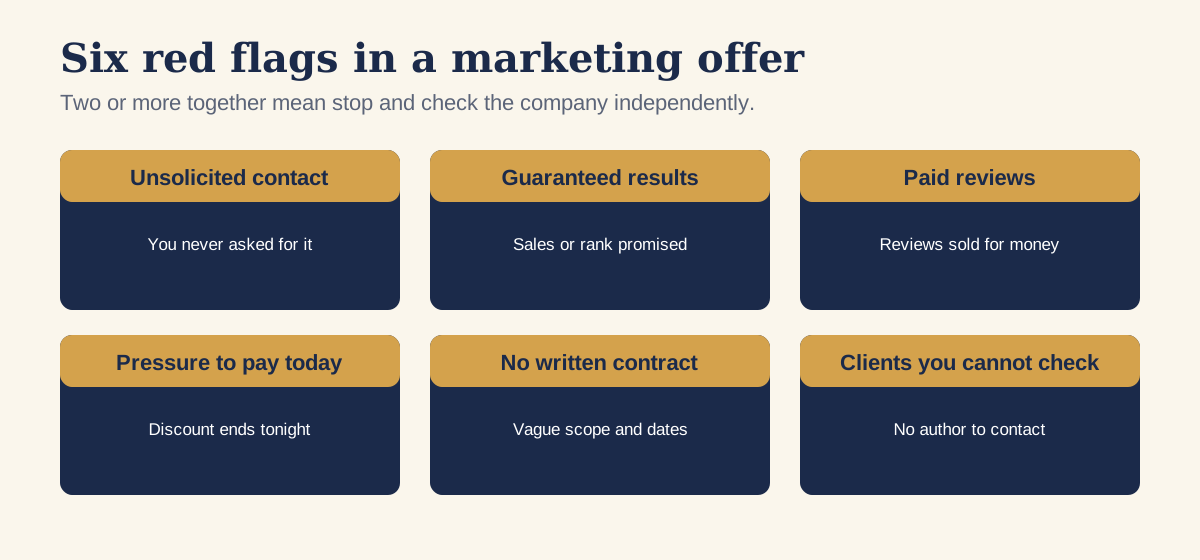
Writer Beware describes a pattern that has spread since 2024. In a post by Victoria Strauss dated 20 September 2024 and updated in 2025, it explains how a stranger who looks like a fellow writer makes friendly conversation, then recommends a marketer or agent. The marketer sends a priced package, sometimes with a discount to close, and the post says buyers rarely hear from them again. Writer Beware says the approaches have since moved to email, often using real writers' names.
Two further warnings are worth keeping. A polished pitch proves nothing, because writing quality in scam outreach has improved. And any offer of reviews in exchange for money is a problem for you as well as for the seller: Amazon's Community Guidelines bar reviews posted in exchange for payment, discounts or gifts, so those reviews can be removed. Our article on running a review team covers what is allowed.
If you have already paid a scammer, expect a second approach. The US Federal Trade Commission's page on "Refund and recovery scams" page says that people who lost money are targeted by others claiming they can get it back, and its advice is never to pay upfront for a refund or for help getting one. The FTC takes reports at ReportFraud.ftc.gov. For the UK we could not read Action Fraud's guidance on the day we checked, so we do not summarise it: look up its current advice on advance fee fraud before you report.
How do you vet a book marketer in seven checks?
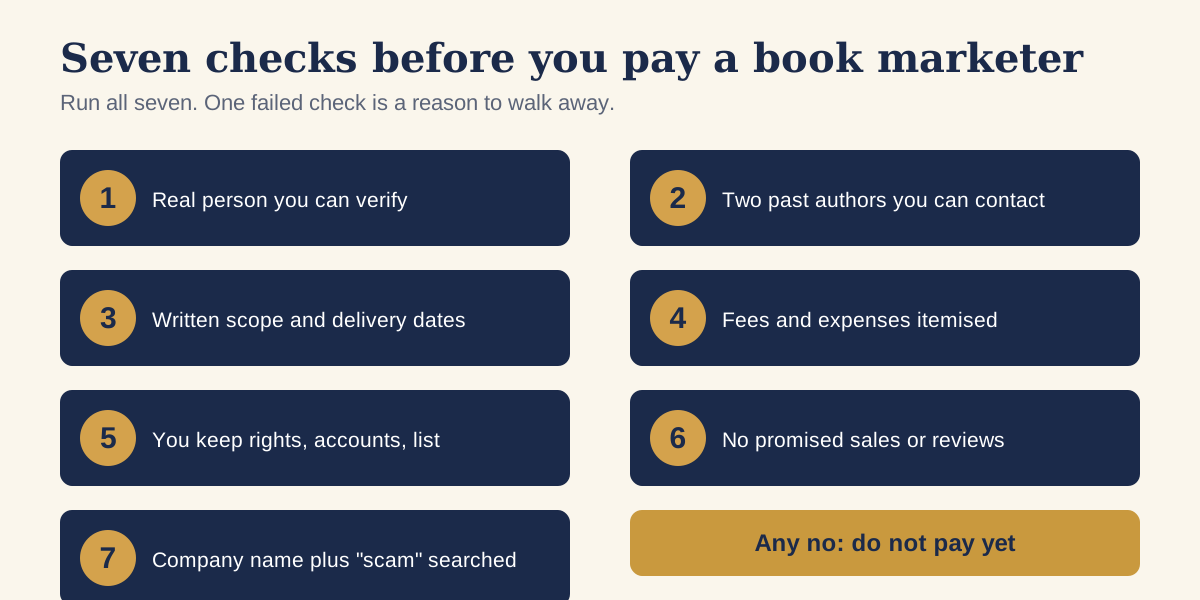
Use the checklist in the first picture as a gate. Each check needs a short answer you can verify without asking the seller to vouch for themselves.
- Confirm the person exists. Find a name, a working website and a history older than a few months, and ask for a call.
- Ask for two past authors you can contact yourself. Writer Beware advises that a legitimate service should be able to show a verifiable track record, and a case study you cannot check is not one.
- Get the scope and dates in writing before you pay.
- Ask for fees and expenses to be itemised, with ad spend shown separately.
- Confirm you keep your rights, your accounts and your reader list.
- Walk away from any promise of sales, rank or reviews.
- Search the company name with the word "scam" and with "review", then look the name up on Writer Beware and the Alliance of Independent Authors' Watchdog Desk.
The Watchdog Desk is the Alliance of Independent Authors' service for vetting and rating author services, headed by the indie author John Doppler. As of November 2026 its Watchdog Desk page says it lists vetted services as Partner Members and rates others in a Service Ratings section as recommended or as ones that overcharge, over-promise, under-deliver or exploit authors. It judges pricing and value, quality, contract terms and rights, transparency, accountability and customer satisfaction. We could not find named rating tiers on the page, so check its ratings page for the current wording. Writer Beware's overview is free for anyone to read.
What questions should you ask before you pay?
Copy this list into an email and send it to every seller on your shortlist. A good one answers in writing within a few days. A weak one dodges, rushes you or offers a discount that expires tonight.
- Who exactly will do the work, and will anyone else be involved?
- What will you deliver, in what format and by which dates?
- Which authors in my genre have you worked for, and may I contact two of them?
- What is included in the price, and what costs extra?
- Will I pay advertising platforms directly, and will you give me access to every account?
- Who owns the email list, the creative files and the data when we finish?
- How will you report results, and how often?
- What happens if I want to stop partway through?
- Do you ever buy, sell or arrange reviews, and what is your policy on Amazon's rules?
- What would make you say this service is not right for my book?
The last question matters. A seller who has never turned a customer away is selling to everyone, and that is a reason to ask how they choose clients.
Which contract terms should you look for?
Reedsy's guide to partnering with a book marketer suggests asking what the marketer will deliver, for example a launch plan with recommendations for each channel, whether they will set up your list and sequences, and which platforms they would run advertising on. Turn those answers into terms. A sound agreement for book marketing services covers the points below.
- Scope and deliverables: each item named, with a date.
- Price: a fixed fee or a stated rate, with a cap on hours or spend.
- Ad spend: paid from your own account, with the marketer given limited access.
- Ownership: you own the list, the creative, the accounts and the data.
- No exclusivity: they cannot stop you using other channels or sellers.
- Reporting: numbers you can check yourself, such as your own sales dashboard.
- Exit: how you stop, what you pay for work done and what you receive.
- No promised results: and no purchase or exchange of reviews.
This is a checklist and not legal advice. For anything over a few hundred pounds, or any contract that grants rights in your book, ask a solicitor or a body such as the Society of Authors to read it first.
When is hiring worth it, and when should you do it yourself?
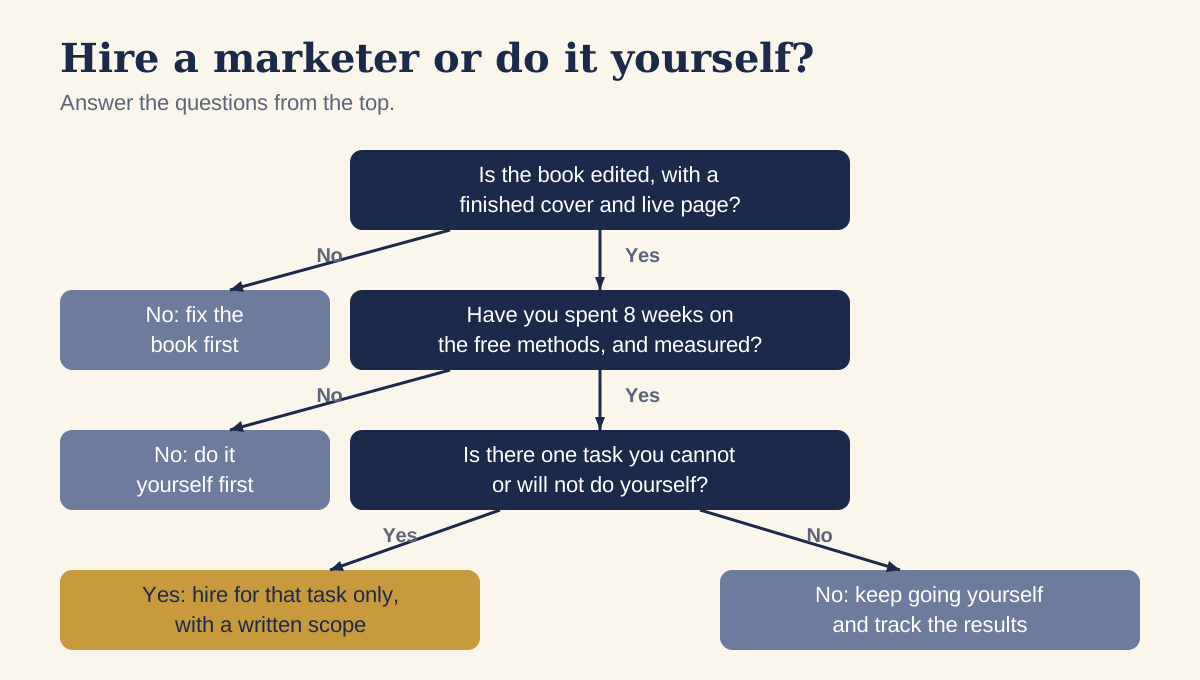
Hiring tends to make sense when you have a finished, edited book with a cover and a live store page, you have tried the free methods long enough to know what you are buying, and one task is beyond your skills or your time. Setting up a technical advertising account is a common example. It makes less sense when the book is not selling for a reason a marketer cannot fix, such as a weak cover or blurb. Our article on why a book is not selling walks through those causes in order.
What does the do-it-yourself alternative look like?
The free version is slower and costs your time, but it teaches you what works for your own books, which no purchased package does. It starts with an invitation to join your list at the back of every book, a reader magnet and a handful of swaps. Our first 100 email subscribers article sets out five sources. The launch checklist covers launch week, and Amazon ads on a first £100 shows how to test paid advertising yourself before paying a manager.
If you do hire, start small: one defined task, a fixed fee and a result you can count. Review it against your own numbers after a month, and only then decide whether to buy more.
Questions, answered
How much do book marketing services cost?
It depends on the task. As of November 2026, Reedsy lists guide prices from its 2026 projects of $1,300 to $2,500 for strategy, $900 to $2,000 for email marketing and $500 to $1,000 a month for advertising, excluding ad spend. Reedsy sells these services, so treat the figures as one marketplace's guide.
Can a book marketer guarantee sales or reviews?
No honest one can. Readers decide whether to buy or review, and Amazon's Community Guidelines bar reviews given in exchange for payment, so a promise of reviews is a warning sign.
How do I check whether an author service is legitimate?
Ask for two past authors you can contact, get the scope in writing, and search the company name with the word scam. Then check Writer Beware and the Alliance of Independent Authors' Watchdog Desk.
What should I do if a stranger offers me marketing after I published?
Do not pay or reply with personal details. Look the company up through official channels, not the contact details in the message, and forward suspicious approaches to the Authors Guild at scams@authorsguild.org.
Is it better to hire a marketer or learn marketing myself?
Start with the free methods, which teach you what works for your book. Hire later for one defined task you cannot or will not do, with a written scope and a fixed fee.
Run it all from one place
Author page, direct sales, reader list, review copies and press kit, built from one ASIN. Free for 14 days, no card.
Start your free trial