
Indie Author Academy / Lessons
Author newsletter: what to send first (six emails)
What to put in an author newsletter: the first six emails written out in full, how often to send, deliverability basics and the UK and US email rules.
An author newsletter should send a welcome email the moment someone joins, then five more over about four weeks, then a regular note at a rhythm you can keep. The first six emails below are written out in full, with square brackets where your own details go.
The sequence introduces you, points the reader to one book and starts a conversation. Each email has one job, and none of them is a sales page. The sections after the templates cover how often to send, what to leave out, deliverability, and the UK and US rules for email marketing as they read in November 2026.
What should an author newsletter send first?
Send the thing you promised on the signup form, then let the reader meet you before you ask for anything. Our article on getting your first 100 subscribers covers where the readers come from, and the one on reader magnet ideas covers what to offer. This article starts at the moment they have joined.
Six emails over 28 days is a working pattern, not a rule. We found no published study that proves a best length for a welcome series, so treat the dates as a starting point and adjust them once you see which emails readers reply to.
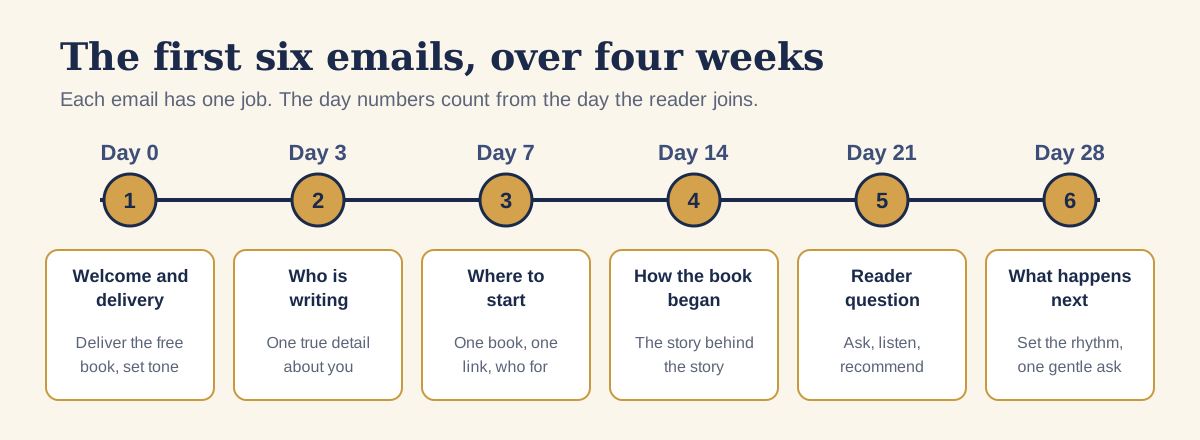
The first six emails, ready to copy
Write them in plain text in your own voice. Replace every item in square brackets before you send, and read each one aloud first. If a line sounds like a brochure, rewrite it the way you would say it across a table.
Email 1, day 0: welcome and delivery
Subject: Your copy of [Reader magnet title] is here
Purpose: keep the promise, say what to expect and invite a reply. Send it automatically at once.
Hi [First name],
Thanks for joining. Your copy of [Reader magnet title] is here: [download link]
I am [Author name], and I write [genre] books, including [Book title]. I will email you [how often], with [what they will get, for example news, free chapters and the occasional recommendation].
If you ever want to stop, every email has an unsubscribe link at the bottom, and I will not mind.
One question, if you would like to answer it: what is the last [genre] book you loved? Hit reply and tell me. I read every answer.
[Author name]
Email 2, day 3: who is writing
Subject: A little about the person writing to you
Purpose: turn a name into a person with one true, specific detail.
Hi [First name],
I thought you might like to know who is on the other end of these emails.
I live in [place], and I write at [where and when you write]. I started writing [genre] because [one true reason, in a sentence or two].
[One small, specific detail: a habit, a place, a book that changed you.]
If you have read [Book title], I would love to hear which character stayed with you. Just reply to this email.
[Author name]
Email 3, day 7: where to start
Subject: Where to start with my books
Purpose: the first email that sells, so it recommends one book with one link and says who it suits.
Hi [First name],
If you are wondering which of my books to read first, start with [Book title]. It is [one-sentence pitch], and it suits you if you like [comparison or feeling].
[Buy link]
If you prefer [other type of story], try [Other title] instead: [link].
Both are standalone, so there is no homework.
[Author name]
P.S. This email promotes my books. You can unsubscribe at any time using the link below.
Email 4, day 14: how the book began
Subject: How [Book title] started
Purpose: give readers a reason to feel closer to the book. No link needed, though one is fine.
Hi [First name],
[Book title] began with [the first spark: an image, a news story, a question].
[Two or three short paragraphs: what you got wrong first, what changed, what you cut. Keep it honest and concrete.]
If you would like more of this kind of thing, reply and tell me, and I will send it more often.
[Author name]
Email 5, day 21: a reader question
Subject: What I am reading, and a question for you
Purpose: make the list a two-way channel. Replies also tell mailbox providers that people want your email.
Hi [First name],
This week I am reading [Title] by [Author], and I [one honest line about why you like it]. [Link, if you want to add one.]
My question for you: [a specific, easy question, such as which fictional place you would like to visit].
Reply with your answer. I will share a few in the next email.
[Author name]
Email 6, day 28: what happens next
Subject: What you will get from me from now on
Purpose: set the long-term rhythm, offer a way to receive less and make one gentle ask.
Hi [First name],
That is the first month. From now on I will send [one email a month, or your own rhythm], usually about [topics].
If that is more than you want, reply with the word "less" and I will move you to [a monthly or launch-only option, if your tool supports it]. If you have read [Book title] and have a minute, an honest review at [link] helps other readers find it. There is no obligation.
Thank you for reading. I am glad you are here.
[Author name]
What one email should contain
Every email above has the same eight parts. The sender line carries your name, because readers recognise people faster than brands. The subject says what the email is about. The rest is a greeting, a one-line reason for writing, one idea, one link or question, a sign-off and a footer.
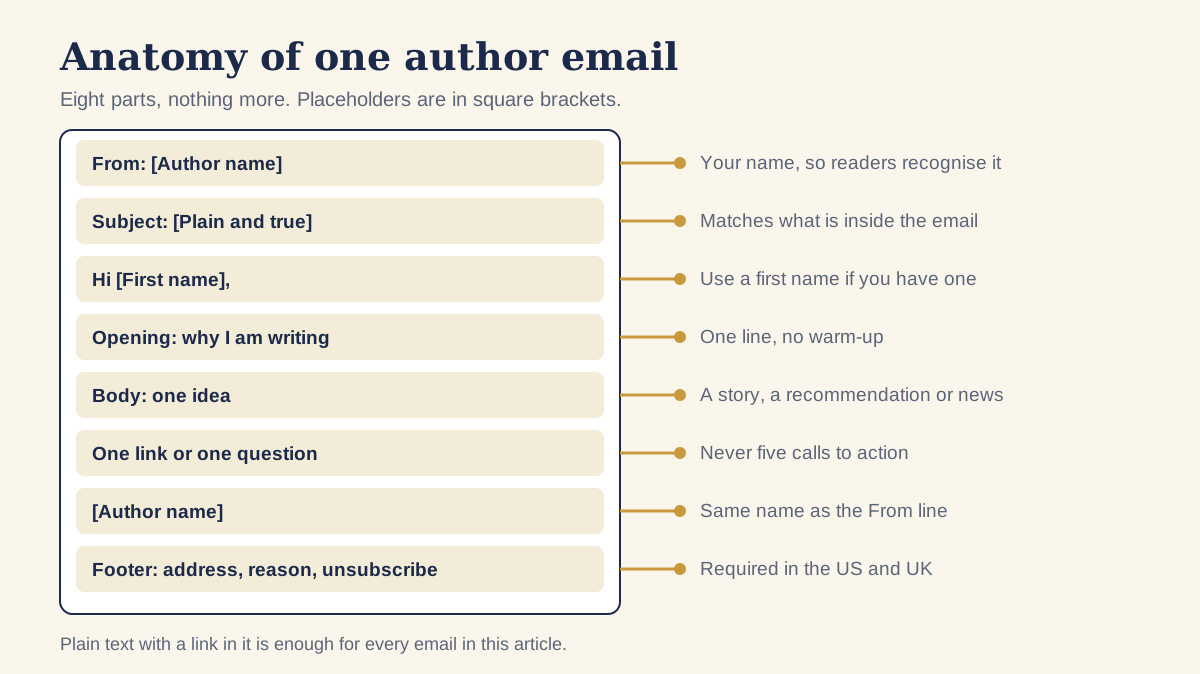
One main link or one question per email keeps the reader's next step obvious. If you want a reply, ask one question that takes a sentence to answer.
How often should an author newsletter go out?
Pick the rhythm you can keep for a year, because a regular small email beats an ambitious one that stops after three months. We found no published benchmark we could verify for the best frequency, so the guide below is our own rule of thumb and not a measured figure.
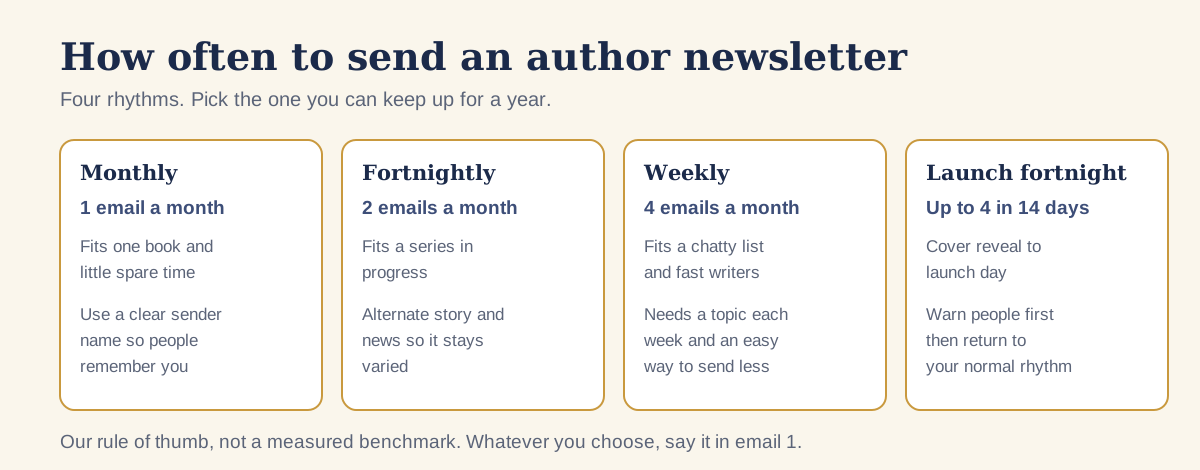
A launch is the one time to send more often. Tell subscribers in the email before it, something like "you will hear from me a bit more over the next two weeks", and go back to normal afterwards. Our book launch checklist shows where the launch emails fit.
What an author newsletter should not send
- Anything to people who have not asked for it. Do not add readers you met at an event, or authors you swapped with, without their agreement.
- Only sales. If every email says "buy my book", readers learn to ignore them. Alternate asking with giving.
- A subject line that promises something the email does not contain. The FTC's CAN-SPAM guide lists accurate subject lines as a legal requirement in the US.
- Files as attachments. Send a link instead, so the email stays small.
- Long, image-heavy designs as your first emails. Start plain and add design once you know what readers respond to.
- Other people's content without telling your readers it is an advert or a swap.
Deliverability: authentication, unsubscribe links and plain text
Deliverability means your email reaches the inbox rather than spam. Three things matter most: authenticated sending, an easy unsubscribe, and a list of people who want your email.
Google's sender guidelines, read in November 2026, say all senders to Gmail need SPF or DKIM authentication. Bulk senders, defined as 5,000 or more messages a day to Gmail, need SPF, DKIM and DMARC, plus one-click unsubscribe. Google also says to keep spam rates in Postmaster Tools below 0.30%. Most authors send far fewer than 5,000 a day, but the tool you use will still ask you to verify your sending domain. Follow its steps, and read the Google email sender guidelines if you send to a large list.
On plain text against design, we recommend starting with plain text, because it loads fast, looks like a note from a person, and takes no design work. Once the list is steady, test one designed email against a plain one to your own address and a friend's, and keep what you can read comfortably on a phone. We found no independent source that settles the question, so test it with your own readers.
The legal basics for UK and US senders
This is not legal advice. It summarises two regulators' guidance as it read in November 2026, and you should check the current text if you send at scale.
In the UK, the Information Commissioner's Office guidance on electronic mail marketing says you can email individuals if they have specifically consented. It allows a "soft opt-in" only for an existing customer who bought, or negotiated to buy, a similar product from you. The soft opt-in does not cover prospective customers, and you must have given a clear chance to opt out when you collected their details and in every message. You must not disguise your identity and must give a valid contact address. The ICO notes that sole traders and some partnerships count as individuals, and that personal data also falls under UK GDPR. It also says its guidance is under review because of the Data (Use and Access) Act, so check for updates.
A reader who downloads a free book has not bought anything, so the soft opt-in will not usually cover them. Rely on their consent through the signup form. The ICO page we read does not say double opt-in is required, but a confirmed address gives you a clearer record of that consent.
In the US, the FTC's CAN-SPAM compliance guide lists eight requirements. In short: honest header information, an accurate subject line, a clear statement that the message is an advert, a valid physical postal address, a way to opt out, honouring opt-outs within 10 business days, and responsibility for anyone who sends on your behalf. The FTC says each separate email in violation can carry penalties of up to $53,088, a figure updated in January 2024. Check the guide for the current number.
| Rule | UK (ICO, PECR) | US (FTC, CAN-SPAM) |
|---|---|---|
| Permission | Consent, or soft opt-in for past customers | No prior consent needed, but opt-outs must be honoured |
| Who you are | Do not disguise your identity | Accurate From, To and reply-to details |
| Contact address | Valid contact address | Valid physical postal address |
| Opting out | Simple opt-out in every message | Opt-out notice, honoured in 10 business days |
| Advert label | Not stated on the page we read | Message must be identified as an advert |
Readers in the EU are covered by their own national rules, which we have not checked here.
Sending the sequence from a free tool or the Toolchest
An automated welcome series is easiest in a tool that supports automations. Our comparison of MailerLite, Kit and Mailchimp found that MailerLite's free plan includes automations, so all six emails can send themselves.
The Indie Author Toolchest has a built-in mailing list with double opt-in. It lets you compose a campaign, shows a mandatory preview of the exact send template, and sends it to your confirmed subscribers. Every campaign includes an unsubscribe link. It also sends a lead magnet to a new subscriber automatically on signup, which covers email 1. The Toolchest's feature list does not include automated multi-step sequences, so you would send emails 2 to 6 by hand as campaigns, or connect an external list. Check the preview footer to see what it contains before you send. Campaigns need an active membership.
Questions, answered
How long should an author newsletter be?
Keep each email to what one idea needs, usually 150 to 400 words, which is our guideline rather than a measured figure. A short email that gets a reply is better than a long one that is skimmed.
How many emails should an author send per month?
One or two is a safe starting point for most authors, and weekly suits only those who can write something worth reading each time. Choose the rate you can keep for a year, and tell readers what to expect in your first email.
Do I need permission to add readers to my author newsletter?
In the UK you need consent, except for the narrow soft opt-in for past customers, according to the ICO's guidance read in November 2026. In the US, CAN-SPAM does not require prior consent but does require honest headers, a postal address and a working opt-out.
Should an author newsletter be plain text or designed?
Start with plain text, which is quick to write and reads like a personal note. Test a designed version later and keep whichever you and your readers find easier to read on a phone.
What should the first email to new subscribers say?
Deliver what you promised, say who you are in two sentences, tell them how often you will write, and ask one easy question they can answer by replying.
Run it all from one place
Author page, direct sales, reader list, review copies and press kit, built from one ASIN. Free for 14 days, no card.
Start your free trial