
Indie Author Academy / Lessons
Editing for self-published authors: kinds, cost and order
Editing for self-published authors: the four kinds, the right order, 2026 per-word costs from Reedsy, the EFA and CIEP, and which stages you can skip.
Editing for self-published authors comes in four kinds: developmental editing, line and copy editing, proofreading, and reader feedback from beta readers or sensitivity readers. Each works on a different level of the book, so the order matters: big-picture work first, typos last. Doing them out of order means paying twice for sentences you later cut.
On cost, Reedsy's 2026 figures put an 80,000-word book at roughly $1,600 to $2,880 per stage, depending on the stage, and the US Editorial Freelancers Association (EFA) 2026 rate chart gives a similar picture. The worked example below shows what that adds up to, and the decision tree shows which stages you can skip.
What are the four kinds of editing for self-published authors?
Developmental editing looks at the whole manuscript: structure, plot, character arcs, pacing, argument and what is missing. The output is usually an editorial letter and margin comments, and you then rewrite. Reedsy also lists a cheaper editorial assessment, which diagnoses the book and tells you what kind of edit it needs without marking up every page.
Line editing works on sentences and paragraphs: rhythm, clarity, voice and repetition. Copy editing checks grammar, spelling, punctuation, consistency (a character's eye colour, a spelling choice) and facts. Many editors combine line and copy editing, so ask what a quote actually covers.
Proofreading is the last check on the laid-out pages, catching the typos and formatting slips that remain. It is not a substitute for a copy edit, because a proofreader is not meant to rework sentences.
Beta readers are unpaid or lightly paid readers from your target audience who tell you where they got bored or confused. A sensitivity reader checks that your portrayal of a culture, community, disability or experience outside your own is accurate and respectful. Both give feedback rather than corrections.
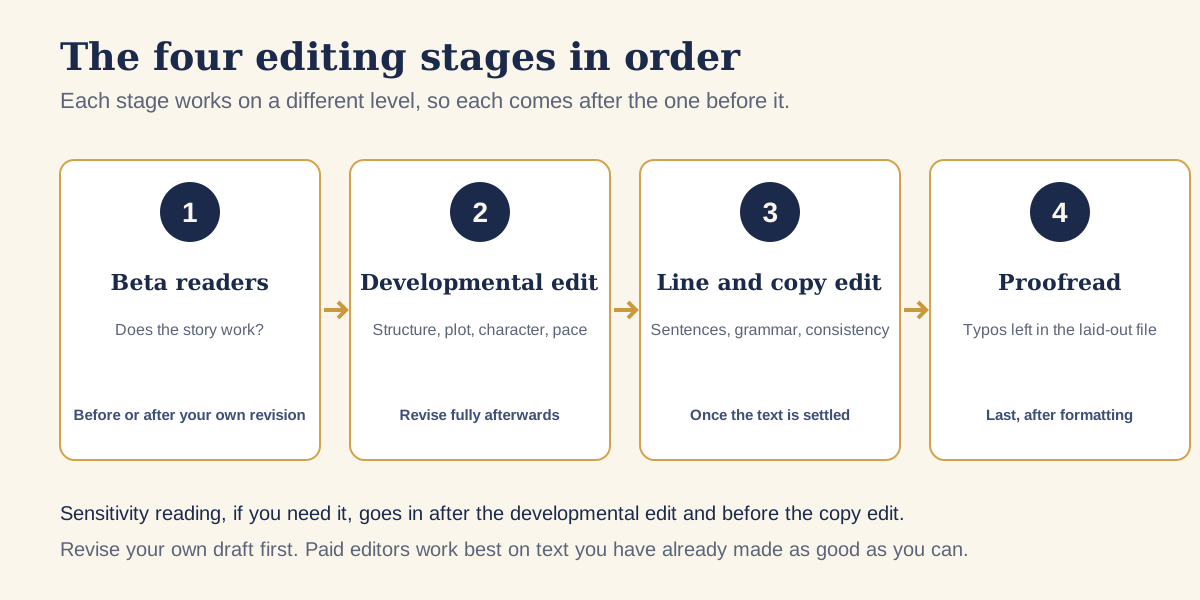
What is the right order for editing a self-published book?
- Revise the draft yourself until you cannot see what else to fix. Paid editing is wasted on a first draft.
- Send it to beta readers, and revise from what they say.
- Book a developmental edit if the structure needs it, then do the rewrite.
- If you use a sensitivity reader, do it now, once the content is settled, so their notes shape the copy edit.
- Book the line and copy edit on the revised text.
- Format the book, using our guide to book formatting software and mistakes.
- Book a proofread on the formatted pages, before you upload.
The logic is simple. Any change after an edit can add new errors, and any edit of text you later cut is money spent on words that no longer exist. Allow for each editor's booking time. Good editors are often booked weeks ahead, so plan the schedule before you write the final chapter. Our steps to self-publishing in order shows where editing sits in the whole timeline.
How much does editing cost per word?
Reedsy's editing cost guide, last updated on 9 February 2026, reviews what it calls thousands of real quotes from editors across genres. Its per-word ranges are in the table below, with the 80,000-word example prices Reedsy itself gives.
| Stage (Reedsy, 2026) | Per word | Reedsy example, 80,000 words |
|---|---|---|
| Editorial assessment | $0.018 to $0.029 | $2,000 |
| Developmental editing | $0.026 to $0.053 | $2,880 |
| Copy editing | $0.020 to $0.032 | $2,160 |
| Proofreading | $0.014 to $0.021 | $1,600 |
The EFA's 2026 rate chart comes from a survey of more than 1,100 members about work done in 2025. It lists median ranges, and for fiction they are 3.0 to 3.5 cents a word for developmental editing, 2.0 to 2.7 cents for copyediting and 1.2 to 2.0 cents for proofreading. Non-fiction runs higher. The EFA says it does not set rates and that individual rates vary with turnaround, expertise and experience.
In the UK, the Chartered Institute of Editing and Proofreading (CIEP) publishes suggested minimum hourly rates. From 1 March 2026 they are £31.92 for proofreading, £37.11 for copyediting and £42.66 for substantial editing and development editing. The CIEP says it has no authority to tell anyone what to charge, and that its rates cover a freelancer's own costs such as pensions and holidays. Its page gives hourly figures only, so it does not convert to a per-word price without knowing how fast the editor works for your type of text.
Prices in pounds and dollars are not interchangeable, and an editor may quote per word, per hour or as a flat fee. Compare quotes on the same basis: total price for your manuscript, what is included, and how many rounds of queries.
What does editing an 80,000-word novel cost in total?
This is arithmetic, not a quote. Multiply each source's published per-word range by 80,000 words. Reedsy's ranges give $2,080 to $4,240 for developmental editing, $1,600 to $2,560 for copy editing and $1,120 to $1,680 for proofreading. The EFA's fiction medians give $2,400 to $2,800, $1,600 to $2,160 and $960 to $1,600 for the same three stages.
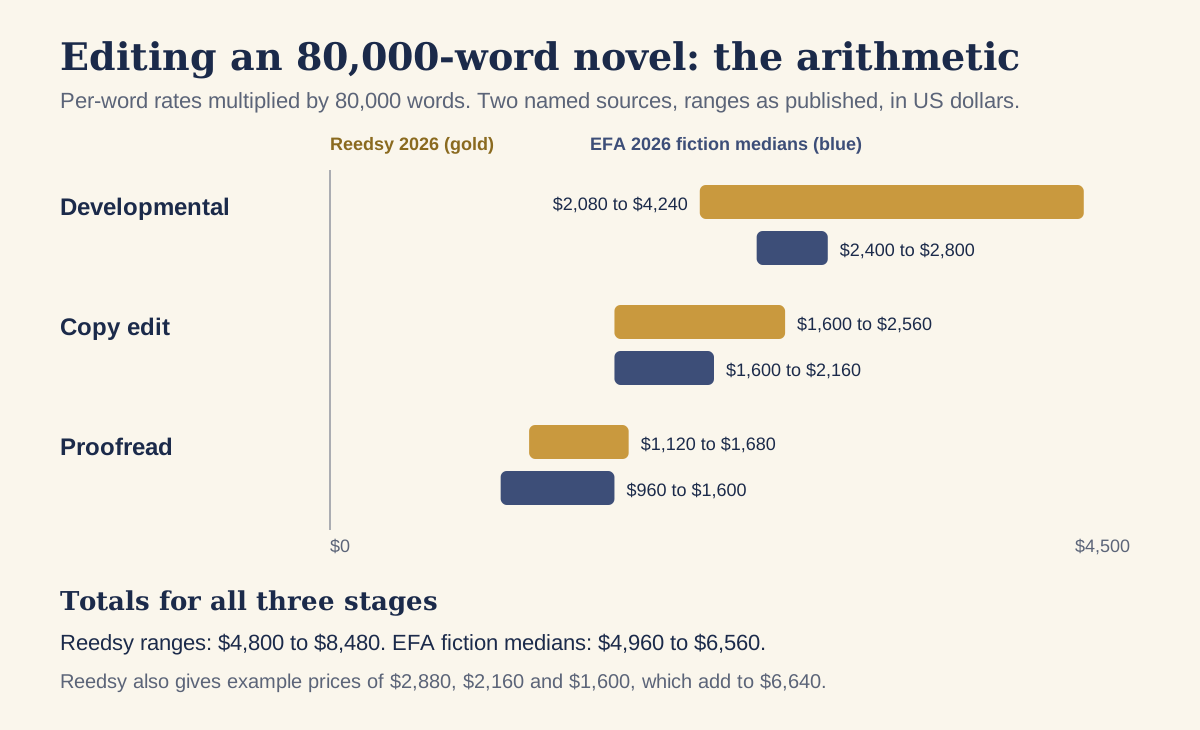
Added together, the three stages come to $4,800 to $8,480 on Reedsy's ranges and $4,960 to $6,560 on the EFA's fiction medians. Reedsy's own example prices ($2,880, $2,160 and $1,600) add to $6,640. If you want an editorial assessment instead of a full developmental edit, Reedsy's per-word range gives $1,440 to $2,320 for 80,000 words, again as our arithmetic.
Beta readers are usually free, because you swap manuscripts or recruit from your readers. We have no sourced figure for sensitivity reading, which editors price individually, so ask for a quote and what it covers.
Which editing stages can you skip?
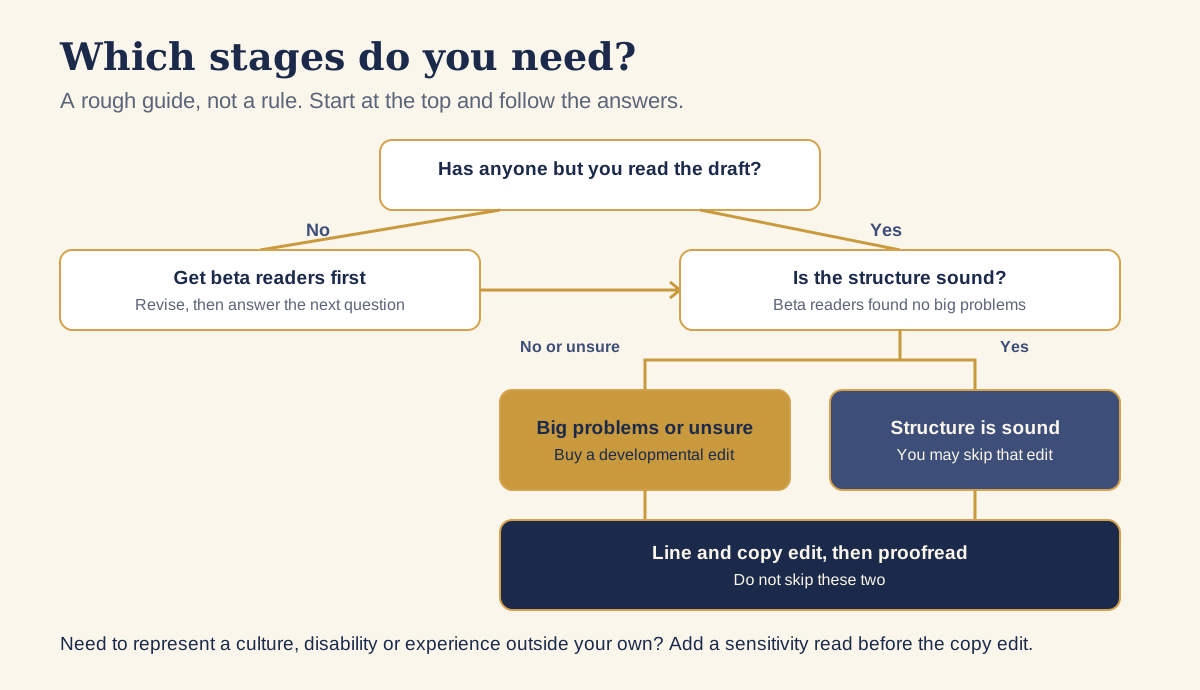
There is no universal answer, and the following is judgement, not a rule. A developmental edit is the stage most authors skip, and it is the one most worth buying for a first novel or a book in a new genre. If beta readers agree the story works, and you have written several books in the genre, you may reasonably skip it, or buy the cheaper assessment as a check.
Copy editing and proofreading are harder to skip, because you cannot reliably see your own mistakes. If the budget is tight, a thorough copy edit followed by a careful read of the formatted proof, plus a second reader, is a better use of money than a developmental edit with no copy edit behind it. A book with typos on page one loses reviews whether or not the story is good.
How do you find and vet an editor?
- The CIEP directory lists members with proven experience, qualifications and specialisms.
- Reedsy's marketplace lets you enter your genre, word count and editing type, and request quotes from editors. Reedsy's page says several editors offer sample edits.
- The Alliance of Independent Authors' watchdog list is the place to check a company before you pay it.
- In the US, the EFA's member directory and rate chart serve the same purpose.
Ask every editor you consider for their experience in your genre, a sample of their work, a written scope, a turnaround date and a payment schedule. Be wary of anyone who promises to make your book a bestseller, because no editor controls sales.
How do you get a sample edit?
Send the same passage, around 1,000 words from the middle of the book rather than the polished first chapter, to two or three editors. Ask each to edit it at the level you want to buy, and to say how long the whole book would take. Reedsy's guide quotes editors who offer a sample of your sample or a free edit of the first page, and some charge a small fee, so ask before you send.
Compare the samples. A good sample explains why a change was made, as well as making it. Check that it keeps your voice, and that the editor's questions show they have understood the book.
What should you send an editor when you ask for a quote?
A quote is only as accurate as the information behind it. Editors price on word count, how clean the text is, how fast you need it and how much intervention the book needs, which is why Reedsy's guide says quotes differ on those factors. Send the same short message to every editor so the quotes are comparable.
- The exact word count from your word processor, and the genre.
- The level of editing you want to buy, in your own words, and whether you want line and copy editing combined.
- Your style choices: British or American spelling, and any style guide you follow.
- Your deadline, and the date you will have the revised manuscript ready.
- Whether the book is part of a series, so the editor can ask for a style sheet from the earlier titles.
- A request for a written scope, the number of rounds of queries, and the payment schedule.
When the work comes back, expect tracked changes plus comments, and expect to disagree with some of them. You have the final say on your book. Accept what improves it, reject what does not, and keep a style sheet of your decisions (character names, invented words, spellings) to hand to the proofreader.
Keep the signed scope and the invoice, and keep every version of the file. If an editor changes the text more than you agreed, the versions are your evidence.
How do you budget for editing?
Decide the total before you collect quotes, then divide it by the stages you have chosen. If the total will not cover all of them, drop or downgrade the cheapest-to-lose stage first, which is usually a full developmental edit in favour of an assessment, and never the copy edit. Our guide to what it costs to self-publish and the DIY author stack costs show where editing sits next to covers, formatting and ISBNs.
Plan too for the cover, since a good edit and a poor cover will not sell the book. Our guide to book cover design, briefs and costs covers that spend. If sales disappoint after both are done, read why your book is not selling before you pay for another edit.
Questions, answered
What is the difference between copy editing and proofreading?
A copy edit checks grammar, consistency, facts and style while the text can still change. A proofread is the final check of the laid-out pages for typos and formatting slips, and it does not rework sentences.
What order should I do editing in?
Revise yourself, then beta readers, a developmental edit if needed, a sensitivity read if needed, a line and copy edit, formatting, and a proofread last. Each stage should only start once the previous kind of change is finished.
How much does editing an 80,000-word novel cost?
Multiplying Reedsy's 2026 per-word ranges by 80,000 gives $4,800 to $8,480 for developmental editing, copy editing and proofreading combined. The EFA's 2026 fiction medians give $4,960 to $6,560. This is arithmetic from published ranges, not a quote.
What are the CIEP suggested minimum rates?
From 1 March 2026 the CIEP suggests £31.92 an hour for proofreading, £37.11 for copyediting and £42.66 for substantial and development editing. It says it cannot tell anyone what to charge.
Can I skip developmental editing?
Some authors do when beta readers agree the story works and they know the genre well. A cheaper editorial assessment is a middle option, and copy editing and proofreading are the stages to keep.
Run it all from one place
Author page, direct sales, reader list, review copies and press kit, built from one ASIN. Free for 14 days, no card.
Start your free trial