
Indie Author Academy / Lessons
Book cover design: brief, cost and specs for authors
Book cover design for indie authors: what to put in a brief, what covers cost (Reedsy average $880), where to find designers and the KDP cover specs.
Good book cover design tells a browsing reader the genre of your book in about a second, at the size of a postage stamp. This guide covers what a cover has to signal, what to put in a brief for a designer, what covers cost, where to find designers and the file specifications KDP asks for as of November 2026.
The short version on cost: Reedsy's 2025 marketplace data puts the average professional cover at $880, and most projects between $625 and $1,250. A premade cover from a UK studio starts at £90. A cover you make yourself costs your time plus any licensed images and fonts.
Why does book cover design matter for your genre?
Readers sort books by genre before they read a single word, and the cover is what they sort with. Colour, typeface, composition and imagery tell them whether this is a cosy mystery, a dark thriller or a sweet romance. A cover that signals the wrong genre attracts the wrong readers, and a cover that signals no genre attracts few.
The practical job is to look like your genre while still being yours. Spend twenty minutes looking at the current top 20 in your category on Amazon. Note the typefaces, the colour range, whether the image is a photograph, an illustration or pure type, and where the author name sits. Your cover should sit comfortably among those, with one thing that makes it easy to pick out.
How do you test a cover at thumbnail size?
Most readers meet your cover as a small image in a search result, a store grid or an email. Shrink your cover to that size before you approve it, and look at it on a phone as well as a monitor.
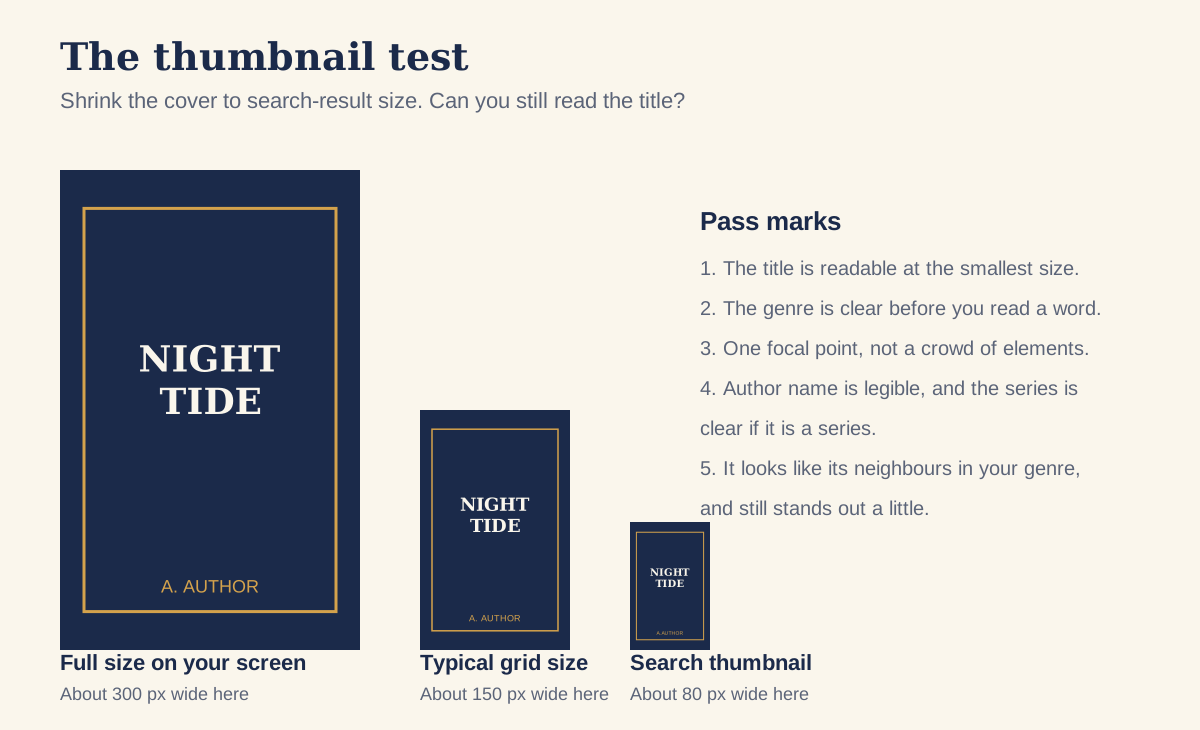
If the title turns to a smudge, the type is too small or too thin, or it has too little contrast against the background. If the cover looks busy, remove elements until one focal point remains. Ask two or three readers of your genre, not friends who read everything, to name the genre from the thumbnail alone. If they guess wrongly, tell your designer what they guessed.
What should you put in a cover designer brief?
A designer works from what you tell them. A vague brief ("something dramatic") produces rounds of revisions, and revision rounds are where budgets overrun. A good brief gives the designer the facts they would otherwise have to ask for, plus examples that show your taste.
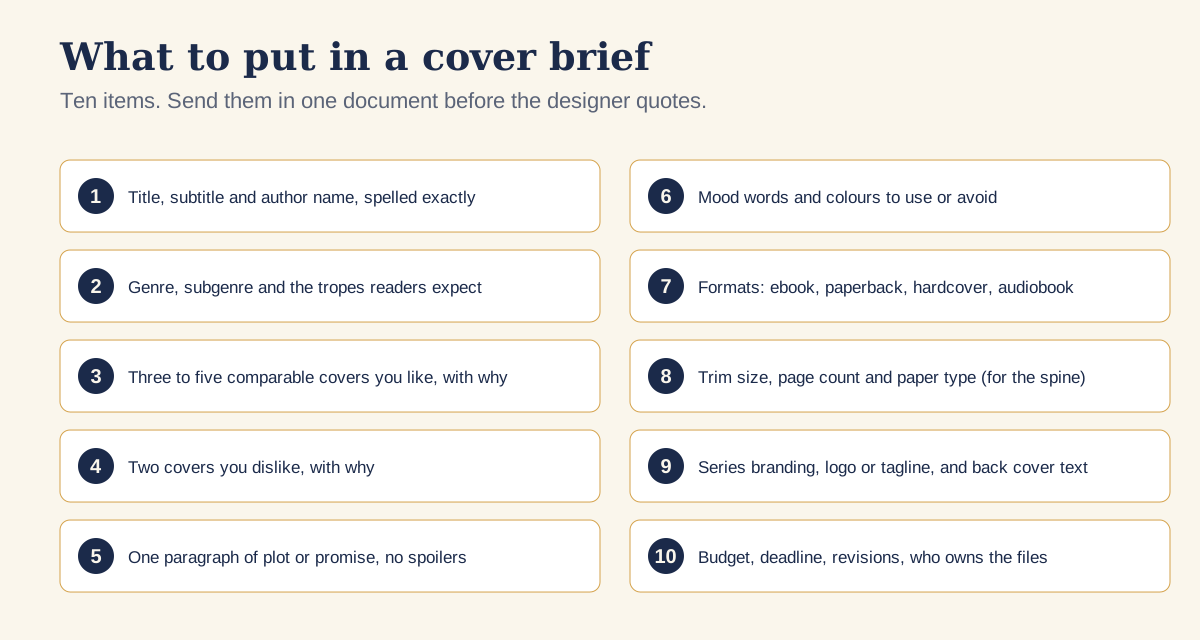
Copy the template below into a document and fill it in. It is written to be sent as it stands.
- Title, subtitle, series name and number, and author name, spelled exactly as they should appear.
- Genre and subgenre, and the three tropes or promises readers of this book expect.
- Three to five published covers you like, each with one sentence on what you like about it (the typeface, the colour, the layout).
- Two covers you dislike, with one sentence on why.
- A paragraph on the story or the promise of the book, with no spoilers, and the one image or idea you would like the cover to carry.
- Mood words, and any colours you want or want to avoid.
- The formats you need: ebook, paperback, hardcover, audiobook square, and any promotional images.
- For print, the trim size, estimated page count and paper type, because the spine width depends on them. Say that you will send the final page count once the interior is formatted.
- Series branding, a logo or tagline if you have one, and the back cover blurb, author bio and ISBN barcode needs. See our guide to ISBNs for self-published authors for the barcode.
- Budget, deadline, number of revision rounds included, who owns the final files and image licences, and whether you may reuse the artwork on ads and your website.
Ask the designer to confirm in writing what the fee includes and what each extra round costs. Ask which stock images or fonts they license and whether the licence covers commercial book sales.
How much does a book cover design cost?
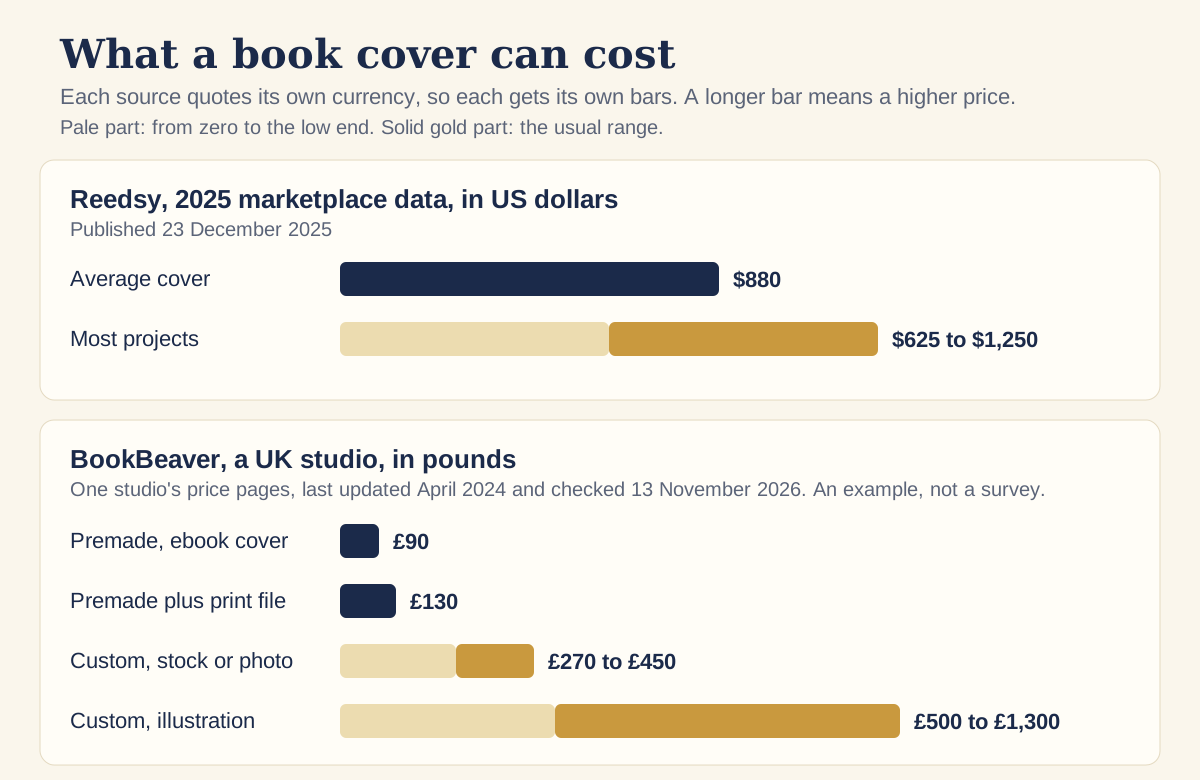
Reedsy analysed more than 9,600 cover collaborations on its marketplace in 2025 and published the results on 23 December 2025. It reports an average of $880 and a typical range of $625 to $1,250. Reedsy notes that the average is pulled upwards by expensive projects, so the median is a better guide to a typical author's spend.
| Genre (Reedsy, 2025 data) | Median | Average |
|---|---|---|
| Thriller, crime and mystery | $700 | $770 |
| Non-fiction | $700 | $800 |
| Science fiction | $850 | $1,155 |
| Romance | $800 | $1,290 |
| Fantasy | $910 | $1,760 |
Reedsy's own designer-rates page gives a different average, $950 for a cover, in an article it last updated in February 2025. The gap is a reminder that averages depend on the data set and the year, so use them as a range rather than a quote.
For UK pounds, one UK studio, BookBeaver, lists custom covers at £270 to £450 for stock-photo or photo-manipulation designs and £500 to £1,300 for illustration, on a page last updated in April 2024. Its premade page listed £90 for an ebook cover and £40 extra for the print file when we checked on 13 November 2026. This is one studio's price list, not a market survey, so treat it as an example.
For a do-it-yourself cover, the same studio's page lists stock images at roughly £5 to £10 each and fonts at roughly £20 to £30, with some fonts costing far more. Add any design software you do not already own, plus the print-cover template from KDP, which is free.
Should you buy a premade cover, commission a custom one or do it yourself?
A premade cover is a finished design that a designer sells to one buyer, who then gets the title and author name added. It is the cheapest route to a professional look and it is quick. The limit is that you choose from what exists, so the image will not be tailored to your plot, and some series need several matching covers that a premade shop may not offer.
A custom cover is made for your book from your brief. It costs more and takes longer, and it is the better choice when the cover has to carry a specific scene, a series look or a genre with strong visual conventions, such as fantasy.
A cover you make yourself is realistic when the genre rewards typography over illustration, which many non-fiction and some literary titles do, and when you have a good eye. Be honest about the thumbnail test. If your cover loses to the neighbours in your category at 80 pixels wide, the saving is not worth it. Our guide to what it costs to self-publish a book shows where a cover sits in the whole budget.
Where do you find a cover designer?
- Reedsy's marketplace lists vetted designers with portfolios and takes a quote request from you. Its prices are the ones reported above.
- The Alliance of Independent Authors (ALLi) keeps a watchdog list of self-publishing services, which is the first place to check before you pay any company.
- Premade shops and independent designers' own sites, which you find by looking at covers in your genre and checking the credit on the copyright page or the designer's name in the book listing.
- Freelance marketplaces, where quality varies widely. Ask for a portfolio in your genre and check each listed cover against the thumbnail test.
Whoever you choose, ask for the portfolio in your genre, a written scope and a contract that says who owns the artwork. Pay in stages if you can.
What are the KDP cover specifications?
These come from KDP Help pages read on 13 November 2026. Check the live pages before you export final files, because KDP updates them.
| Item | KDP guidance |
|---|---|
| Ebook cover file | JPEG or TIFF, RGB, under 50 MB |
| Ebook cover size | Ideal 2,560 pixels high by 1,600 wide, minimum 1,000 by 625, height to width ratio of at least 1.6 to 1 |
| Light covers | Add a 3 to 4 pixel medium grey border if the background is white or very light |
| Print cover file | One PDF holding back cover, spine and front cover, 40 MB or less recommended, fonts embedded |
| Bleed | 0.125 inch (3.2 mm) on the top, bottom and outside edges |
| Images | CMYK, flattened, at least 300 DPI |
| Safe area | Keep text at least 0.125 inch inside the trim lines, and at least 0.0625 inch from the spine edge |
| Spine text | Needs at least 79 pages (80 if you use Cover Creator) |
The sources are KDP's ebook cover image guidelines and its paperback cover guide.
How do you work out the spine width and cover size?
KDP gives a spine width per page by ink and paper type: 0.002252 inch per page for black and white on white paper, 0.0025 for black and white on cream paper, 0.002347 for premium colour and 0.002252 for standard colour. The full cover width is bleed, back cover, spine, front cover and bleed added together. The height is bleed plus trim height plus bleed.
Worked example (our arithmetic, using KDP's figures): a 300-page black and white book on white paper with a 6 by 9 inch trim. The spine is 300 x 0.002252 = 0.6756 inch. The cover width is 0.125 + 6 + 0.6756 + 6 + 0.125 = 12.9256 inches and the height is 0.125 + 9 + 0.125 = 9.25 inches.
Do not guess the page count. Format the interior first, take the final page count from the exported PDF, and only then order the cover. Our guide to book formatting software and mistakes covers that step. KDP's cover calculator and template generator produces a template for your trim size and page count, and KDP's Cover Creator suits simple designs that meet its specifications.
Can you use AI art or stock images on a cover?
KDP's content guidelines separate AI-generated content from AI-assisted content. If an AI tool created the text, images or translations, KDP treats the content as AI-generated, and substantial editing afterwards does not change that. KDP says you must tell it about AI-generated content when you publish, and that this covers cover and interior images and artwork. You do not have to disclose AI-assisted content, where you made the work and used AI to refine or brainstorm. Either way, you remain responsible for checking that the content meets KDP's guidelines, including intellectual property rights.
If a designer uses AI imagery, ask them to say so in writing, so that you can answer the disclosure question accurately.
Stock images carry a licence, and licences differ. Before you buy, read the licence for three things: whether book covers and products for sale are allowed, whether there is a limit on copies, and whether the image may appear on merchandise or in ads. We could not read the licence pages of the large stock sites on the day we checked, so we cannot quote their terms. Read the current licence text for the site you use. Keep the licence receipt with your files, because a designer's licence may not transfer to you.
Photographs of recognisable people need a model release for commercial use. Choose images marked as suitable for commercial book covers and keep the proof.
What should you check before approving the final files?
- Run the thumbnail test one last time at 80 to 150 pixels wide.
- Check the title, subtitle and author name letter by letter against your copyright page. See our copyright page template.
- Confirm the ebook file meets the KDP pixel and ratio limits above.
- Confirm the print PDF width and height match the template for the final page count.
- Keep the layered source files, the licence receipts and a written statement of who owns the cover.
- Upload to KDP and read the previewer proof. Approve the cover early, because most items on a launch checklist need it.
Questions, answered
How much does a book cover design cost?
Reedsy's 2025 marketplace data, published in December 2025, puts the average at $880, with most projects between $625 and $1,250. Premade covers are cheaper, and one UK studio lists £90 for an ebook cover as of November 2026.
What size should a Kindle ebook cover be?
KDP's ideal is 2,560 pixels high by 1,600 wide, in JPEG or TIFF, with a minimum of 1,000 by 625 and a height to width ratio of at least 1.6 to 1. The file must be under 50 MB and in RGB.
How do I work out my paperback spine width?
Multiply the page count by KDP's per-page figure for your paper and ink, for example 0.002252 inch for black and white on white paper. A 300-page book gives 0.6756 inch, and you add bleed, the back cover and the front cover to get the full width.
Do I have to tell KDP if my cover uses AI?
KDP says you must disclose AI-generated content, including cover images, when you publish. You do not have to disclose AI-assisted content, where you created the work and used AI to refine it.
Can I make my own book cover?
Yes, and it works best for typography-led genres such as many non-fiction books. Test it at thumbnail size against the top books in your category before you publish.
Run it all from one place
Author page, direct sales, reader list, review copies and press kit, built from one ASIN. Free for 14 days, no card.
Start your free trial