
Indie Author Academy / Resources
B-roll batching for authors: film a month in one session
Use B-roll batching for authors to film 25 reusable clips in one two-hour session, organise folders by mood and schedule 15 to 20 book posts a month.
Use B-roll batching for authors to record 25 short, silent video clips in one two-hour monthly session, sort them into mood folders and schedule 15 to 20 book marketing posts without daily camera stress. Instead of tidying your desk and setting up lighting every single Tuesday morning, you separate filming from caption writing completely.
Short-form platforms reward steady posting over glossy studio production. Because four of the five core author clip categories film your hands, your paperback and your desk rather than your face, this system works equally well for camera-shy writers and busy authors drafting their next novel.
Why B-roll batching for authors beats daily filming
Most indie authors abandon TikTok, Instagram Reels and YouTube Shorts around week three for one simple reason: switching out of manuscript drafting mode to clean a room, dress for camera, think of a hook, film three takes and edit captions every second day destroys creative focus. By Friday, marketing feels heavier than writing the actual book.
Worked arithmetic makes the time leak obvious. Suppose creating one standalone short video from scratch takes 30 minutes once you clear desk clutter, position your phone, record four shaky attempts and type a caption. At 20 posts a month, that daily habit consumes 600 minutes, or ten full hours, broken into twenty awkward interruptions. Filming 25 silent eight-to-twelve-second B-roll clips in a single two-hour afternoon and pairing them with pre-written book hooks cuts monthly production time down to 120 minutes, returning eight full hours to writing.
Consistent visual rhythm also aligns with how short-form platforms distribute content. As of November 2026, guidance from the TikTok Creator Portal and Written Word Media emphasises posting steadily three to five times a week with a clear reader hook inside the opening seconds. B-roll clips paired with sharp on-screen text let you maintain that cadence even when you have a cold, a tight deadline or zero desire to talk to a lens. Our broader overview of social media for authors and BookTok explains how this steady posting schedule fits alongside your email list.
The five shot categories that cover every genre
Staring at your phone wondering what to point the lens at wastes half your filming block. Build your clip bank around five reliable visual categories, shooting five silent clips in each group for a clean total of 25 clips per session.
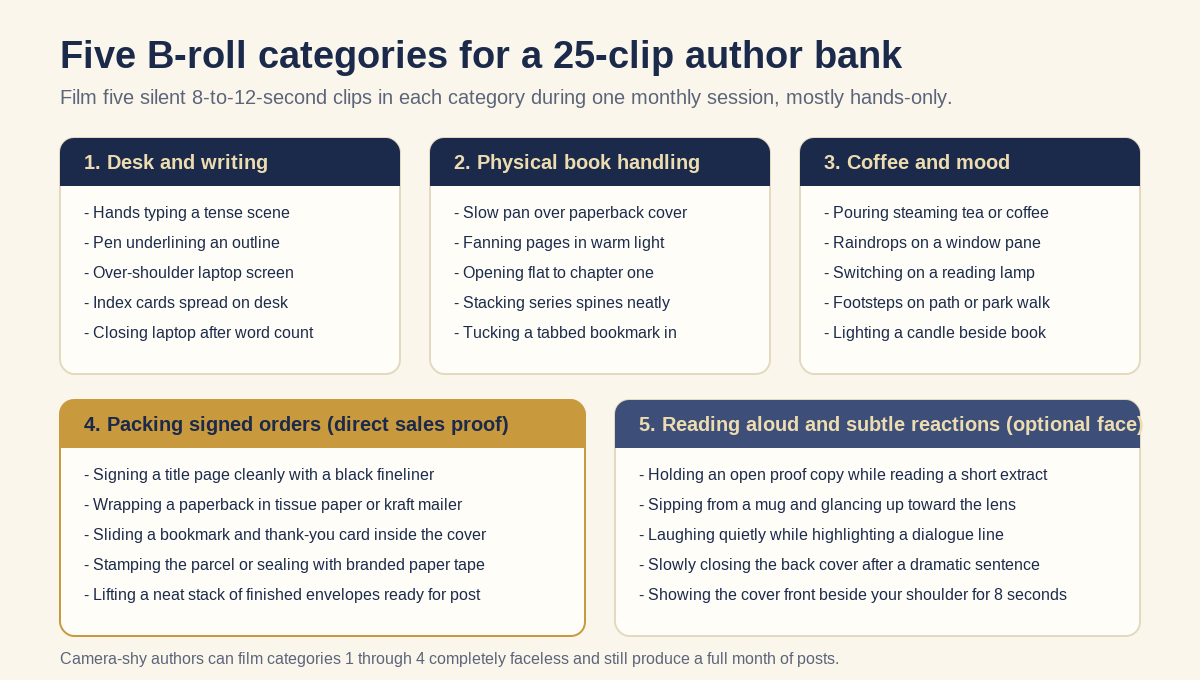
Match your props to your book's mood before pressing record:
| Shot category | Works completely faceless? | Ideal genre hooks to pair over the clip |
|---|---|---|
| Desk and writing | Yes, hands and notebook only | Work-in-progress updates, word-count milestones, plotting twists, character backstories |
| Physical book handling | Yes, hands and paperback | Book blurbs, trope lists, chapter one lines, reader review pull quotes |
| Coffee and mood transitions | Yes, environment and props | Atmospheric setting hooks, seasonal reading lists, "if you loved" recommendations |
| Packing signed orders | Yes, overhead parcel view | Direct shop promotions, special edition reveals, reader thank-you notes |
| Reading aloud and reactions | Optional face or side profile | Three-minute extract previews, playful three-star review reactions, personal author notes |
If you sell signed editions from your own site, category four pulls double duty: viewers love watching real orders wrapped in tissue paper, stamped and stacked for the post office, and every parcel reminds scrolling fans that signed copies exist. Our step-by-step guide to selling signed paperbacks direct from your website covers packaging supplies that look tidy on camera without hurting your margins.
Your two-hour monthly batching schedule step by step
Treat your filming block like a fixed calendar appointment on the first Saturday or Sunday afternoon of the month. Keeping a timer beside your tripod stops perfectionism turning a simple 10-second shot into a two-hour reshoot.
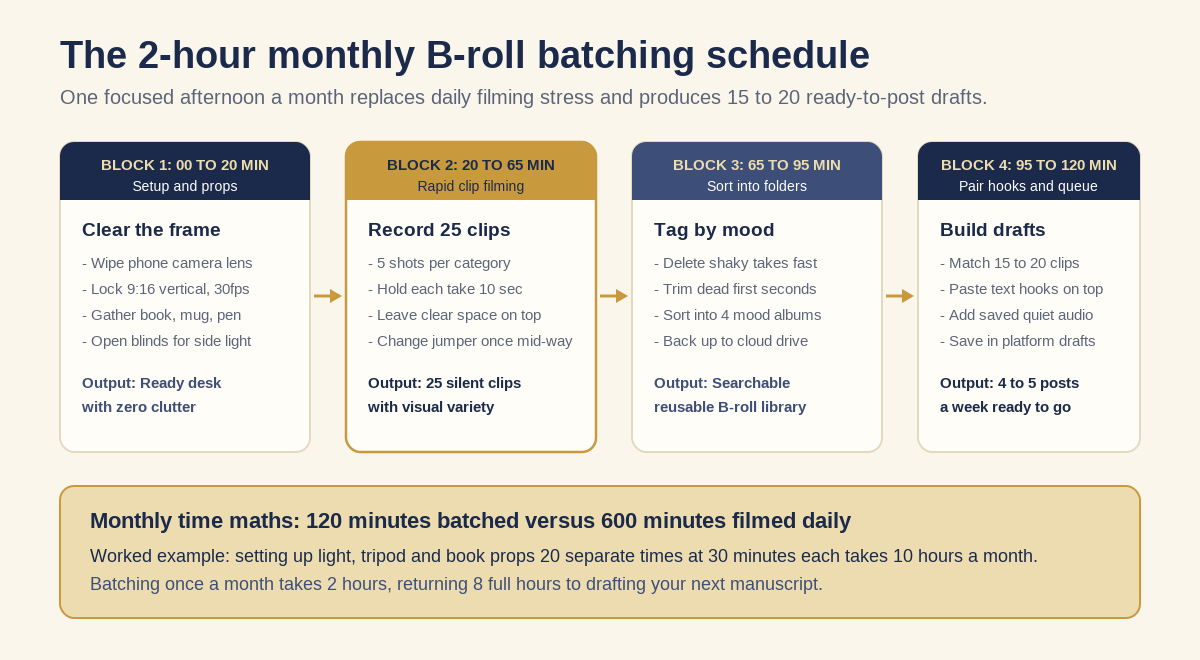
Follow these four timed blocks in exact order:
- Minutes 00 to 20: clear one small corner beside a window, wipe your rear phone camera lens with a soft cloth, mount the phone on a cheap tripod in vertical 9:16 framing and place your books, mug, pen, highlighter and mailers within arm's reach.
- Minutes 20 to 65: film five clips from each category in sequence, holding every single take steady for 10 to 12 seconds without rushing. Swap your jumper or cardigan halfway through minute 45 and shift the tripod angle slightly so the second half of the month looks visually fresh.
- Minutes 65 to 95: sit down with a cup of tea, delete blurry or jittery takes immediately, trim the awkward first second where your hand reached for the record button and move the best 20 to 25 clips into named mood folders on your phone.
- Minutes 95 to 120: open your hook bank spreadsheet, pair 15 to 20 clips with short text overlays inside your preferred video app, attach saved quiet audio tracks and save them as ready-to-publish drafts.
Do not try to write fresh hooks from scratch during minute 95. Keep a running notes file on your phone all month where you drop stray dialogue lines, tropes, reader review snippets and character dilemmas whenever they occur to you while drafting or walking.
Framing, lighting and camera settings for crisp text overlays
Silent B-roll exists to carry readable text without competing against it. Busy wallpaper, tilted horizons and harsh overhead shadows make white overlay text hard to read, forcing viewers to scroll past before finishing line one.
Use six fast technical habits every time you set up your tripod:
- Shoot with your rear camera rather than the front selfie camera, because the rear lens captures far sharper book covers and cleaner colours in indoor light.
- Lock your phone video settings to 1080p at 30 frames per second, which keeps file sizes manageable while uploading crisply to TikTok, Reels and Shorts without heavy compression.
- Position your desk at a 45-degree angle to a daylight window rather than placing the bright window behind your subject, so covers show rich detail without dark silhouettes.
- Leave empty negative space in the upper middle third of every vertical frame where your two-line book hook will sit, avoiding the extreme bottom and right edges covered by app captions and buttons.
- Tap and hold on the book cover on your phone screen to lock exposure and focus before pressing record, preventing the camera from hunting back and forth as your hand moves.
- Film slow, steady motion: turning one page gently or pouring tea calmly looks polished, whereas rapid panning causes motion blur and triggers quick exits.
As of November 2026, TikTok for Business creative guidance highlights vertical full-screen framing and clear text placement inside safe zones as core technical basics for holding viewer attention past the first three seconds. Recording two extra seconds of stillness before and after your main hand movement gives you clean handles when trimming later.
How to organise your clip bank by mood and trope
Leaving 150 untitled clips mixed among holiday photos and screenshots in your camera roll kills the entire batching advantage. The next time you want a moody clip for a suspense quote, scrolling past 400 unrelated pictures eats fifteen minutes and invites procrastination.
Create five dedicated albums directly inside your phone photos app (and mirror them once a month to Google Drive or iCloud for backup) named strictly by emotional mood rather than shooting date:
B-Roll 01 Cosy Warmfor tea mugs, candles, warm lamps, knitwear and autumn leaves.B-Roll 02 Dark Tensefor rainy glass, shadowy desk typing, slow page turns and moody lamp clicks.B-Roll 03 Book Cover Focusfor crisp shots showing your flagship cover, series spines and tabbed pages.B-Roll 04 Packing Directfor signing title pages, tissue wrapping, stamping cards and stacked parcels.B-Roll 05 Writing Processfor laptops, notebooks, index cards and coffee beside a manuscript draft.
When you pull a great trope hook from your notes, you open one exact folder and pick a matching clip in ten seconds flat. After three monthly batching sessions, your phone holds 70 to 75 clean, mood-sorted author clips covering every season and launch need without filming a single emergency video on a busy week.
Pairing one silent clip with three different book hooks
Many authors mistakenly assume every video clip can only ever be published once. Short-form algorithms distribute most posts to cold non-followers first, meaning 90% of people seeing your Thursday post never saw the clip you posted three weeks earlier. Reusing a strong seven-second background clip with a fresh text hook multiplies your return on every minute spent filming.
Look at how one single 10-second clip of hands opening a paperback beside a steaming mug generates three completely different posts across six weeks:
| Posting week | On-screen text hook over the same clip | Caption call to action |
|---|---|---|
| Week 1 (Trope pitch) | "POV: you wanted a quiet Yorkshire village holiday, not a locked-room inheritance mystery with your ex-rival." | "Read chapters 1 to 3 of The Saltmarsh Letter free via my bio link." |
| Week 4 (Review quote) | "A reader said: 'I stayed up until 2am because chapter 14 completely fooled me.' Thank you for reading!" | "Grab the free opening chapters in my bio and see if you spot the clue." |
| Week 7 (First-line extract) | "Opening line of my indie mystery: 'Nobody locks a greenhouse from the inside unless they expect company.'" | "Want page two? The free sample and signed paperbacks live at my bio link." |
Keep every on-screen text hook under 22 words so a viewer can read it comfortably inside a seven-second loop. If a clip runs six seconds and takes nine seconds to read, viewers naturally replay the clip to finish the final phrase, which boosts completion signals organically. Always pair your captions with one clear next step, such as downloading a free story from our reader magnet ideas guide or visiting your clean author landing page built with an author website builder.
Scheduling 15 to 20 monthly posts without burning out
With 15 to 20 finished drafts sitting inside your folder or platform scheduler at the end of your two-hour afternoon, posting throughout the month takes less than three minutes a day. Aim for four posts per week on a predictable rhythm: Monday for a trope hook, Wednesday for a dialogue line or opening scene, Friday for a reader review quote and Sunday for behind-the-scenes writing or packing signed orders.
Cross-post your exact same clean vertical video (exported without a TikTok watermark) to Instagram Reels and YouTube Shorts if you have already established those profiles, or stick strictly to one platform until your monthly batching habit feels effortless. You can check how short video slots alongside free mailing list tactics inside our no-budget self-published book marketing plan.
Remember that every single batched clip needs a working destination behind your profile bio so views turn into readers you actually own. Platforms such as Indie Author Toolchest ($12.99 a month or $120 a year, with a 14-day free trial requiring no card and direct sales switched on when you subscribe) let you host your free-chapter signup form and direct ebook checkout on one clean author page so every video caption points to the same reliable link. Book your first two-hour filming window in your calendar today, gather one paperback and a mug, and record your opening 25 clips before the week ends.
Questions, answered
Can camera-shy indie authors use B-roll batching without showing their face?
Yes. Four of the five core author B-roll categories rely purely on hands, books, notebooks, mugs and packing supplies, meaning you never need to speak on camera or show your face to post four times a week.
How long should each B-roll clip be for TikTok, Reels and YouTube Shorts?
Film each raw clip for 8 to 12 seconds with steady framing and two seconds of extra stillness at the start and end. That length trims cleanly into a 5-to-9-second looping video that gives scrolling readers enough time to read two lines of text overlay.
Can indie authors reuse the same B-roll video clip with a different text hook?
Yes, provided you space repeats three to four weeks apart and change the on-screen book hook, audio track and caption. Short-form feeds deliver posts mainly to new viewers who have never seen your earlier clips, so a single clean clip can work three or four times across a year.
What phone camera settings work best for author B-roll clips?
Shoot vertically in 9:16 format at 1080p resolution and 30 frames per second using your rear phone camera rather than the selfie lens. Wipe the lens before starting and position your desk beside a daylight window so colours stay natural without grainy shadows.
How many posts per month should one two-hour batching session cover?
Filming 25 raw silent clips in one session comfortably covers 15 to 20 finished posts per month, which equals four to five posts a week. Keeping a few spare clips in reserve also protects your publishing rhythm during busy launch or editing weeks.