
Indie Author Academy / Lessons
How to market a self-published book with no budget
A ranked plan to market a self-published book for free: what to do before launch, in launch week and after, what to skip and how to measure results.
To market a self-published book with no money, do the cheap jobs that reach readers who already trust you before anything else: a signup link in the book, an email to your list on launch day, review copies and a few partnerships with authors in your genre. Leave paid adverts and daily posting for later. The plan below puts every job in order, gives it a time box and tells you what to skip.
It ties together articles we have already written, so each stage links to the detail. The ranking is our judgement from the sources cited, not measured data, and nobody can promise what any of it will earn.
How do you market a self-published book with no money?
Rank every job on two things: the effort it takes and the payoff it is likely to give. Then do them in that order. Jobs that cost one evening and reach existing readers come first. Jobs that cost weeks and reach strangers come last.
Our first 100 email subscribers article reports that respondents to Written Word Media's 2025 Author Survey ranked their own email list as the most effective marketing tactic they used. That is a survey of what authors say, and it shows a link and not a cause. It is the reason the plan below keeps returning to the list.
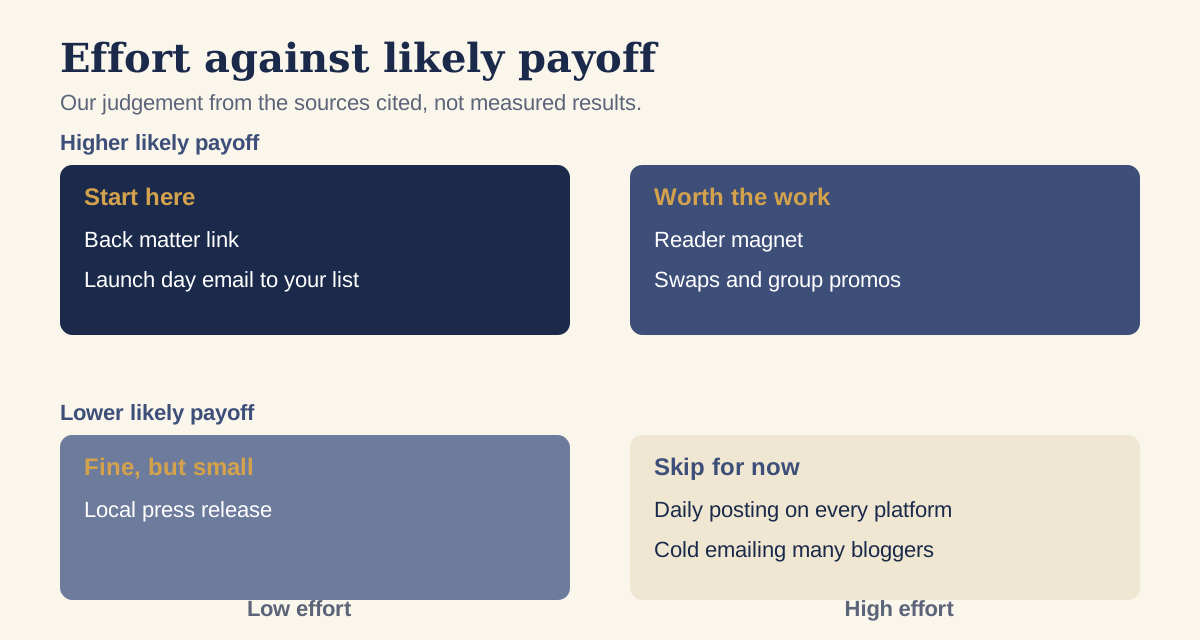
Which free jobs come first?
| Rank | Job | Effort | Likely payoff | Detail |
|---|---|---|---|---|
| 1 | Signup link in the back of every book | An evening | Builds slowly and keeps building | First 100 subscribers |
| 2 | Email to your list on launch day | An hour | Reaches people who chose to hear from you | Launch checklist |
| 3 | Review copies to a small team | A few hours | Reviews on the page when readers arrive | Review team |
| 4 | A reader magnet | Days to weeks | Turns visitors into subscribers | Reader magnets |
| 5 | Newsletter swaps and group promos | An hour each, once you have a list | Borrowed readers who match your genre | Swaps and promos |
| 6 | A one-page press kit and a local press release | A day | Small and uncertain, but it is reusable | Press kit |
Ranks 1 to 3 cost almost nothing and can be done before you have an audience. Ranks 4 and 5 need some list to work with, so they come after the first few weeks.
What should you do before launch?
Give this stage about eight weeks if you can, and no more than two hours in any one of them. The aim is to have somewhere to send people before the book exists.
- Weeks 8 to 6: add the signup link and a one-line offer to the back of every book you have published, and upload the revised files. Build a single page that explains the offer.
- Weeks 6 to 4: make the reader magnet, or choose the simplest one you can finish. Send a short note to two or three authors in your genre who might swap with you, once you have a list worth offering.
- Weeks 4 to 2: invite a small review team, using a request link and not email attachments. Build the press kit page.
- Final week: write the launch email, schedule it and check that every link works.
The 12-week launch timeline gives the full production schedule behind this stage, and a press release template saves the writing for the last item.
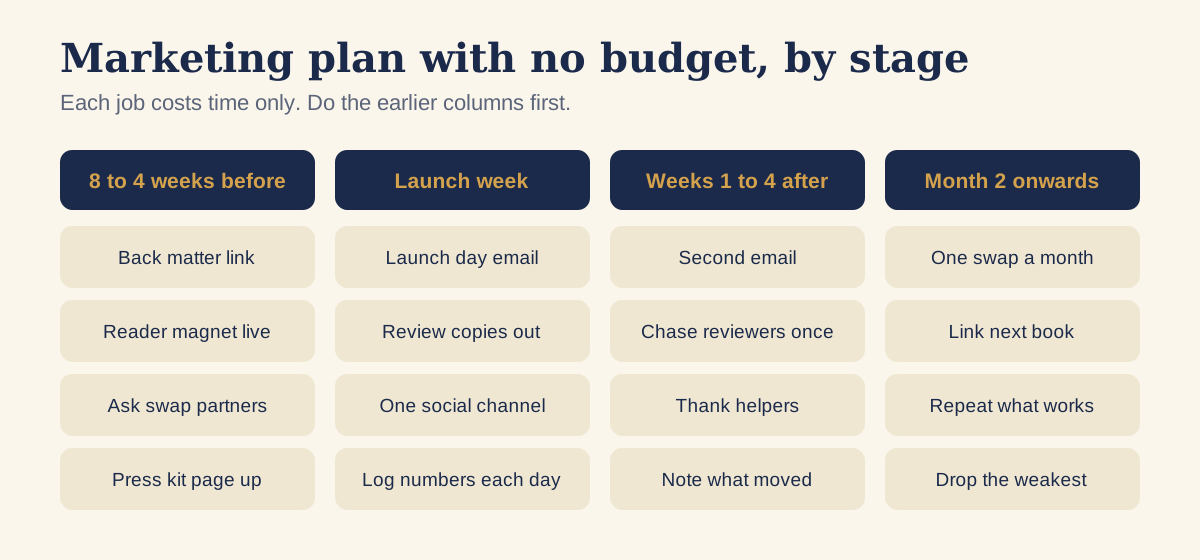
What should you do in launch week?
Launch week is for a small number of jobs done well. Anything that is not in this list can wait.
- Send the launch email, with the buy link first and the story of the book second.
- Remind the review team by email once and thank each reviewer as a review appears.
- Post on the one social channel you have chosen, and answer every comment.
- Send swap partners their copy and links on the day agreed.
- Write down sales rank, reviews and new subscribers each evening in one sheet.
Keep the time box to about an hour a day. The danger in launch week is spending ten hours reloading the sales page and none on the people who might buy.
For the launch email itself, keep it short. Lead with the cover and one sentence on what the book is, give the buy link, and say why you are writing now. Send it at a time your readers are likely to read it, and tell them if the price is a launch price that will rise. A second, shorter email a few days later to those who did not open the first is normal practice and costs nothing.
What should you do after launch?
Most of a book's life happens after the first week, and the free jobs that suit that stage are the slow ones. In weeks one to four, send a second email to people who did not open the first, chase each outstanding review copy once, and thank the people who helped. In month two and beyond, arrange one swap a month, link your next book in the back matter of this one, and repeat whichever job produced the most subscribers.
This is also the point to look at why a book is not selling, because marketing cannot repair a weak cover or blurb. Fix the page before you send more people to it.
What does the plan look like in numbers?
A labelled illustration, not a forecast, shows how the pieces add up. Suppose you start eight weeks before launch with 60 subscribers. You add the back-matter link to three older books, and over the eight weeks 40 readers join through it. You swap with two authors whose lists are about your size, and each swap brings 10 sign-ups. That gives 120 subscribers on launch day. If 40% open the launch email and one in ten of those buys, you have about five sales from the email itself.
Five sales will not look like much, and that is the honest scale of a small list. The same arithmetic shows where to push: every extra 100 subscribers adds about four sales to each future email at those rates, and the list carries over to the next book. Swap in your own open and buy rates after the first launch, because the percentages above belong to nobody in particular.
How do you choose the one social channel?
Choose where readers of your genre already talk, and where you can post without dreading it. Search your genre on each platform, see whether recent posts get replies, and commit to that one place for 30 days. Every post should carry the same invitation: the link to your signup page. If a channel brings no subscribers after a month, drop it and try another, because the time you spend there is the main cost.
What should you skip while you have no budget?
- Posting daily on every platform. It consumes the hours the plan needs for the list. Pick one channel, as our guide to social media for authors explains.
- Paid review services and review swaps. Amazon bars reviews in exchange for compensation and reviews from people with a personal connection, so they risk removal.
- Mass cold emails to bloggers. Send a few personal requests to people who review your genre instead.
- Paid promotion sites before you have reviews. Test paid advertising once the free jobs are running, starting with Amazon ads on a first £100.
- Giving the book away as your main plan. Free and discounted promotions have rules, set out below.
Which platform rules apply?
Two Amazon rules catch authors out. The first concerns reviews. Amazon's Community Guidelines say customers may not create, edit or remove reviews in exchange for payments, refunds, discounts or gifts, and may not post reviews on products from authors they have a personal connection with. Authors who provide free advance copies cannot require a review or try to shape the reader's opinion. Amazon's pages were readable to us in November 2026 only in part, so read the current text before you act.
The second concerns promotions. KDP Help's page on Kindle Countdown Deals says a deal needs the title to have been in KDP Select for at least 30 days. The list price cannot change for 30 days before or 14 days after the deal. Each deal allows up to five price steps, and the page limits you to one Kindle Countdown Deal per KDP Select term. It also says only one type of promotion can be used during the enrolment period. KDP Select needs the ebook to stay exclusive to Amazon, so weigh that against the swaps and sales channels above. Our KDP Select or going wide article covers the choice.
How much time should the plan take each week?
An author with a day job can run the plan in about four hours a week. This is a suggested split and not a measured average, so move the hours to wherever your own numbers say they pay.
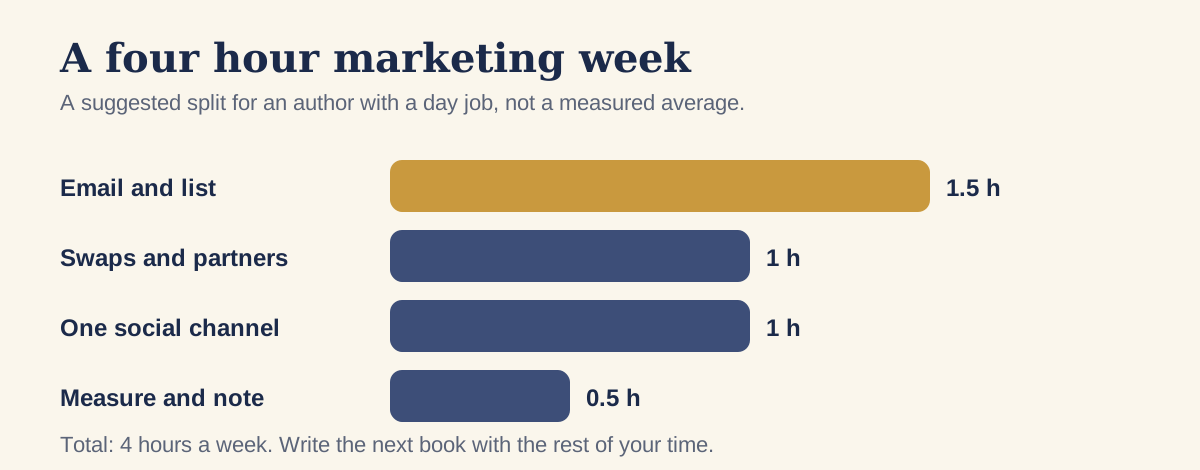
If you have only two hours, drop the social channel first and keep the email work. If you have six, add a second swap each month before you add anything new.
How do you measure whether it worked?
Measure the three things you can see: new subscribers, reviews on the page and sales. Record them weekly in one sheet, with a note of what you did that week. After four weeks, look for the job that happened in the week the numbers moved, and repeat it. Platform dashboards also show clicks on a link, which tells you where subscribers came from.
Be careful about conclusions. One good week after one swap is a signal and not a proof, and sales can move for reasons you did not cause. Our guide to tracking sales and return shows a monthly routine for keeping the figures straight. If you ever consider paying someone else to do the work, read book marketing services: cost, scams and how to vet one first.
Questions, answered
What is the cheapest way to market a self-published book?
Put a signup link in the back of your book, email your list on launch day and arrange a few swaps with authors in your genre. All three cost time and no money.
How long should I market a book before it sells?
Give any single tactic at least a month before judging it, and keep a weekly record of subscribers, reviews and sales. Nobody can promise a timescale, so judge by whether your own numbers move.
Can I run a free promotion on Amazon without KDP Select?
Kindle Countdown Deals need the title to be in KDP Select, according to KDP Help. KDP Help's Countdown Deals page also mentions Free Book Promotions as a Select option, so read its current rules before you plan one.
Should I ask friends and family for reviews?
Amazon's Community Guidelines do not allow reviews on products from authors someone has a personal connection with, so those reviews can be removed. Invite readers who have no connection to you, and do not require a review.
How many hours a week does a no-budget marketing plan need?
About four hours a week is a workable split for an author with another job, mostly on email and partnerships. Treat that as a suggestion and adjust it using your own results.
Run it all from one place
Author page, direct sales, reader list, review copies and press kit, built from one ASIN. Free for 14 days, no card.
Start your free trial