
Indie Author Academy / Lessons
Social media for authors: which platform to use and when
Social media for authors: how to pick one platform by genre, format and time, what BookTok is, how often to post and how to turn followers into subscribers.
For social media for authors, choose one platform that suits the way you like to work and where readers of your genre already talk, post three times a week for 30 days, and put one link in every profile that leads to your email list. Most authors do better with one platform used steadily than five used badly. This guide covers how to choose, what BookTok is, what to post, how often, how to turn attention into subscribers and when to stop.
One point first: no source we could find shows that posting on any platform sells books, and we do not claim it. Social media is a place to be found and to invite people to your list, where you can sell to them later. Our no-budget marketing plan shows where it fits among the other jobs.
Which social media platform should an author use?
Pick by three tests: what you enjoy making, where your genre's readers talk, and how much time you have. The first test decides whether you will keep going, which matters more than any difference between platforms. The picture matches formats to platforms, and the sections after it cover the other two tests.
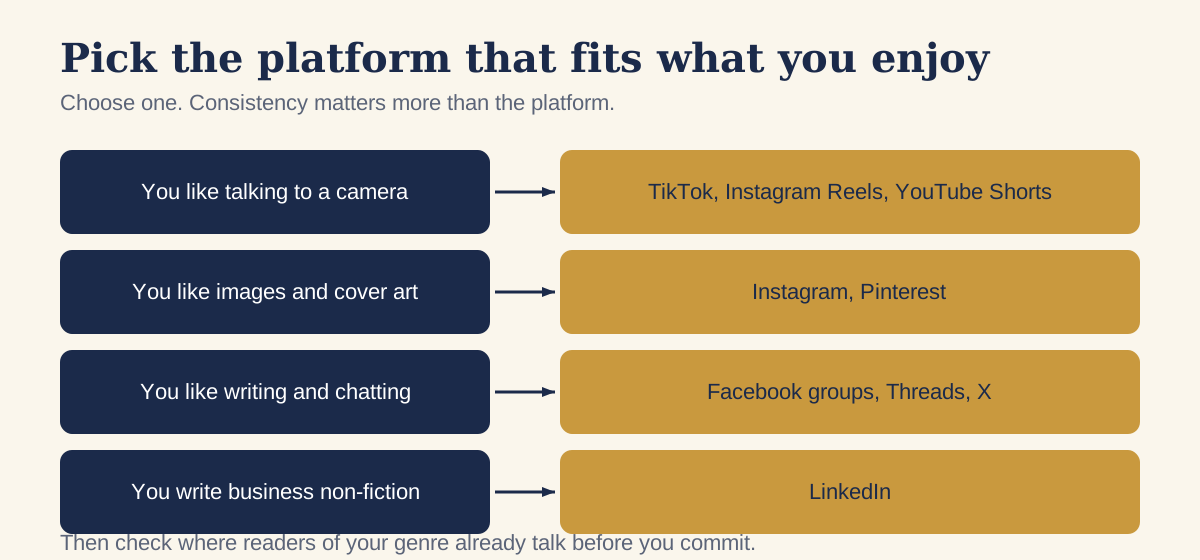
Each format asks for a different habit. Short-video platforms ask for a face, a voice or a screen recording. Image platforms ask for good cover art and a clear caption. Text platforms ask for regular conversation. None is easier than the others, so pick the habit you can keep up when the book is out and you are busy with the next one.
Size is a fourth test, and a weaker one. Pew Research Center's social media fact sheet, based on its National Public Opinion Reference Survey of 5,511 US adults, conducted 30 January to 18 June 2026, found that 84% say they ever use YouTube, 70% Facebook, 51% Instagram and 31% TikTok. Pew reports about adults in the United States only, and we found no equivalent source for the UK, so do not read those figures as the position for your readers. They tell you which platforms are widely used, not which ones sell books.
How do you choose social media for authors by genre?
We found no published ranking of platforms by genre, so choose by looking, not by rule. Search your genre's hashtags and phrases on each platform you might use, and note three things: whether authors similar to you post there, whether recent posts get replies and not just views, and whether readers talk to each other. A platform where your genre is active is worth more than a bigger one where it is quiet.
Written Word Media's BookTok guide suggests adding niche tags such as #ThrillerBooks or #CozyMystery to your captions, which is a quick way to see how busy your corner is. If you write business or professional non-fiction, a platform built around professional topics may suit you better than one built around book reactions. Test, then decide.
How much time do you have?
Match the format to your hours. Short video takes the most time per post, because it needs filming and editing. Images and short text posts take less. If you have under two hours a week for marketing, use a platform where a post takes minutes, and keep the rest of the time for your email list.
What is BookTok and how do authors use it?
BookTok is the book community on TikTok, where readers, authors and reviewers post short videos about books. Written Word Media describes it as a reader-driven conversation and not an advertising channel, with readers sharing recommendations, reactions, reviews and trope-based content. Its advice to authors is to lead with the reader's experience and the feeling the book gives, show the genre and themes in the first few seconds, and choose two or three repeatable formats, such as a theme spotlight, a quote overlay or an "if you liked" post.
Authors also comment on other people's videos in their genre without promoting themselves, and they reply to early comments on their own. The same guide says it gives anecdotes and not quantitative sales data for BookTok, which matches what we found. Treat BookTok as a place readers are paying attention, not as proof of sales.
How often should you post?
Written Word Media advises three to five posts a week on BookTok and at least 30 days before you judge the results. That is one publisher's advice and not a measured finding, but it is a workable starting point, because it is regular and still possible next to writing. Three posts a week is the lower end, and the picture below shows a week built around it.
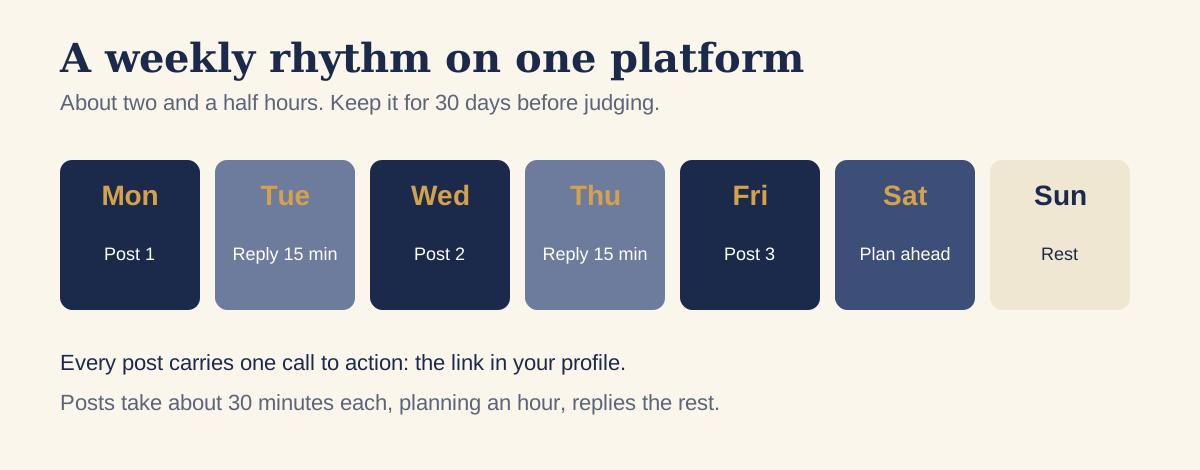
The rhythm is a suggestion for one platform. Batch the next week's ideas on Saturday so Monday does not start with a blank page. Quality of replies matters as much as number of posts, since the same guide ranks real discussion above passive views.
What should an author post?
Post things readers of your genre would enjoy even if you had no book to sell, and mention your book some of the time. A simple mix for fiction is the following.
- The feeling or the trope: why a reader of your genre would like this kind of story.
- A short extract or a line from a scene, with the cover.
- A behind-the-scenes post about the setting, research or characters.
- A question to readers about their favourites in your genre.
- A direct invitation: the free story or the new book, with the link in your profile.
For non-fiction, replace the trope and extract with a tip drawn from the book, a worked example or an answer to a question readers send you. Do not paste the same promotional post on every platform. A cover and a link with nothing else is easy to scroll past.
How do you turn attention into email subscribers?
Social platforms own your audience, and the platform can change how many people see your posts without telling you. An email list is one you control. The path is short: a post earns a click, the profile link goes to one page, the page offers a reader magnet for an email address, and a confirmation email completes the sign-up.
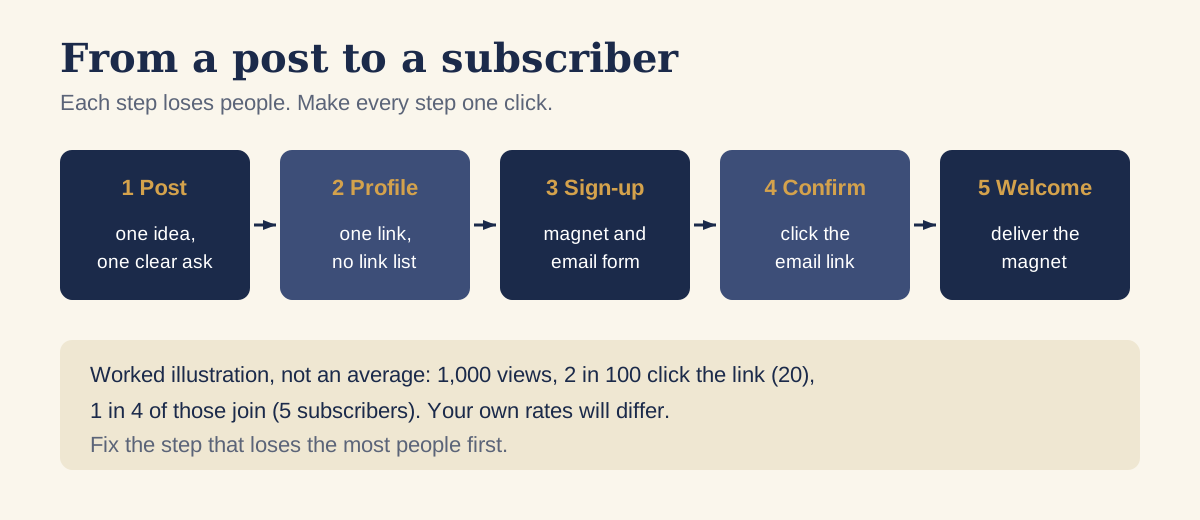
Every step loses people, so keep each one to a single action. Use one link in your profile, and not a list of links. Send that link to a page with one offer, and our article on reader magnets lists what to give away. Then send a short welcome email, as described in the first six newsletter emails.
The illustration in the picture is arithmetic and not an average. If 1,000 people see your posts, 2 in 100 click the link and 1 in 4 of those join, you gain five subscribers. If your own figures are half that, you gain two or three, and the picture shows which step to fix. The Indie Author Toolchest gives each author a page on its own subdomain with a free-ebook landing page and a signup form, which can serve as that one link. Any mailing tool with a hosted signup page does the same job, as our mailing list tools comparison shows.
How do you set up an author profile in an hour?
A profile that is clear in five seconds does more than a clever post. Work through the steps below once, then leave it alone.
- Use your author name and the same photo on every platform, so readers recognise you.
- Write a one-line bio that names your genre and what readers get, for example the kind of story and the setting.
- Add one link, to the page where readers can join your list, and no other links.
- Pin or feature one post that explains who you write for.
- Follow and read ten accounts in your genre before posting, so you know what readers respond to.
How do you run a 30 day test?
Treat the first month as an experiment with a stated end. Before day one, write down the platform, the three posts a week, the one link and the number you will check, which is new subscribers from that link. On day 30, add up the hours you spent and the subscribers you gained, and divide. If you spent 10 hours and gained 5 subscribers, that is two hours per subscriber, a figure you can compare with a swap or a back-matter link. The numbers are your own, and nobody else's average applies.
If the test is promising, keep the rhythm for another month before you add a second platform. If it is not, change one thing at a time, such as the format or the call to action, so you can tell what made the difference.
When should you quit a platform?
Give a platform a fair trial and then decide with numbers. After 30 days of steady posting, count the new subscribers that came from it, and note how many hours it took. Quit, or cut back to a minimum, when one of the following is true.
- You have posted regularly for 30 days and it has sent you no subscribers.
- You dread it, and the dread is making you skip writing.
- The audience does not match your genre, whatever its size.
- The time it costs is more than your list is gaining elsewhere.
Quitting is not failing. Keep the profile live with a link to your list, so anyone who finds you can still join, and move the hours to the job that is working. Track what you keep with the monthly routine in our sales and return guide, and revisit another platform when you have time to spare.
Questions, answered
Which social media platform is best for authors?
There is no best platform for every author. Choose the one where readers of your genre already talk and where you can post steadily without dreading it, and use it to point people to your email list.
What is BookTok?
BookTok is the book community on TikTok, where readers, authors and reviewers post short videos about books. Written Word Media describes it as a reader-driven conversation and not an advertising channel.
How often should an author post on social media?
Written Word Media advises three to five posts a week on BookTok and at least 30 days before judging results. That is advice and not a measured rule, so adjust it to the time you have.
Does social media sell books?
We found no source showing that posting on any platform sells books, so we do not claim it. Use social media to be found and to invite readers to join your email list.
How do I get email subscribers from social media?
Put one link in your profile that leads to a single page offering a reader magnet for an email address. Then confirm the sign-up and send a welcome email.
Run it all from one place
Author page, direct sales, reader list, review copies and press kit, built from one ASIN. Free for 14 days, no card.
Start your free trial