
Indie Author Academy / Resources
Book launch press release template with a worked example
A book launch press release template with a fictional worked example, who to send it to, timing and embargoes, and a checklist, sources read November 2026.
A book launch press release is a one-page news announcement with a headline, a dateline, a first paragraph that answers who, what, when, where and why, a quote, the book details, a short bio and a contact block. This article gives you the full template, a fictional worked example and a list of who to send it to.
A release does not guarantee coverage. According to PR Academy's guide to news release writing, published on 18 December 2024, journalists and editors decide whether to report a release, so it has to contain something they can use. Keep it to one page and lead with the news.
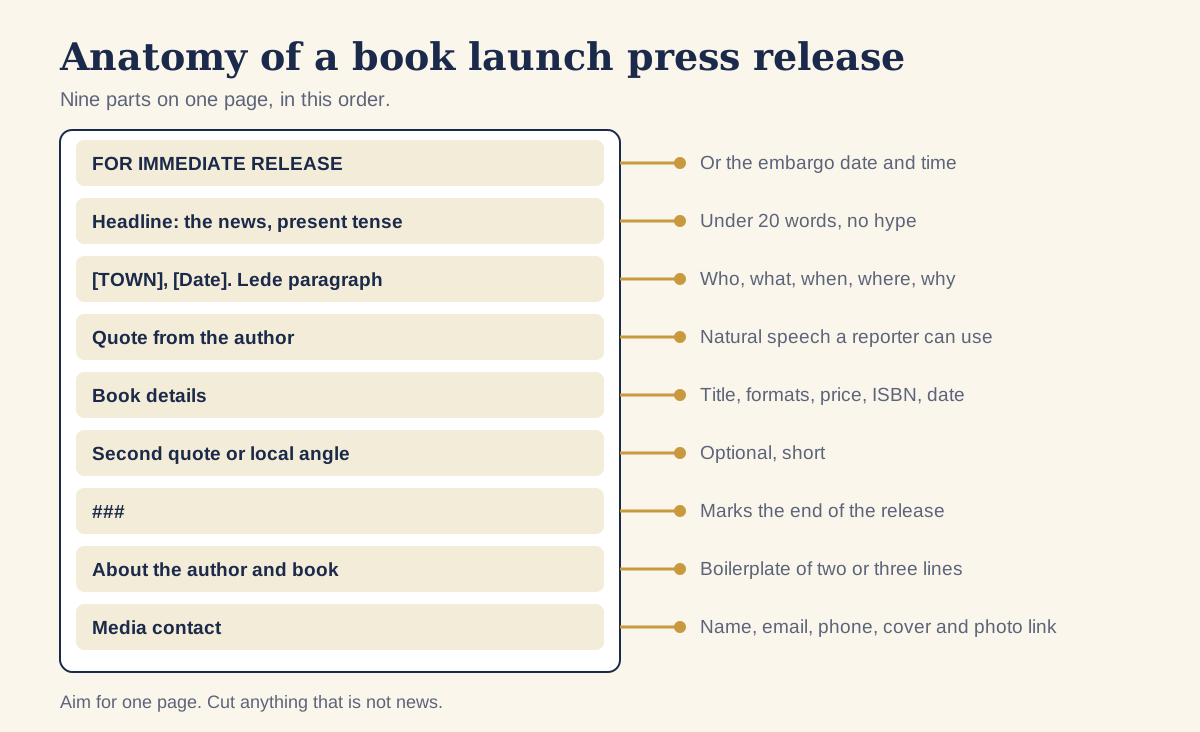
The book launch press release template
Copy this layout and replace everything in square brackets. It follows the structure in PR Academy's guide, written by Richard Bailey, and in Kirkus's guide to writing a book press release, both read in November 2026.
[FOR IMMEDIATE RELEASE] or [EMBARGOED until 00:01 on date]
[HEADLINE: the news in the present tense, under 20 words]
[Optional subheading: one line that adds a detail]
[TOWN], [Date]. [Lede: in two or three short sentences, say who has done what, when and where, and why it matters to your readers. Example: "[Author name], a [local description], has published [Book title], a [genre] novel set in [place], on [publication date]."]
"[Quote from you, two or three sentences, in natural speech: why you wrote the book, or what readers will find.]," said [Author name].
[Book details paragraph: what the book is about in two sentences, with no spoilers. Add a line about any event, such as "[Author name] will read at [venue] on [date and time]. Entry is free."]
[Optional second quote from a named early reader, bookseller or local figure, used with their permission.]
[Availability: "[Book title] is available as a paperback at £[price] and an ebook at £[price] from [where to buy]. ISBN [number]."]
###
About [Author name]: [Two or three lines of bio that matter to this audience: where you live, what you do, your other books.]
About [Book title]: [Format, page count, publisher or imprint, ISBN, publication date, price, a link to a page with the cover.]
Media contact: [Name], [email], [phone]. Review copies, interviews and a high-resolution cover and author photo are available at [link].
How to write each part
Headline. Put the news first, in the present tense. PR Academy says present-tense headlines make the news appear fresh, and Kirkus suggests keeping the headline under 20 words. "Local author launches mystery set in village hall" is a headline. "Exciting new book from talented writer" is not.
Dateline and lede. Open with your town and the date, then answer who, what, when, where and why in two or three short sentences. PR Academy calls this the inverted pyramid: the most important information goes first, so an editor can cut from the bottom without losing the news.
Quote. PR Academy recommends at least one quote from a named person, with their name and role. Write yours the way you speak, and make it say something specific. A quote such as "I am so excited" gives a journalist nothing to print.
Book details. Give title, formats, price, publication date, ISBN and where to buy. Reedsy's author media kit guide lists the same basics for a release: publisher, price and publication date, plus a synopsis and contact details.
Author bio and boilerplate. PR Academy's "notes to editors" hold background and a standard paragraph describing the person or product. Write two or three lines, once, and reuse them on every release. Our guide to author bios of 50, 100 and 200 words has versions you can adapt.
Contact block. Put a real name, email and phone at the bottom, and answer them. A release with no contact route is hard to use. Link to your press page for images, as described in our guide to the author press kit.
Tone and format. Kirkus advises a direct, informative tone rather than a salesy one, a simple professional font at 12 point, and an end marker of three hash symbols. Write in the third person so the release reads like a news item, and set the draft aside for a couple of hours before a final proofread. Send it in the body of the email, with a PDF copy attached or linked, because many people will not open an unknown attachment.
A worked example, with a fictional author
This example is fictional. The author, village, book, publisher and phone number are invented for illustration, and the number is in the range Ofcom reserves for drama. Use it to see how the template reads once it is filled in.
FOR IMMEDIATE RELEASE
Retired librarian turns Haverdale village hall into a murder scene in debut cosy mystery
HAVERDALE, 12 March 2027. Hannah Pell, a retired librarian from Haverdale, has published her first novel, The Salt Road Murders, a cosy mystery set in a village hall during the annual autumn fair. The paperback and ebook are available from today.
"I spent 31 years stamping other people's books and wondering how I would plot one," said Hannah Pell. "The village hall is where everyone in Haverdale ends up sooner or later, so it seemed the right place for a crime."
The book follows a parish clerk who finds a body behind the tombola stall. It is the first in a planned series. Hannah Pell will read from the book at Haverdale Library at 2pm on Saturday 13 March 2027. Entry is free.
The Salt Road Murders is published by Lantern Row Books as a 312-page paperback at £8.99 and an ebook at £3.99. ISBN 978-1-00000-000-0.
###
About Hannah Pell: Hannah Pell worked in libraries across [county] before retiring in 2024. She lives in Haverdale with her two dogs.
Media contact: Hannah Pell, example@example.com, 07700 900123. Review copies, interviews and images are available at example.com/press.
The example runs to about 190 words, and an editor can cut any paragraph from the bottom up without losing the news. The headline names the place, which is the local hook. Replace the details with true ones, and never claim an award, quote or sales figure you cannot support.
To adapt the example, change the hook to whatever is true for you: a local setting, a profession, an anniversary, a charity tie-in or an event. A release with no angle beyond "book published" gives an editor little reason to run it, so name the angle in the headline.
Who to send a book launch press release to
Send it to a short list of people you have checked, rather than a long list you have not. Kirkus suggests local and known media, editors, journalists, reviewers and bloggers, your own audience, and your social media. Keep a separate media list so you can reuse it for the next book.
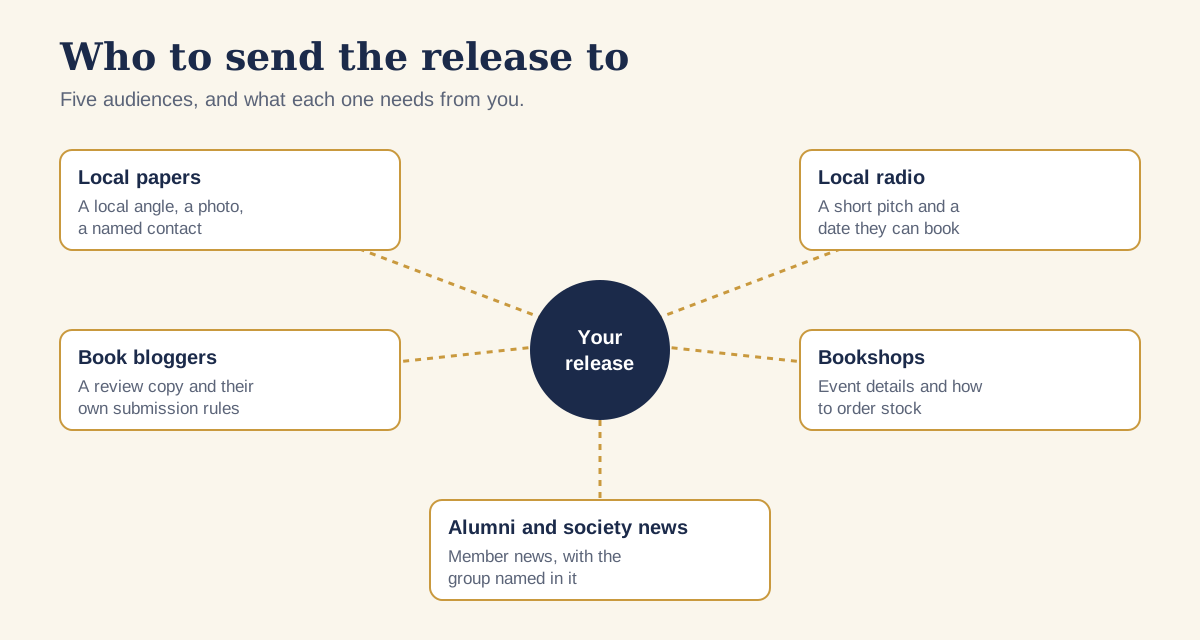
- Local papers and magazines: a local angle, a photo and a named person to call. Look for a news or features email on their website.
- Local radio: a short pitch and a date when you can be interviewed. A reading or signing gives them something to promote.
- Book bloggers and reviewers: a review copy and a pitch that follows their own submission rules, which most publish on their site.
- Bookshops and libraries: event details, how to order the book and the price. Send the release with a one-line note.
- Alumni and society newsletters: your school, college, writers' circle or local history group, with the group's name in the first paragraph, because their members care about their own.
Write a short personal note for each recipient and attach the release, rather than sending one email to everybody. PR Academy's guide describes news releases as something organisations issue and journalists choose to use, so a note that says why this suits their readers helps.
Timing and embargoes
The Reedsy author media kit guide, read in November 2026, says to start contacting journalists and bloggers three to four months before launch, and to put the media kit together six months before publication. Reedsy also says the press release is the one time-sensitive part of the kit, so include it only when a book is launching.
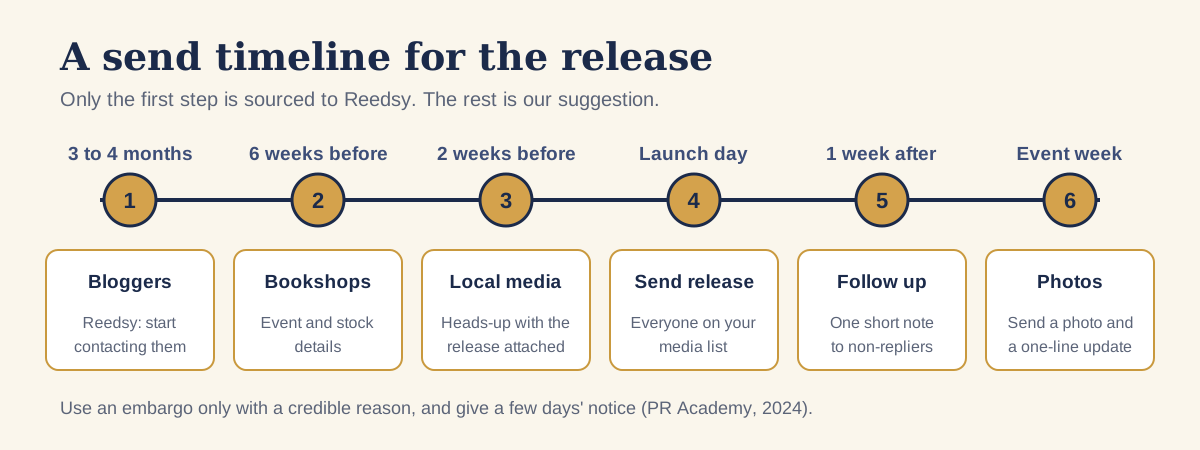
An embargo asks recipients not to publish before a set time. PR Academy says there needs to be a credible reason for one and that journalists may break an embargo, and it advises giving a few days' notice for embargoed stories. For most books, no embargo is needed. Use one only if you are sending review copies or an extract ahead of launch and want coverage to land together.
The week-by-week steps after the first one are our suggestions. For a full plan around the release, see our book launch checklist and the 12-week launch timeline.
Send checklist
- The news is in the headline and the first paragraph, and the release fits on one page.
- Every fact is true and checked, including the ISBN, price, date and place names.
- The quote sounds like you and says something specific.
- The contact block has a real email and phone number that you will answer.
- The cover and author photo are linked from a press page, not attached at full size.
- Each email has a short personal note and names the person you are writing to.
- The embargo, if any, is stated at the top and in the email, with a reason.
- You have a date in your diary to send one follow-up, and then stop.
What the Toolchest does for a press release
The Indie Author Toolchest lets you type a press release of up to about 3,500 characters. It renders a letterheaded PDF as soon as the book is published or marked coming soon. Drafts stay private, and a toggle controls whether the book is featured on your press kit. You can also email a journalist or reviewer a review copy directly, with the same 14-day watermarked delivery as an ARC, and no approval step. Put your own media contact in the text, and open the PDF to check how it prints before you send it.
Questions, answered
What should a book launch press release include?
A headline, a dateline, a first paragraph that answers who, what, when, where and why, a quote, the book details, a short author bio and a contact block. Keep it to one page and put the news first.
How long should a book press release be?
One page. Kirkus recommends one page, and PR Academy says a release should be as short as possible.
When should I send a book launch press release?
Reedsy says to start contacting journalists and bloggers three to four months before launch. Send the release itself around launch day, with a heads-up to local media a couple of weeks before.
Do I need an embargo on a book press release?
Usually not. PR Academy says there must be a credible reason for an embargo, and that journalists may break one. Use one only when you send review copies or an extract in advance.
Who should I send my book press release to?
Local papers and radio, book bloggers and reviewers, bookshops and libraries, and the newsletters of groups you belong to, such as an alumni association or a writers' circle. Send a personal note with each one rather than a mass email.
Run it all from one place
Author page, direct sales, reader list, review copies and press kit, built from one ASIN. Free for 14 days, no card.
Start your free trial