
Indie Author Academy / Resources
Review request email templates for ARC readers and fans
Copy-ready review request email templates for ARC readers and fans, with the Amazon and Goodreads rules on what you may ask or offer, read November 2026.
A review request email may invite a reader to leave an honest review, and may offer a free or discounted copy, but it may not require a review, offer a reward or tell the reader what to write. Amazon's Community Guidelines and Goodreads' Author Guidelines both say so, and both were read on 13 November 2026.
Below are six copy-ready templates for ARC readers and fans: the invitation, the pre-release reminder, the launch-day note, the polite follow-up, the thank-you and the last note to readers who never replied. Each one stays inside the rules in the next section.
What a review request email may and may not say
Amazon's Community Guidelines let readers review free books from authors or publishers, with one condition: the author cannot require a review in exchange or try to influence the reader's opinion. The same page lists what counts as compensation, namely payments, refunds, discounts, products, gift cards, warranties and services. It also says people should not review products from authors they have a personal connection with, and that anyone with a connection must disclose it clearly and conspicuously.
KDP Help's page on customer reviews repeats the author's side. You may give free or discounted copies, but offering anything other than a free or discounted copy, including gift cards, invalidates the review and the Amazon Community team will remove it. Amazon allows a seller to encourage an unbiased, unincentivised review. Our article on running a review team covers delivery and leaks, so this article sticks to the words of the request.
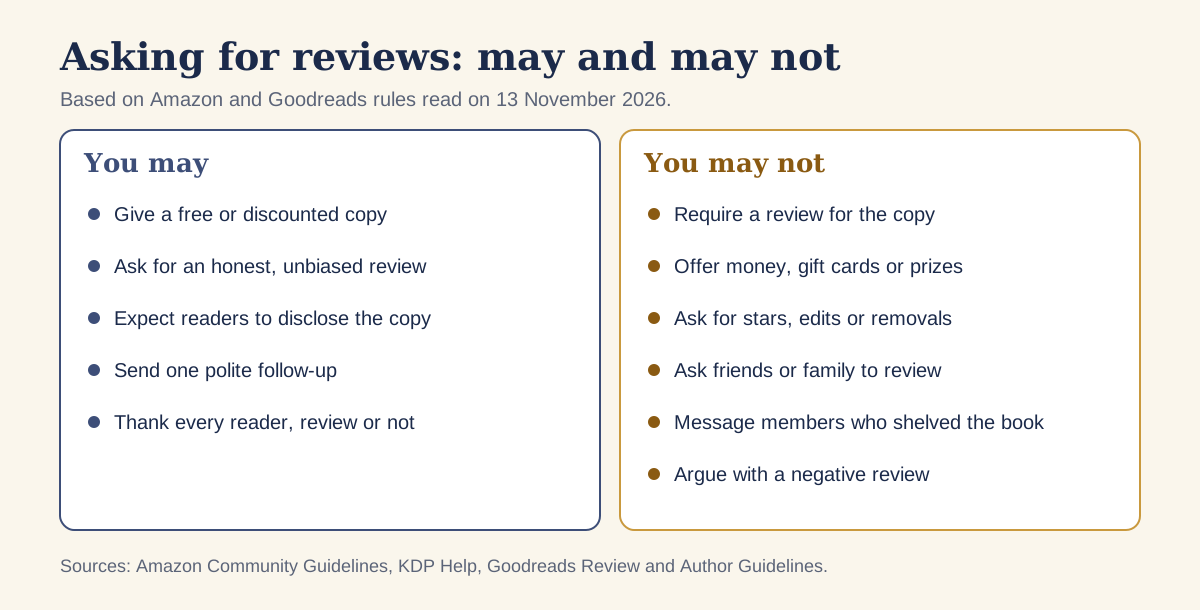
Goodreads is stricter about one thing and clearer about another. Its Rating and Review Guidelines say a reader who receives a free copy in exchange for a review must disclose it in the review, and they encourage pre-publication reviews from readers with advance copies. Its Author Guidelines say you can provide free or discounted copies but cannot require a review, that paid and incentivised reviews are prohibited, and that contacting members who have shelved your book is treated as spam.
| Situation | Allowed? | Source |
|---|---|---|
| Free or discounted copy for readers | Yes, if no review is required | Amazon, KDP Help, Goodreads |
| Asking for an honest, unincentivised review | Yes | Amazon Community Guidelines |
| Gift card, prize draw or refund for a review | No | Amazon, KDP Help, Goodreads |
| Asking for five stars or a particular verdict | No, that is influencing | Amazon Community Guidelines |
| Offering a refund to change or remove a negative review | No | Amazon Community Guidelines |
| Friends, family or business associates reviewing | No | Amazon Community Guidelines |
| Messaging Goodreads members who shelved your book | No, treated as spam | Goodreads Author Guidelines |
Amazon does not give a set sentence for disclosing a free copy. Goodreads says disclosure is required, and Amazon requires a clear and conspicuous disclosure of any connection. Tell readers a short note is expected and let them word it themselves.
What a good review request email contains
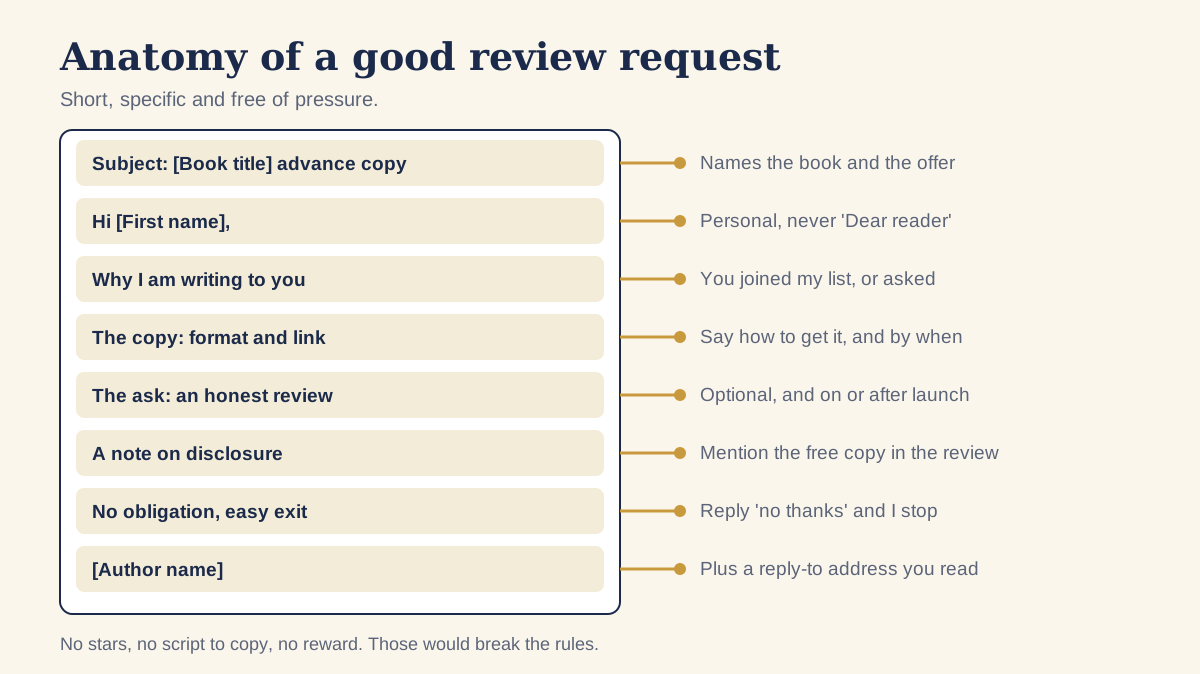
A good request is short, names the book, makes one clear offer and leaves the reader free to say no. It has eight parts, shown below. Everything else you might add, such as a reward or a script, is either unnecessary or against the rules.
When to send each review request email
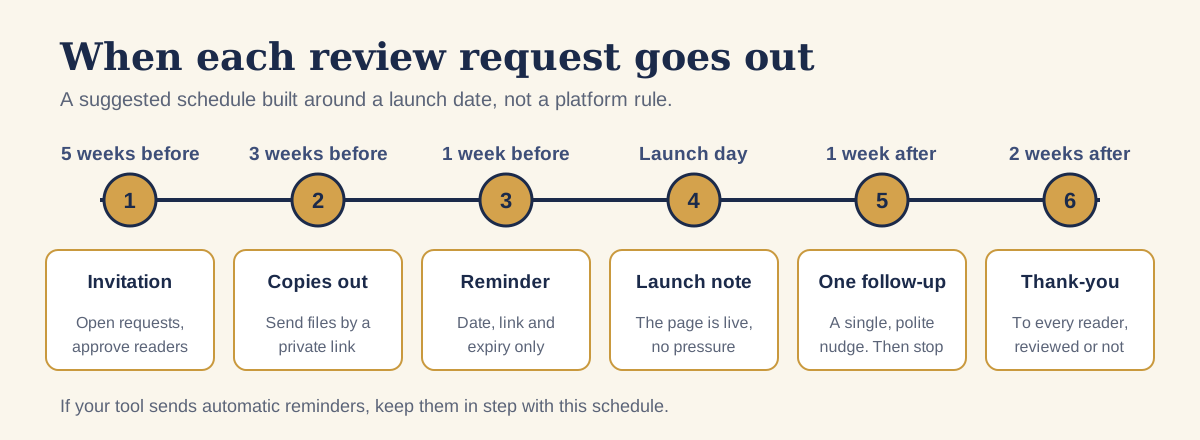
Space the emails around the launch date. The timeline below is our suggestion, not a platform rule. Copies go out about three weeks before launch so that readers have time to read, and the reminder lands one week before. The review can only go live once the book is on sale, so the main ask comes on launch day.
For how many readers to invite in the first place, see how many review readers you need for 20 launch-week reviews.
Six review request email templates to copy
Send the invitation to your own reader list, which our guide to the first six newsletter emails explains how to build, and to readers who join through the five free list sources. Replace every item in square brackets and keep the tone you use with readers you know.
Template 1: the invitation
Subject: Would you like an advance copy of [Book title]?
Hi [First name],
You joined my list after [how they joined], so I thought you might enjoy an early copy of [Book title], my [genre] novel, out on [release date].
It is [one-sentence pitch]. The copy is a [format] file, and you can get it here: [request or download link]. The link works until [date].
There is no obligation to review it. If you read it and would like to leave an honest review on [Amazon or Goodreads] on or after [release date], I would be grateful, whatever you think of it. If you do, please mention that you received a free copy.
If this is not for you, just ignore this email, or reply "no thanks" and I will not mention it again.
[Author name]
Template 2: the pre-release reminder
Subject: [Book title] comes out on [date]
Purpose: a one-week reminder. Send a version to readers who downloaded and another to those who did not.
Hi [First name],
A quick note that [Book title] comes out on [release date]. If you have downloaded your copy, I hope you are enjoying it.
[For readers who have not downloaded: your link is [link] and it stops working on [date].]
Once the book is live, I will email you the page. No pressure at all.
[Author name]
Template 3: the launch-day note
Subject: [Book title] is out today
Hi [First name],
[Book title] is out today. Thank you for reading an early copy.
If you would like to leave a review, here is the page: [Amazon link]. You can also review it on Goodreads: [Goodreads link]. Please write it in your own words, and say you received a free copy.
If you would rather not review, that is completely fine.
[Author name]
Template 4: the polite follow-up
Subject: A quick follow-up on [Book title]
Purpose: one nudge, one week after launch, to readers who have not told you they posted. Then stop.
Hi [First name],
Just a short note, a week after launch. If you have finished [Book title] and want to leave a review, the page is here: [link]. An honest review of any length helps other readers decide.
If you did not get to it, or it was not for you, no worries at all. Thank you for taking a look.
[Author name]
For fans who bought the book rather than receiving an advance copy, use this shorter version after launch: "Hi [First name], thank you for buying [Book title]. If you have read it and have a minute, an honest review at [link] helps other readers find it. No obligation, and thank you either way."
Template 5: the thank-you
Subject: Thank you for reading [Book title]
Purpose: send to every reader who received a copy. It should not depend on whether they posted a review, because a thank-you that is conditional starts to look like a reward.
Hi [First name],
Thank you for reading an early copy of [Book title]. Readers like you make a launch possible, and I am grateful for your time.
[Optional: a line about what is next, such as the next book, with no ask.]
[Author name]
Template 6: the last note for readers who never opened
Subject: Your copy of [Book title] expires on [date]
Hi [First name],
Your advance copy of [Book title] is still waiting at [link], but it stops working on [date]. If you would like it, now is the time. If not, no problem, and thank you for signing up.
[Author name]
What to do when someone does not reply
Send one follow-up and then stop. A second chase moves from a reminder into pressure, which is where the rule against influencing a review starts to bite. Most readers who do not reply are busy, did not enjoy the book enough to say so, or never meant to review.
- Do not ask again, and do not message the same person on social media. On Goodreads, contacting members who shelved your book is treated as spam.
- Do not remove them from your list or from future copies as a penalty. Amazon's rules bar rewards for reviews, and a perk that depends on posting one looks like the same thing from the other side.
- Do not respond to a negative review. Goodreads' Author Guidelines tell authors not to engage with negative feedback and to report reviews that break the rules instead.
- Do keep a simple record of who downloaded, so the reminder goes only to the right people.
Where the reviews go: Amazon, Goodreads and retailers
Amazon is where most readers will buy, so it is the first link in the launch-day note. KDP Help says reviews appear only after the Amazon Community team confirms they meet the guidelines, which can take a few days, so a review that has not appeared on launch day is not necessarily missing. KDP support cannot restore one that was removed.
Goodreads suits readers who track what they read, and the Review Guidelines specifically welcome reviews from advance copies. Give both links and let readers choose. Other retailers, such as Kobo, Apple Books and Barnes & Noble, run their own review systems with their own terms, and we did not check those here, so read each store's current rules before you ask.
Tracking review copies with the Toolchest
The Indie Author Toolchest has an ARC campaign for one book at a time. You set a maximum number of copies and an optional close date, share a request link, and approve or decline each reader. Approval sends a watermarked copy by email, and the 14-day download window starts when the reader clicks the link. A day-10 reminder goes to readers whose copy is not marked reviewed, and an "it's out today" note goes to everyone who downloaded on release day. Marking a copy reviewed is for your own records only and does not gate anything. The Toolchest's own emails overlap with templates 2 and 3, so use your own words for the parts it does not cover, such as the invitation and the thank-you.
Questions, answered
Can I ask readers for a review in an email?
Yes. Amazon's Community Guidelines allow a seller to encourage an unbiased, unincentivised review. You cannot require one, reward it or try to steer the verdict.
Can I offer an ARC reader a gift card or a free book for reviewing?
A free or discounted copy of the book you are asking about is allowed. Anything else, including gift cards, invalidates the review under KDP Help and breaks Amazon's rules on compensation.
How many times should I follow up on a review request?
Once. One reminder after launch is polite, and a second moves towards pressure. Keep the thank-you separate and send it to everyone regardless of whether they posted.
Should I ask my friends and family for reviews?
No. Amazon's Community Guidelines say people should not review products from authors they have a personal connection with. Ask readers who are genuinely independent of you.
When is the best time to send a review request email?
The reader cannot post an Amazon review until the book is on sale, so the main ask goes out on launch day. Send the invitation about five weeks before, the copy three weeks before and a reminder one week before, which is our suggestion rather than a platform rule.
Run it all from one place
Author page, direct sales, reader list, review copies and press kit, built from one ASIN. Free for 14 days, no card.
Start your free trial