
Indie Author Academy / Lessons
How indie bookstores decide to stock self-published books
How independent booksellers decide to stock self-published books: trade discounts, returns, cover quality, local pull demand, and a one-page sell sheet.
Independent bookshops decide whether to stock self-published books by weighing shelf economics, physical book quality, and proof that readers will actually walk through the door to buy them. A typical independent shop stocks between 4,000 and 15,000 titles in a finite room while receiving hundreds of publisher catalogues and author emails every single month.
As of November 2026, most indie pitches fail in the first thirty seconds for predictable commercial reasons: narrow non-trade discounts, non-returnable wholesale listings, amateur spines, or zero local marketing plan. When you understand the six checks a bookseller runs at the ordering desk, you can fix the weak points before sending a single email and turn a cold rejection into a genuine partnership.
Why indie bookshops say no to most pitches
Independent booksellers run small retail businesses with tight margins. Rent, electricity, business rates, staff wages, and heating bills have to be paid out of the gap between wholesale cost and cover price. If a book sits untouched on a table for four months, it blocks a slot that could have earned five sales of a reliable bestseller.
Understanding that daily pressure changes how you approach a buyer. A bookseller who declines your email is rarely questioning your talent as a writer. They are asking one practical question: will stocking three copies of this paperback bring readers into my shop and leave enough gross profit to cover the shelf space? Organisations such as the Booksellers Association UK and the American Booksellers Association represent thousands of independent shops navigating those exact retail numbers every week.
The six criteria buyers use to stock self-published books
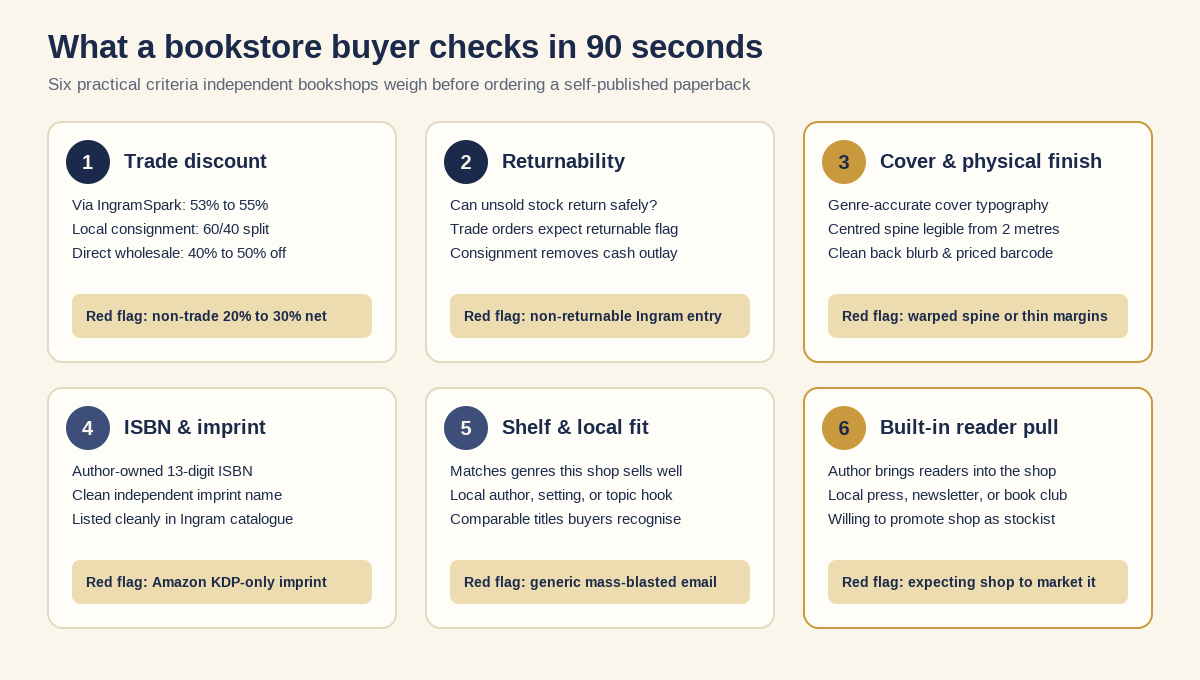
When a buyer opens your pitch email or looks up your ISBN on a wholesale terminal, they move through six rapid checks. Missing even one of the commercial checks usually ends the review straight away.
1. Trade discount that covers shop overheads
When a shop orders through Ingram, the wholesaler takes a share of the discount before passing the remainder to the retailer. That is why IngramSpark global book distribution recommends a 53% to 55% trade discount for physical bookstore shelves as of November 2026. If your title sits at IngramSpark's 40% US minimum discount, the bookshop often receives only 20% to 25% off cover price after wholesale handling, which is too thin for speculative shelf stock. On local consignment (with no wholesaler in the middle), shops typically expect a 60/40 split giving 40% to the retailer, while direct wholesale orders usually run at 40% to 50% off cover price.
2. Returnability or zero upfront cash risk
Traditional publishers let bookshops return unsold stock for credit after 90 to 180 days. If a buyer looks up your ISBN in Ingram and sees a non-returnable flag, they know any unsold copy becomes dead cash on their balance sheet. Local consignment solves this objection cleanly because the shop pays nothing until a reader buys a copy. Before switching IngramSpark returns on for national trade pitching, weigh the chargeback risk carefully, because returned wholesale copies are billed back to you in full. Our comparison of IngramSpark vs KDP for indie authors breaks down how discounts and return settings affect your net payout.
3. Cover design, spine legibility, and print finish
Online shoppers judge a thumbnail; bookstore shoppers browse spines from two metres away and pick up a paperback to feel the paper weight. A buyer will inspect the front cover, back blurb, spine centring, interior margins, and binding glue in ten seconds. Any sign of a cramped font, pixelated artwork, or crooked spine text signals that customers will put the book straight back down.
4. Author-owned ISBN and independent imprint
Free KDP ISBNs display Amazon's imprint in trade databases and restrict wholesale distribution. Independent bookshops regard Amazon as their primary retail rival and rarely stock books tied to Amazon's imprint. Buying your own ISBN block and registering a tidy independent imprint name immediately signals a serious publishing approach. Check our walkthrough on ISBNs for self-published authors in the UK and US for registration steps.
5. Genuine fit for that specific shop's shelves
Every independent bookshop has a personality shaped by its neighbourhood. One shop thrives on crime fiction and regional walking guides; another specialises in literary fiction, translated novels, and children's picture books. Pitching a space opera to a shop that does not keep a science fiction bay proves you never visited the store or checked its website.
6. Evidence of built-in reader pull
Booksellers stock books that already have momentum behind them. A local author who brings twenty friends, newsletter subscribers, and book club members to a Thursday evening reading introduces brand-new regular customers to the shop. An author who drops off five copies and never mentions the shop on social media or in a newsletter leaves all the selling work on the staff.
Why cover design, spine width, and ISBN matter on real shelves
Physical shelving exposes formatting flaws that online retail hides. Most indie paperbacks sit spine-out after the first week on a new-release table, which means the spine carries the entire sales burden. If your book is under 120 pages, spine text can easily wrap onto the front or back hinge during trimming if the cover template is off by two millimetres.
Inspect a physical proof copy against three traditionally published paperbacks in the exact same genre before contacting any buyer:
- Confirm your trim size matches the shelf standard for your genre, such as 5 x 8 inches, 5.25 x 8 inches, or UK B-format (129 x 198 mm) for trade fiction.
- Check that your interior paper uses cream stock for fiction and crisp white stock for practical non-fiction, with comfortable inner gutter margins so readers do not crack the spine trying to read near the fold.
- Verify that your back cover includes a clean barcode with your 13-digit ISBN and a five-digit price extension (or clear printed retail price) so till scanners recognise the book cleanly.
- Check that your title, author name, and small publisher colophon sit dead centre on the spine and read cleanly from two metres away.
If you want exact measurements before exporting your print PDF, consult our KDP and IngramSpark print specs guide covering spine, margins, and bleed. Industry bodies such as the Alliance of Independent Authors also maintain quality checklists for print editions aimed at retail bookshops.
Cold pitch versus reader demand pull
Most self-published authors spend weeks sending cold emails to fifty distant shops and receive forty-eight silences and two polite rejections. That happens because a cold email tries to push stock onto a buyer who has zero proof that local readers want the book. Reader pull works in the opposite direction: readers ask for your book first, and the bookseller responds to proven demand.
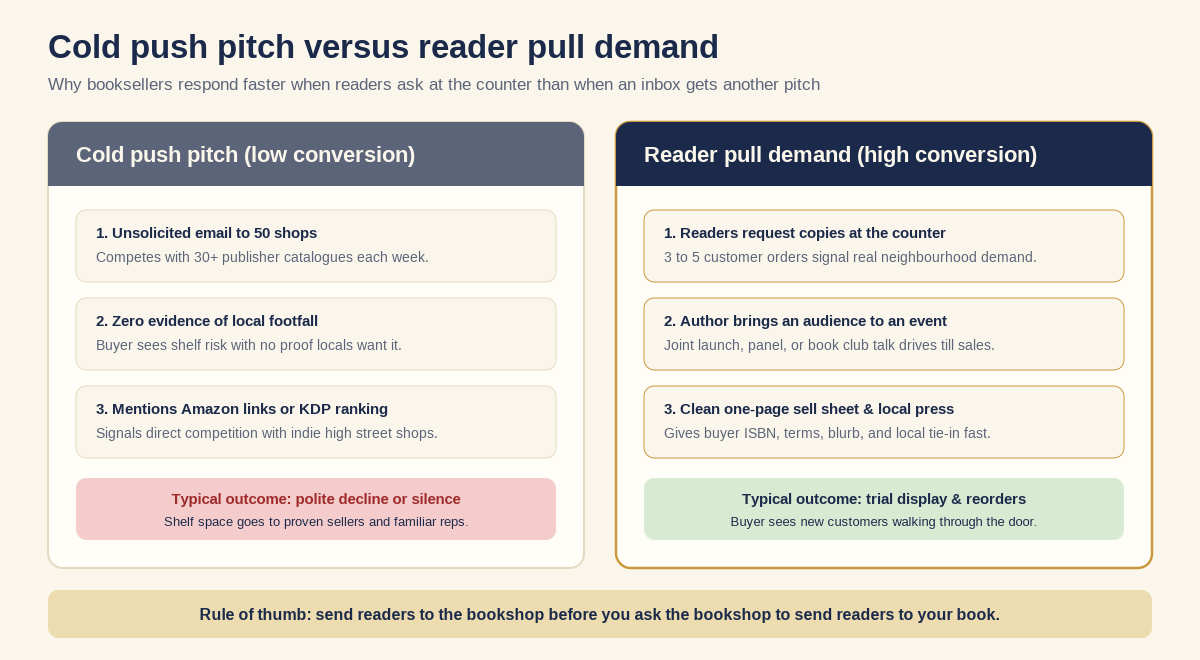
Consider what happens when three local customers walk up to the counter in one fortnight and ask to order the same locally set thriller. On the first order, the shop special-orders one copy via Ingram. On the second, the buyer notes the title. On the third, the buyer often orders extra table stock or replies warmly to an event proposal.
Drop one common mistake when writing to any independent shop: never boast about your Amazon bestseller badge or paste an Amazon link inside your pitch. Link instead to your own author website, your press page, or your Ingram listing details.
What to put on a one-page bookstore sell sheet
Booksellers rarely read multi-page press kits during ordering hours. They want a single tidy PDF (a sell sheet or advance information sheet) kept strictly to one page and under 2 MB so it opens cleanly on a counter computer.
| Sell sheet section | Exact details to include | Why the buyer checks it |
|---|---|---|
| Header and cover image | High-resolution front cover, book title, subtitle, author name | Tests instant visual fit for shop tables |
| Blurb and hook | 80 to 120 words focused on reader appeal, plus two recent comparable titles | Helps staff hand-sell the book in one sentence |
| Metadata block | 13-digit ISBN, publication date, format, trim size, page count, retail price | Required to look up or enter the title in the till system |
| Ordering and terms | IngramSpark wholesale availability (discount and return flag) or local consignment terms | Confirms margin and risk within five seconds |
| Local and marketing hook | Author town, local setting, planned press, newsletter reach, event readiness | Shows how the author will bring customers into the store |
| Contact details | Author email, phone number, website URL, press kit link | Allows fast reply for event dates or stock requests |
Keep your sell sheet alongside your bio, headshot, and cover files on one page of your website. Our guide to what to include in an author press kit and our author press kit overview show how to organise those files, and you can pair regional media outreach with our book launch press release template.
How to build local pull demand through events and readers
Four practical moves generate genuine footfall for independent bookshops without a national media budget:
- Become a regular customer first. Visit target shops months before launch, buy books there, and notice which local authors they already champion.
- Propose a joint event instead of a solo signing. Partner with two local writers in your genre for a themed panel or Q&A where all three authors invite their own email lists.
- Promote the shop publicly before and after placement. Share a photo of the shopfront with your newsletter, link to the shop's site, and direct local readers there for signed stock.
- Connect with local book clubs. Offer a twenty-minute author Q&A and suggest the group orders its copies through your partner independent bookshop.
A practical outreach schedule that respects booksellers
Timing matters almost as much as your terms. High street bookshops spend November and December focused entirely on Christmas trading and gift tables, so pitching local consignment during late autumn almost always stalls. January, February, late spring, and early autumn give buyers far more breathing room to read local submissions and schedule author evenings.
Follow a calm four-step sequence for your next paperback:
- Twelve weeks before launch, verify your print proof, confirm your author-owned ISBN and wholesale terms, and build a focused list of five to ten realistic local or specialist shops that match your genre.
- Ten weeks before launch, read every target shop's local author submission policy on its website and send a short, personalised email (under 150 words) attaching your one-page sell sheet PDF.
- Two weeks later, send one polite, brief follow-up email if you have not heard back, or drop in on a quiet weekday morning if the shop's website invites in-person local author submissions.
- Once a shop stocks your book, check in gently at the agreed 60-day or 90-day review date, share every local media mention, and bring fresh copies promptly whenever they sell through.
Pick three independent bookshops within thirty miles of your home this week, read their local author pages carefully, and draft a crisp one-page sell sheet before sending your first email.
Questions, answered
Do independent bookshops refuse all self-published books?
No. Many independent bookshops stock local self-published books regularly, especially when the author brings an existing neighbourhood audience, offers fair trade or consignment terms, and presents a professionally edited and designed paperback. Refusals usually come down to shelf space, poor wholesale terms, or missing reader demand rather than a blanket ban.
Why do independent booksellers dislike seeing an Amazon KDP imprint?
Independent bookshops compete directly with Amazon for retail customers, and KDP's free ISBNs carry Amazon's imprint while blocking standard returnable wholesale ordering. Using your own ISBN under an independent imprint name and listing via IngramSpark or local consignment removes both objections.
What should I include on a one-page bookstore sell sheet?
A bookstore sell sheet should fit on one single A4 or US Letter page and include your front cover image, title, subtitle, 13-digit ISBN, trim size, page count, retail cover price, wholesale route and discount, a short 100-word blurb, two comparable titles, your local connection, and direct contact details.
How far ahead should I pitch an independent bookshop before launch?
Contact target shops eight to twelve weeks before publication if you want to discuss a launch event or trade pre-order. For local consignment on an already published paperback, follow the shop's stated intake window and avoid November and December when high street shops focus on peak holiday trading.
Does a bookstore buyer need a free review copy before agreeing to stock my book?
Never post unsolicited physical books to a shop without asking, because unwanted parcels often end up in charity boxes. Email your one-page sell sheet first, check the shop's local author submission policy, and offer to drop off or post a finished inspection copy if the buyer wants to examine the binding and print finish.