
Indie Author Academy / Lessons
IngramSpark vs KDP: which platform should you use?
IngramSpark vs KDP in November 2026: what each costs, how returns and ISBNs work, and which route suits your book, with a worked paperback example.
Most authors do not need to choose between IngramSpark vs KDP, because the two do different jobs. KDP gets your ebook and paperback onto Amazon with no upfront cost. IngramSpark adds the one thing KDP cannot give you: a print listing that bookshops and libraries can order on normal trade terms, with a wholesale discount and returns that you set. If you want only Amazon sales, KDP alone is enough.
Prices and terms below were read on the vendors' own pages on 13 November 2026. Where a page would not load for my reader, I say so and name what I used instead. Check the live page before you commit.
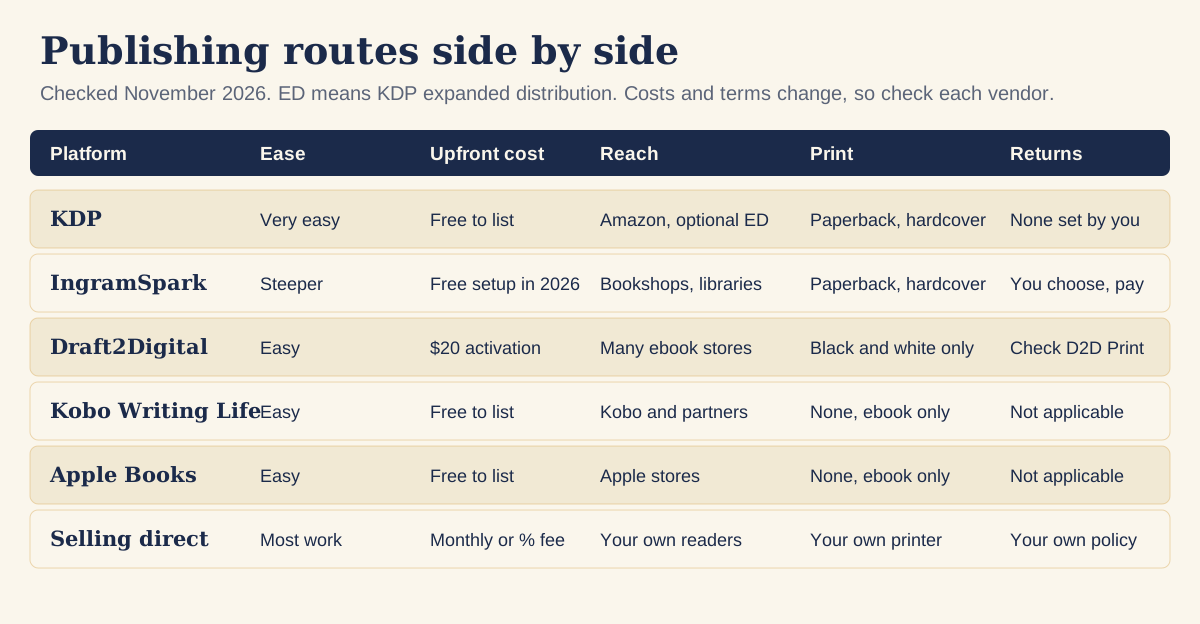
The six routes at a glance
Self-publishing has more than two doors. KDP covers Amazon. IngramSpark covers print distribution to the wholesale network that bookshops and libraries buy from. Draft2Digital is an aggregator that sends one ebook file to many stores. Kobo Writing Life and Apple Books for Authors are direct routes into two ebook stores, and selling direct puts you on your own site with your own readers.
You can use several at once. The usual order is KDP first, then one or two additions chosen for a reason, such as bookshop orders or a wider ebook audience. The existing guide to getting your book onto Apple Books, Kobo, Google Play and Barnes & Noble covers the store set-up steps, so this article concentrates on the choice.
IngramSpark vs KDP: what each is for
KDP prints on demand and ships through Amazon. Its paperback royalty is 60% of list price at or above $9.99 (50% below), minus printing cost, and our guide to KDP royalties for ebook, paperback and hardcover works through the formulas. KDP also offers expanded distribution for paperbacks, which KDP Help describes as a way to reach bookstores, online retailers, libraries and academic institutions. It is not available for hardcovers.
The catch is in the terms. KDP Help states that the expanded distribution royalty is 40% of list price minus printing. I could not find a setting on the KDP pages I read for choosing your own wholesale discount or accepting returns. Several author-education sites say expanded distribution is non-returnable and that bookshops rarely order through it. I could not confirm that from a KDP page, so treat it as reported and not as KDP policy.
IngramSpark is a wholesaler and printer that serves the trade. You set the retail price, the wholesale discount and whether copies can come back. That control is what bookshops expect, and it is also where the risk sits, as the next two sections show.
What IngramSpark costs in 2026
Setup is free. IngramSpark's own pages say title setup costs nothing, and its pricing page says signing up and uploading a print or ebook costs nothing. Older guides that quote a $49 setup fee and a $25 revision fee describe the old pricing and are out of date.
The fee that remains is a market access fee, taken from sales through distribution. IngramSpark's help article on the February 2026 changes, which blocked my automated reader, was summarised in search results as removing revision fees from 1 February 2026 and charging a 1.875% market access fee. A report from a member of the Alliance of Independent Authors, dated 22 April 2026, says the rate rose from 1.5% to 1.875%. Other sites say it rose from 1%. IngramSpark's older announcement page quotes 1% of the local list price at the time of sale. The sources disagree on the old rate, so quote 1.875% only as the figure to verify on IngramSpark's current rate card.
Print costs also rose in February 2026 according to the same reports, without a single published figure. Use IngramSpark's own print calculator for your trim size and page count, and do not reuse a number from a blog post.
For ebooks, IngramSpark's pricing page says you earn 85% of the net revenue it receives, and that converting a print book to an ebook costs $0.60 a page. That conversion fee is the only ebook charge I found.
ISBNs: what you need to run both
Your own ISBN is the cleanest way to use both platforms. Each format needs its own number, so the paperback, hardcover and ebook each need one. With an ISBN you bought from your national agency, the same paperback number can sit on KDP and on IngramSpark, so the book has one identity everywhere.
IngramSpark offers a free ISBN to US self-publishers only. Its page says the book then carries IngramSpark's imprint, Indy Pub, and that the number works only with your IngramSpark title. It also says free ISBN titles must be offered for wholesale distribution in at least one market. A KDP free ISBN is likewise tied to KDP. Authors outside the US must buy ISBNs from their national agency, which for UK authors is Nielsen. Our guide to ISBNs for UK and US authors lists the costs.
Wholesale discount and returns on IngramSpark
IngramSpark's blog says you can set a wholesale discount between 40% and 55% in the US, with a minimum of 35% for the UK, EU and Australia. It suggests 50% to 55% to stay competitive with bookshops, which buy at trade discount. A higher discount means a lower payout per copy, so you are paying bookshops for the right to be stocked.
Returns are the part that catches authors out. Per IngramSpark's blog on making a book returnable, you pick one of three options: no returns, Yes Deliver (the copy is posted back to you) or Yes Destroy. In every case IngramSpark charges you the wholesale cost of each returned copy. Yes Deliver adds $3.00 a book for a US address and $20.00 for an international one. Returns come out of your payment in the month they are received, and if returns exceed sales the balance can be invoiced to you.
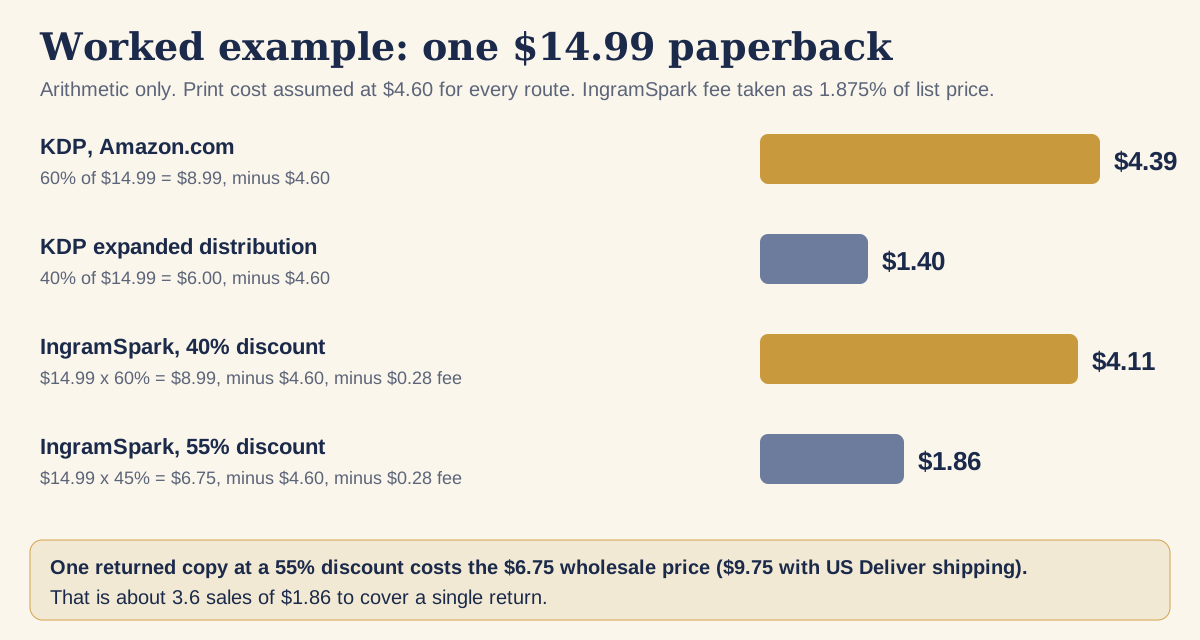
Worked example: one $14.99 paperback
This is arithmetic, not a forecast. Assume a 300-page paperback at $14.99 and the same $4.60 print cost on every route, which is KDP's Amazon.com cost for that page count from our royalties guide. IngramSpark's own cost may differ, so run its calculator before you rely on this.
- KDP on Amazon.com: 60% of $14.99 is $8.99, minus $4.60, leaves $4.39.
- KDP expanded distribution: 40% of $14.99 is $6.00, minus $4.60, leaves $1.40.
- IngramSpark at a 40% discount: $14.99 less 40% is $8.99, minus $4.60 and a 1.875% fee of $0.28, leaves $4.11.
- IngramSpark at a 55% discount: $14.99 less 55% is $6.75, minus $4.60 and $0.28, leaves $1.86.
A copy returned at the 55% discount costs you $6.75, or $9.75 with US Deliver shipping. That single return wipes out about 3.6 sales of $1.86. The takeaway is that a bookshop sale can leave very little, and a returnable title can lose money. If bookshop orders are a hope and not a plan, setting returns to No is the safer default, and you accept that some shops will not stock the book.
Ebook routes: Draft2Digital, Kobo, Apple and direct
Draft2Digital's FAQ says its commission is about 10% of the retail price. A support article explains the exact method: it keeps 15% of the net the store sends after the store's own share, and the two figures land close together. For a new account the FAQ lists a one-time $20 activation fee, plus a $12 annual maintenance fee for accounts earning under $100 a year in book sales. Its FAQ also lists stores including Apple Books, Barnes & Noble, Kobo, Bookshop.org, Tolino, OverDrive and Hoopla, with Amazon by invitation only, and a free ISBN that works only through D2D.
Apple states it pays 70% royalties on every ebook regardless of price, with no file delivery fees. Kobo Writing Life's help centre, which blocked my reader, is reported to pay 70% at $2.99 and above and 45% below that, so read it before pricing. Our guide to KDP Select or going wide, book by book covers whether leaving Amazon's exclusive programme is worth it, and the exclusivity rules show what stays blocked while a book is enrolled.
Selling direct means you are the seller, so you keep the sale and the reader's email. The breakdown of a $4.99 ebook sold direct shows the fees, and the article on signed paperbacks covers print. Indie Author Toolchest is one way to take those orders with you as the seller.
The same $4.99 ebook through each route
Again, this is arithmetic before tax, bank and payment fees. On KDP at 70%, a 1 MB file pays 70% of ($4.99 minus a $0.15 delivery fee), which is $3.39. Through Apple direct at 70%, $4.99 pays $3.49. Through Kobo at 70% the figure would also be $3.49. Through Draft2Digital, if the store keeps 30% as in D2D's own example, the store takes about $1.50 and D2D about $0.50, leaving about $2.99.
The difference between direct and aggregator is roughly the commission, around $0.50 here. Whether that is worth paying depends on how much admin you want to avoid across several dashboards.
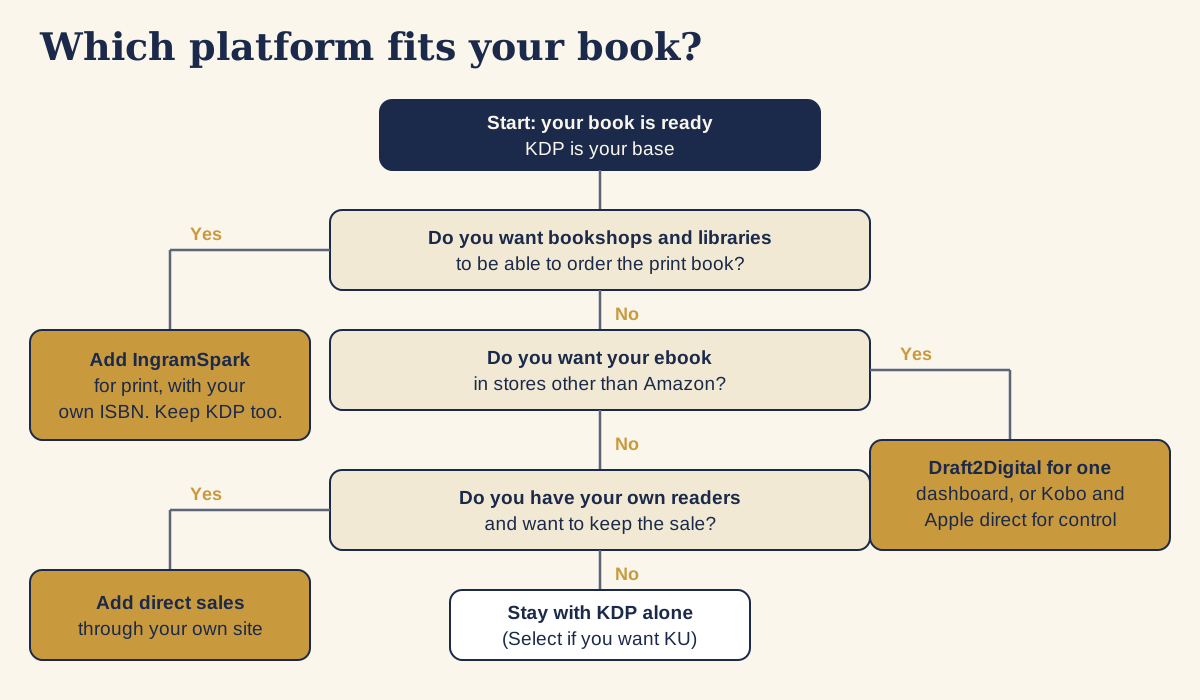
Which platform to choose for which author
Pick the route that matches what you want the book to do, and add platforms one at a time.
- You want Amazon sales and the simplest set-up: publish ebook and paperback on KDP and stop there.
- You want a bookshop or library to be able to order your paperback: add IngramSpark for print, with your own ISBN, and set returns to No unless you can afford them.
- You want your ebook on many stores without managing each one: use Draft2Digital and accept its commission.
- You want maximum control and promotions in two big stores: go direct to Kobo and Apple, and use an aggregator for the rest.
- You have a mailing list and want the full sale price: sell direct as well, which works with all of the above unless the ebook is in KDP Select.
Test the order of operations before spending money. Upload to KDP, check the proof, and only then decide whether an IngramSpark file at a different trim size or a second ISBN is worth the extra work. For the sources behind each figure, see the IngramSpark setup fee page, the returns guide, the Draft2Digital FAQ and the KDP paperback royalty page.
Questions, answered
Is IngramSpark better than KDP?
Neither is better overall because they serve different readers. KDP is the simplest way to reach Amazon, while IngramSpark is how you offer bookshops and libraries trade terms. Many authors use KDP for Amazon and IngramSpark for wider print.
Does IngramSpark charge a setup fee in 2026?
No. IngramSpark says title setup is free and its pricing page says uploading a print or ebook costs nothing. A market access fee on distributed sales still applies, so check its current rate card.
Can I use the same ISBN on KDP and IngramSpark?
Yes, if you bought the ISBN yourself, the same paperback number can be used on both. Free ISBNs from KDP and IngramSpark are tied to their own platforms. Each format, such as paperback and hardcover, needs its own number.
What happens if a bookshop returns my IngramSpark book?
IngramSpark charges you the wholesale cost of each returned copy, plus shipping if you chose Yes Deliver. The amount comes out of your payment in the month it is processed. Setting returns to No avoids this, with fewer shops willing to stock the book.
How much does Draft2Digital take from each ebook sale?
Draft2Digital says it keeps about 10% of the retail price, which it explains as 15% of the net after the store's cut. New accounts pay a $20 one-time activation fee, and a $12 annual fee applies below $100 a year in sales.
Run it all from one place
Author page, direct sales, reader list, review copies and press kit, built from one ASIN. Free for 14 days, no card.
Start your free trial