
Indie Author Academy / Lessons
How to self-publish and market a book: the complete guide
How to self-publish a book and market it: the steps in order, what it costs, where to sell, how to price it and how to find readers, with sources.
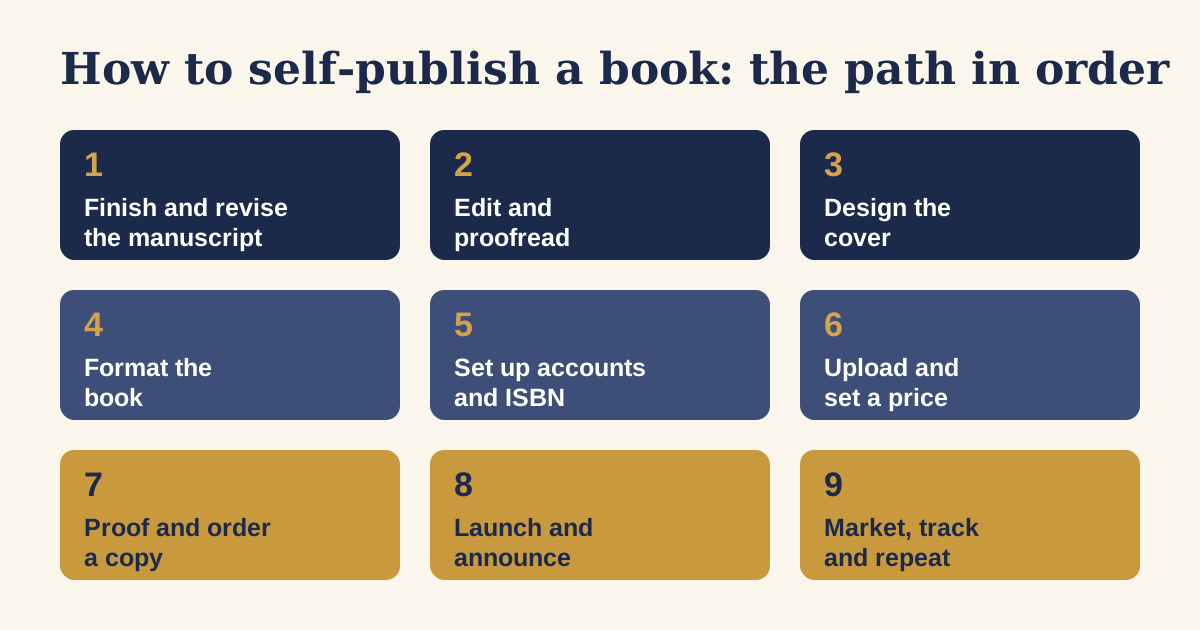
Learning how to self-publish a book comes down to nine jobs done in order: finish the manuscript, edit it, give it a cover, format it, set up your accounts, upload and price it, check a proof, launch it and market it. You do them yourself or pay people to do them, and either way you keep control of the book and its rights. This guide covers each job, what it costs, where to sell and how to find readers, with a link to a detailed post on each.
Key takeaways
- Self-publishing means you are the publisher: you decide, pay for and organise everything between a finished manuscript and a book on sale.
- Uploading to the main retailers is free. The costs are the services you choose to buy, mainly editing, a cover and formatting.
- Amazon pays 70 percent on ebooks priced from $2.99 to $12.99 in its US store and 35 percent outside that band, so price is mostly arithmetic.
- Most of the work that sells a book happens after you publish it: a good cover and blurb, readers who can find the book, and a way to reach them again.
- No reliable figure tells you how much a first book will earn. Model your own numbers instead of trusting averages.
What this guide covers
How to self-publish a book: the steps in order
Some of these steps depend on each other and some do not, which is why the order matters. A cover cannot be finished before the title is fixed, and a book cannot be formatted until the editing is done. The full sequence, with the dependencies and the one deadline that carries a real penalty, is in our post on the steps to self-publishing in order. In short:
- Finish the manuscript and revise it until you are not embarrassed by it.
- Get it edited and proofread, by a professional or by readers you trust.
- Commission or design a cover that signals the right genre.
- Format the interior for ebook and print.
- Set up your retailer accounts and decide whether you need your own ISBN.
- Upload the files, write the description, choose categories and set a price.
- Order a proof copy and check it before you approve it.
- Announce the book to the people who already want it.
- Keep marketing it, track what works and write the next one.
Self-publishing or traditional publishing: how to choose
The honest answer is that it depends on what you want from a book, and the two routes suit different people. The table sets out the main differences. Our post on the benefits of self-publishing and what each one costs you goes into more detail.
| Question | Self-publishing | Traditional publishing |
|---|---|---|
| Who owns the rights? | You keep them. | The publisher licenses them from you for the term of the contract. |
| Who pays for editing, cover and formatting? | You do, or you do the work yourself. | The publisher. |
| Who decides the cover, title and price? | You do. | The publisher, usually with your input. |
| Who controls the timetable? | You do. | The publisher's schedule. |
| How do you get paid? | You receive the royalty on each sale from the retailer or your own shop. | Typically an advance and a royalty set in the contract. |
| Who does the marketing? | You do, or you hire help. | Shared with the publisher, and how much help you get varies by deal. |
Self-publishing tends to suit authors who want control and are willing to learn the business side, and traditional publishing tends to suit authors who want a publisher's support and are willing to give up control and wait. Many authors do both. If you have not yet decided, a practical test is to ask which jobs on the list above you would be glad to do yourself and which you would rather hand over.
What self-publishing costs
Uploading to Amazon KDP, Kobo Writing Life, Draft2Digital or Apple Books is free, and these services take their share from sales instead of charging you up front. Everything else is a service you choose to buy, which is why the cost of a book ranges from very little to several thousand pounds.
Our post on how much it costs to self-publish sets out current prices in detail. Three figures show the scale. Reedsy's 2025 marketplace data puts average editing rates at roughly $0.020 a word for proofreading, $0.027 for copy editing and $0.036 for developmental editing. Reedsy also reports a median cover price of $930, with more than half of its cover projects between $630 and $1,200. In the UK, recent reports of Nielsen's ISBN store put a single ISBN at about £93 and a block of ten at about £174, so check the store itself before you buy.
A tight budget does not stop you publishing. Spend first on the parts a reader judges before they read a word, which are the cover and the editing, and use the free formatting tools that KDP and Draft2Digital provide until you have a reason to pay for more.
The tools you need
An indie author's tools fall into seven groups, and the image shows them in the order a book moves through them. The groups are writing software, editing, cover design, formatting, distribution, a website with an email list, and a way to track sales.
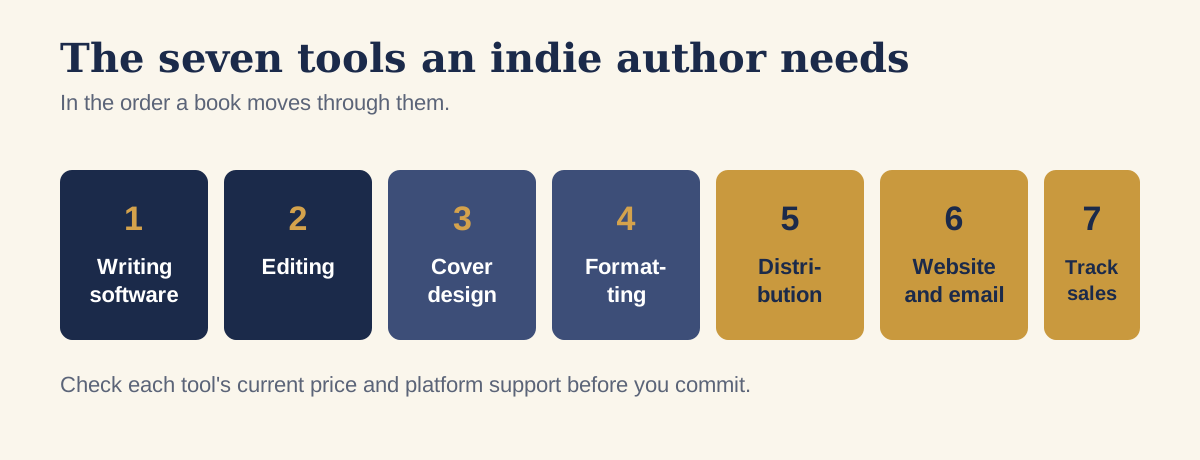
You do not need a paid tool for every group on day one. A word processor or a writing program such as Scrivener covers the first. The formatting tools offered free by KDP and Draft2Digital cover the fourth. The ones people tend to underbuild are the last two: a home for your readers that you own, and a record of what each sale cost you and where it came from. Our post on whether you need your own author website covers the sixth, and the one on what the whole stack costs adds the monthly bills.
Prices and platform support for software change often, so check each tool's own page before you buy.
Formatting and covers: what readers judge in seconds
A reader decides whether to look at a book from its cover, its title and the first lines of its description, before they have any other evidence. The cover has one job, which is to tell the right reader what kind of book this is. A cover that looks like a different genre attracts the wrong people and puts off the right ones.
Look at the covers of the bestselling books in your category and note what they share: the typography, the colours, how the title and author name are placed, and whether they use illustration or photography. You are not copying a cover. You are learning what your readers already recognise as belonging to the genre.
Formatting is where a book looks either professional or home-made. Check that the chapter headings are consistent, the paragraphs have normal indents and spacing, there are no stray line breaks, and the ebook reflows properly on a small screen. Always read a proof of the print edition before you approve it, because problems that are invisible on a screen show on paper.
Where to publish: Amazon, other stores or your own shop
You have three choices, and they are not exclusive. You can sell through Amazon KDP, you can distribute to other retailers such as Kobo, Apple Books and Google Play, and you can sell direct from your own website.
KDP offers an exclusivity programme called KDP Select. Enrolment is a 90-day term on a single ebook, it renews automatically unless you switch that off, and it stops you selling that ebook anywhere else for the term. Whether it pays depends on the book and the genre, and you can decide book by book. Our post on KDP Select or going wide shows how to run the numbers, and the one on selling direct while you are in KDP Select explains exactly what the exclusivity covers.
Selling direct changes the arithmetic. On your own store you keep the price minus payment processing, which is closer to 90 percent than 70 percent, and you keep the customer's email address. In exchange you take on delivery, tax and support. Three of our posts cover the practical side: what you keep on a £4.99 ebook sold direct, how readers get a direct ebook onto their Kindle and VAT and sales tax on ebooks you sell yourself. If you plan to post paperbacks to the EU, read the GPSR guide for indie authors first.
How to price your book
Pricing is mostly arithmetic, and the royalty bands set the shape of it. KDP pays 70 percent on ebooks priced from $2.99 to $12.99 in its US store, after Amazon raised the old $9.99 ceiling on 7 July 2026. Outside that band the royalty is 35 percent. The 70 percent option also deducts a delivery fee based on the size of your file, $0.15 per megabyte in the US store, so an image-heavy book keeps less per sale than a plain novel.
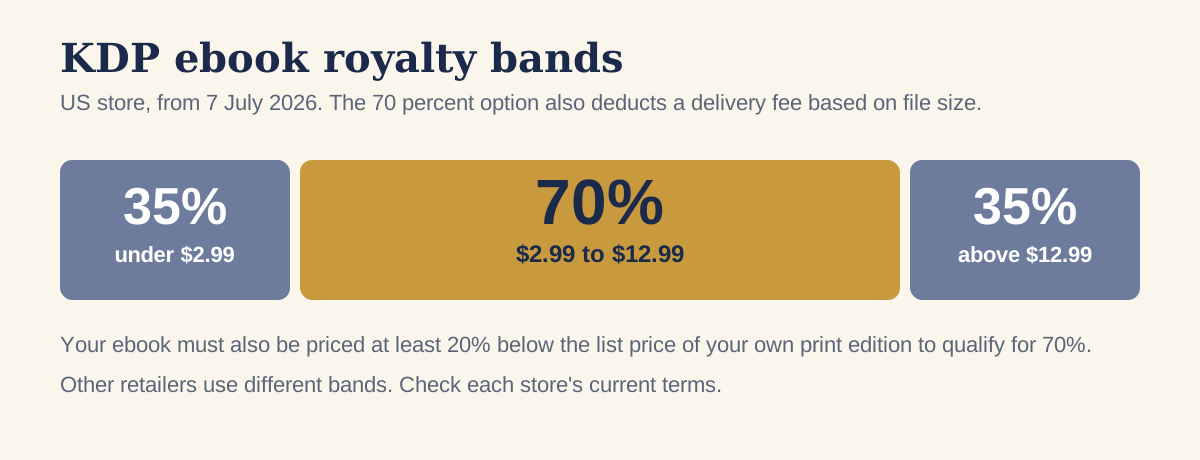
Two rules catch authors out. To qualify for 70 percent, your ebook list price has to sit at least 20 percent below the list price of your own print edition. And other retailers use different bands: Apple Books pays 70 percent at every price, and Kobo's 70 percent band starts at $2.99, so check each store's current terms before you set a price there. For worked examples and a pricing method, read how to price your book, and read which books to reprice after the July 2026 change if you already have titles listed above $9.99.
How to research your readers before you publish
Research should tell you who the book is for and where those readers already are, and it cannot tell you what will sell. Anyone who claims it can is guessing.
Start with five to ten books that readers of your genre already love and that are close to yours. Read their descriptions, their covers, their categories and their reader reviews, and write down the words readers use when they praise or criticise them. Those words belong in your own description. Then find where those readers gather: the retailers' category lists, genre forums, reading groups and newsletters. You are looking for a place to join in, and not a place to advertise.
You will often hear that you need an author platform before you publish, meaning a following. A following helps, but it is not a precondition. A small list of people who asked to hear from you is worth more than a large audience that does not know your name, and our guide to getting your first 100 email subscribers shows where a first list comes from.
How to market a self-published book with no budget
Free marketing costs time and not money, and it works best when you pick two or three activities and keep doing them. These are the ones authors use most:
- Build an email list from the back of the book and from a reader magnet, because it is the one channel you own.
- Trade newsletter features with authors who write for similar readers, and join group promotions where the rules allow it.
- Ask for honest reviews from early readers, within the retailer's rules on free copies and disclosure.
- Prepare a one-page author press kit so that podcasts, bloggers and bookshops can feature you in a single reply.
- Show up where your readers already talk, as a reader first and an author second.
Our post on the ten most important things to do after writing the book puts these in an order that connects with readers before it asks them for anything.
Should you pay someone to market your book? How to avoid predatory services
You can hire help with marketing, and some freelancers and agencies do honest work. The difficulty is that prices and quality vary widely and the sector attracts companies that sell expensive packages with little to show for them. Ask any provider for a written scope, samples of earlier work, the names of authors you can contact, a plain statement of who owns the rights and the material, and what you receive if the result is poor.
Two independent watchdogs publish warnings. The Alliance of Independent Authors runs a Watchdog Desk that rates author services and publishes advisories, and Writer Beware, founded in 1998 and sponsored by the Science Fiction and Fantasy Writers Association, tracks predatory practices aimed at writers. Neither list is a complete safety check, and a company missing from both is not automatically trustworthy, so treat them as a starting point for your own questions.
Social media and TikTok for authors
Whether social media helps depends on whether your readers are on a platform and on whether you will keep posting there. No one can promise a result from any platform, so choose one that you enjoy using and give it a fair run before you judge it.
TikTok suits authors who are comfortable making short videos, and the genres that already have an active community there are the ones most likely to reward it. If the idea of filming yourself puts you off, a platform built around text or images is a better use of your effort. In every case the profile link should lead to one place, your sign-up page, so that attention turns into an address you can use later.
Why your book is not selling, and how long sales take
Nobody can give you a dependable timeline for sales after publishing, because it depends on the book, the genre, your existing readers and how much promotion you do. What you can do is find where readers are dropping out. A book has to be seen, clicked, bought and finished, and the first stage that leaks is the one to fix.
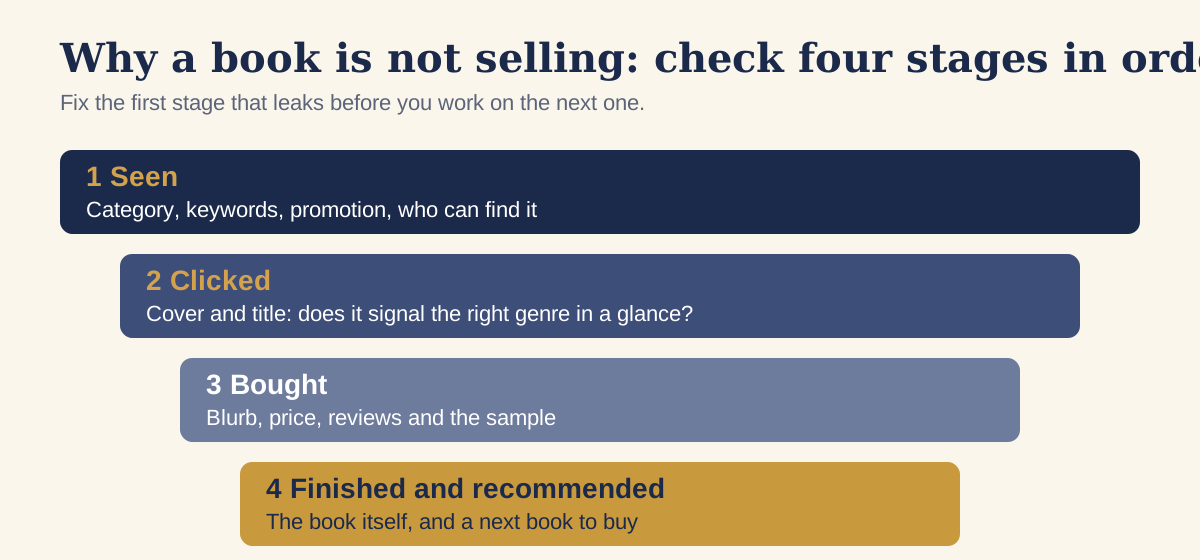
If few people see the book, look at your categories, your keywords and how many readers you have told. If people see it and do not click, the cover and title are the likely cause. If they click and do not buy, look at the description, the price, the reviews and the sample. If they buy and do not finish or recommend, the book itself or the lack of a next book is the issue. Change one thing at a time and give each change time to show, or you will not know which one worked.
How to track sales and return on investment
You cannot judge what works without a record. For each book, keep the units sold and the royalties received each month by retailer, what you spent on the book and when, and where readers came from where you can tell. A spreadsheet is enough. The return on a cost is the royalties it helped to earn, less the cost, and for most one-off costs such as a cover you measure it over the life of the book and not in one month.
Advertising needs more care than any other spend, because it is easy to keep paying without checking what it returns. Amazon Ads lets you run a campaign on about £1 a day, so you can test cheaply, but set a limit and review the results before you raise it.
How much money can you make?
The reliable answer is that you can model it but not predict it. The Alliance of Independent Authors commissioned a University of Glasgow analysis that found a median revenue of US$12,749 for 2022, against a mean of US$82,607, because a small number of very high earners lifts the average far above what most authors earn. A median describes the typical author far better than a mean does. Our post on how much a self-published author makes gives the survey results in full and a way to model your own earnings.
The arithmetic of one sale is more useful than a survey. Multiply the price by the royalty rate, subtract any delivery fee, and multiply by the copies you expect to sell. Then ask whether that is a realistic number of copies for your readers and your budget. That is a forecast of your own business, and it makes no promise of income.
Mistakes first-time self-publishers make
- Publishing without an outside edit, then paying later in reviews.
- Choosing a cover that signals the wrong genre.
- Pricing outside the royalty band by accident and losing half the royalty.
- Starting to look for readers on launch day, instead of weeks before.
- Having no way to contact readers who liked the book.
- Spending on advertising without tracking what it returns.
- Judging the book on the first month of sales.
Where the Toolchest fits
The Indie Author Toolchest is a membership for authors who want the business side in one place. It includes a personal author site, selling ebooks and paperbacks direct, a mailing list, free-download pages and tools for advance reader copies, a press kit, and sales and subscriber reports. It costs $12.99 a month or $120 a year, with a 14-day free trial, so you can see whether it suits the way you work. You can read more on the Indie Author Toolchest page.
Questions, answered
How do I self-publish a book for free?
Uploading to KDP, Kobo Writing Life, Draft2Digital and Apple Books costs nothing, and the free formatting tools those services offer will produce a usable file. The costs you cannot avoid for a good result are editing and a cover, and you can reduce them by using beta readers and a premade cover.
How long does it take to self-publish a book?
The upload and review stage is short, since KDP review usually takes up to 72 hours, so the time is spent on revising, editing, the cover and your launch preparation. You set the timetable yourself, which is one of the main differences from traditional publishing.
Do I need an ISBN to self-publish?
You can publish ebooks and print books on KDP with the identifiers the platform provides. Authors who want their own imprint and the freedom to use the same number across retailers buy their own ISBNs, and a block of ten is much cheaper per number than a single one.
Should I use KDP Select or go wide?
It depends on the book. Select is a 90-day exclusive on one ebook, and going wide means selling through other retailers and your own shop. You can decide book by book, and our guide to KDP Select and going wide shows how to test it.
How much should I charge for my self-published book?
Start from the royalty bands and the cost of printing, then narrow the range to two or three prices and test them. Ebooks priced from $2.99 to $12.99 earn 70 percent on Amazon's US store, and the right point inside that band depends on your genre and your place in a series.
Run it all from one place
Author page, direct sales, reader list, review copies and press kit, built from one ASIN. Free for 14 days, no card.
Start your free trial