
Indie Author Academy / Lessons
How to write a book blurb: structure and templates
Learn how to write a book blurb that converts browsers into readers, with fiction and non-fiction templates, Amazon KDP HTML formatting and real examples.
A reader clicks your book cover because the genre looks right. They buy the book because the blurb confirms the promise in twenty seconds. Learning how to write a book blurb cleanly is one of the highest-return skills in self-publishing because the same 180 words sell your book on Amazon, Apple Books, Kobo, your paperback back cover and your own author website.
Most struggling descriptions fail for one simple reason: the author writes a mini-plot summary instead of a decision aid. A reader browsing on a phone wants to know three things fast: whose story this is (or what problem this solves), what goes wrong, and what emotional experience they will get if they buy today. This guide sets out repeatable templates for both fiction and non-fiction, grounded in the current Amazon KDP book description HTML guidelines and KDP book details documentation as of November 2026.
Why the first 250 characters do most of the work
On Amazon product pages, both desktop and mobile storefronts collapse your book description behind a Read more toggle after roughly 250 to 300 characters. If your opening two lines spend space on backstory, historical world-building or a polite explanation of why you wrote the book, half your browsers never click Read more at all.
Start with a single bold hook line that establishes the core conflict or reader promise before the fold. In fiction, that means naming the irony, danger or central dilemma immediately. In non-fiction, that means naming the exact problem the reader wants solved and the concrete outcome waiting inside the chapters.
Read your opening 250 characters aloud on your phone screen before you publish. If a stranger in your target genre would immediately recognise the tone and stakes from those two lines alone, the rest of the blurb has room to work.
The four-part fiction book blurb formula
Across crime, romance, fantasy, thrillers and commercial fiction, strong book blurbs follow a tight four-part rhythm totalling 150 to 200 words. Keeping paragraphs to two or three lines makes the description effortless to scan on a phone.
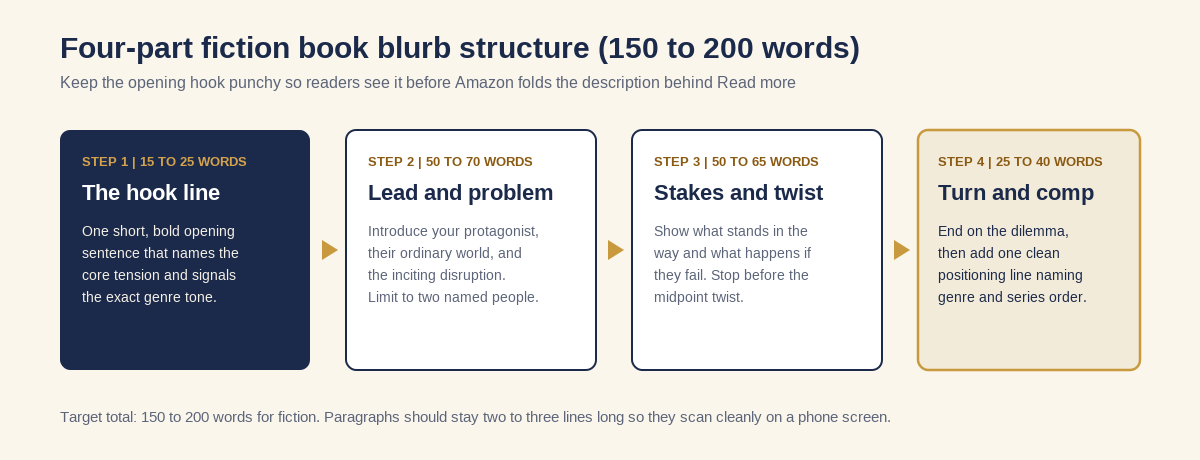
- The hook line (15 to 25 words): One short, bold sentence that captures the premise and tone. Example for a cosy mystery: A luxury cruise across the Mediterranean should mean sunshine and scones, until the ship's most disliked guest vanishes before dinner.
- Lead character and inciting problem (50 to 70 words): Introduce one protagonist (or two leads in romance), anchor them in their ordinary role, and show the specific event that disrupts their plans. Resist naming four secondary characters, three towns and a royal lineage; readers forget extra proper nouns immediately.
- Raising the stakes and the obstacle (50 to 65 words): Explain why the character cannot walk away, what stands in their path, and what happens if they fail. Stop cleanly before the midpoint twist so you preserve surprise for the actual novel.
- Final turn and genre signpost (25 to 40 words): Close on the central dilemma or ticking clock, followed by one calm positioning line naming the subgenre, tone and whether the book stands alone or starts a series.
Fiction book blurb template
Use the skeleton below as a first draft, then tighten every clause until no word feels decorative:
- Hook: [One bold sentence naming the central contradiction, threat or unexpected twist of the premise.]
- Setup: [Protagonist name], a [brief defining role], only wanted [ordinary goal]. When [inciting event happens in specific setting], [protagonist] is pulled straight into [central problem].
- Stakes: With [main obstacle or antagonist pressure] closing in and [personal secret or time limit] threatening everything [he/she/they] built, [protagonist] must [difficult choice] before [concrete consequence].
- Signpost: [Book Title] is a [tone, e.g. sharp, fast-paced] [subgenre] novel featuring [two core genre tropes]. It can be read as a standalone or as book one in the [Series Name] series.
If your novel sits inside a multi-book series, tell readers plainly whether they need to read earlier books first. Clear series signposting reduces hesitation and pairs directly with the pricing approaches in series pricing: free first book, box sets and bundles.
How to structure a non-fiction book description
Non-fiction readers shop differently from fiction readers. They arrive with a specific question, skill gap or frustration, and they scan the description for evidence that your chapters contain practical answers rather than recycled generalities.
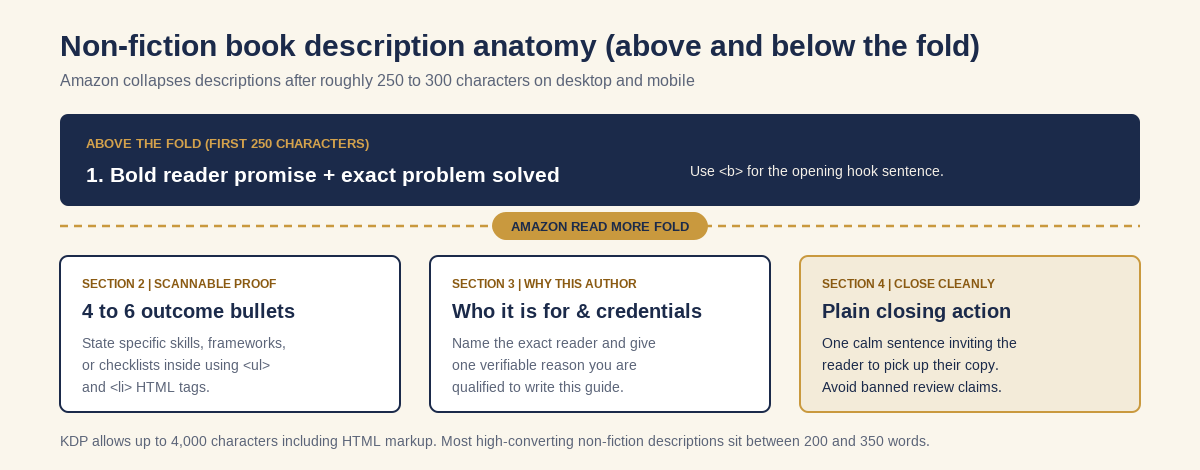
A strong non-fiction description runs 200 to 350 words across four clear blocks:
- Reader pain and promise (above the fold): Name the exact frustration in plain language and state what the reader will be able to do after finishing the book.
- Four to six outcome-led bullets: Replace vague chapter titles with concrete takeaways. Write How to calculate exact KDP and IngramSpark spine widths so print covers pass first time rather than Chapter 4: Print production.
- Who the book is for and why you wrote it: Name the specific audience (for instance, UK small business owners or first-time managers) and share one verifiable credential or body of experience that grounds the advice. Keep longer credentials on your author bio and author press kit.
- Calm closing action: End with one straightforward sentence inviting the reader to pick up the book and begin applying the framework.
Non-fiction book description template
- Opening promise: [Clear statement of the core problem and what this book helps the reader achieve.]
- Context paragraph: Most advice on [topic] leaves out [specific gap]. Written in plain English with worked examples, [Book Title] gives you a practical step-by-step path from [starting state] to [finished outcome].
- Inside this book you will learn: [Bullet 1: concrete skill or decision framework] / [Bullet 2: common costly mistake to avoid] / [Bullet 3: worked example, checklist or template included] / [Bullet 4: how to apply it in real life without extra fluff].
- Audience and proof: Designed for [specific reader group], written by [Author Name], drawing on [verifiable real-world experience].
Before and after: cutting the five blurb habits that kill sales
Comparing a weak draft against a tightened version shows how quickly small edits sharpen reader interest. Take a fictional cosy mystery draft:
| Weak draft habit | Why it loses browsers | Stronger rewrite approach |
|---|---|---|
| Starting with lore or backstory: In 1924 the harbour was built... | Wastes the 250 characters above the Amazon Read more fold. | Open on the inciting disruption happening to your lead today. |
| Listing five character names in paragraph one | Creates cognitive friction before the reader cares about anyone. | Name one lead (two in romance) and refer to others by role. |
| Rhetorical clichés: Will she survive? Nothing is as it seems! | Signals generic writing and gives zero genre-specific information. | State the concrete dilemma or ticking clock instead. |
| Praising your own book: This gripping, unforgettable masterpiece... | Readers discount self-praise immediately. | Let concrete stakes, sharp voice and verified editorial reviews speak. |
| Explaining the entire plot through chapter twenty | Kills curiosity and turns sales copy into a spoiler summary. | Stop cleanly at the central problem of Act One. |
Formatting your book description cleanly for Amazon KDP
Plain unformatted blocks of text look dense on retail pages. Amazon KDP's description box supports a focused set of HTML tags documented on KDP Help so your blurb scans comfortably across phones and tablets:
<b>...</b>for your opening hook line or short subheadings.<i>...</i>for book titles, emphasis and the closing genre signpost line.<p>...</p>for clean paragraph spacing (keep paragraphs short).<ul><li>...</li></ul>for non-fiction takeaway bullets or series reading lists.
Watch two rules that trip authors up during KDP review. First, never include raw website links, email addresses, temporary promotional prices (such as On sale for 99p this week!) or copy-pasted Amazon customer reviews inside your main book description. Second, place genuine editorial praise, podcast quotes and review pull-quotes in the dedicated Editorial Reviews box inside Amazon Author Central rather than stuffing them at the top of your KDP description.
Testing and updating your blurb after launch
Your book blurb is never carved in stone. If your cover and Amazon Ads are generating steady clicks while sales lag behind, the description is the first element to test, as explained in why isn't my book selling? Four checks and how long to wait.
Before rewriting from scratch, study the top ten independent titles in your exact Amazon category (see KDP keywords and categories). Note three details across those top descriptions: how long the opening hook is, which subgenre phrases recur naturally, and how many words the description uses overall. Then change one element at a time, give the new blurb at least two to three weeks of comparable traffic, and track conversion before deciding whether to keep the revision.
Keep your finished blurb consistent across every store and your own site so readers who follow a podcast link or newsletter click see the exact same promise everywhere. If you run your author site through the Indie Author Toolchest, pasting your ASIN or ISBN pulls your cover and blurb onto your book page automatically, and you can refine the copy from your dashboard whenever you update your positioning. Pair a crisp blurb with clear retailer links using getting your book on Apple Books, Kobo, Google Play and Barnes & Noble and your author website with one book out.
Once your draft blurb is ready, format bold hooks, subheadings and bullet lists with our free Amazon KDP book description HTML formatter.
Questions, answered
How long should a book blurb be on Amazon KDP?
Most effective fiction book blurbs run between 150 and 200 words, while non-fiction book descriptions typically work well at 200 to 350 words including bulleted takeaways. Amazon KDP accepts up to 4,000 characters including HTML tags, though readers rarely scroll through long walls of text on mobile.
What is the difference between a book blurb and a synopsis?
A synopsis summarises the whole plot from beginning to ending for an agent or editor, including every twist and the final resolution. A book blurb is sales copy written for a prospective reader: it introduces the hook, the protagonist and the central stakes, then stops well before the climax.
Which HTML tags work inside an Amazon KDP book description?
Amazon KDP supports basic formatting tags including bold, italics, paragraph breaks, line breaks, headings (h4 through h6) and bulleted or numbered lists. External links, promotional price claims, and customer review snippets inside the main description violate KDP guidelines.
Should I put reader reviews or comparison authors in my book blurb?
Amazon's own content guidelines state that book descriptions should focus on the book itself rather than customer reviews or time-sensitive pricing claims. You can place a clean genre positioning line at the bottom, and keep editorial reviews in the separate Editorial Reviews field inside Amazon Author Central.
Should my back-cover paperback blurb match my Amazon description?
Use the same core hook, stakes and positioning across both, then shorten the paperback back cover slightly so it fits comfortably above the ISBN barcode with generous white space. Online descriptions can keep a bulleted section or series reading note that would crowd a physical cover.