
Indie Author Academy / Lessons
Why isn't my book selling? Four checks and how long to wait
Why isn't my book selling? Check four stages in order: seen, clicked, bought, finished. Each has a fix and a waiting time. No one can promise a timeline.
If you are asking "why isn't my book selling", the answer sits at one of four stages: readers do not see the book, they see it and do not click, they click and do not buy, or they buy and do not finish or come back. Each stage has its own check, its own fix and its own waiting time, and the order matters because a leak early on makes every later number meaningless.
Nobody can promise you a timeline. Amazon does not publish how long a new book keeps any extra visibility, and no honest source can tell you how many weeks a particular book needs. What this article gives you is a way to find the leaking stage, change one thing, and wait long enough to judge it. All figures in the worked examples are invented for illustration and are not benchmarks.
Why isn't my book selling? Four stages to check in order
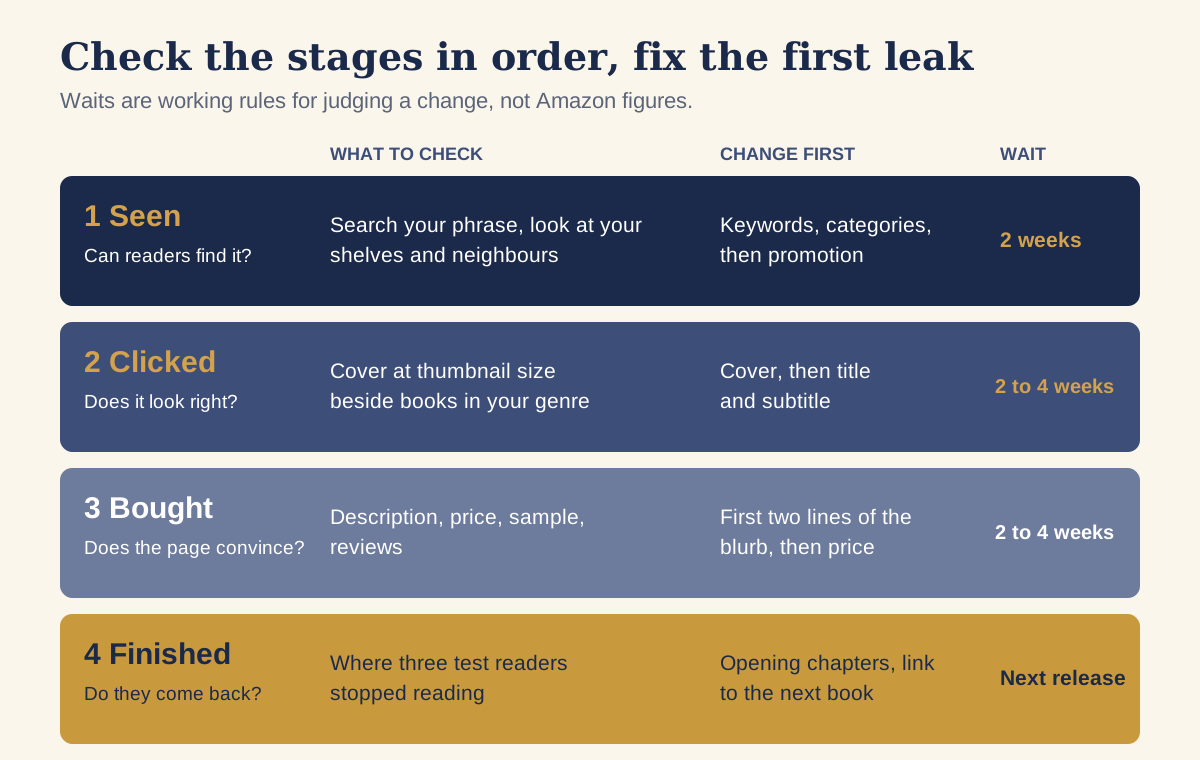
A reader has to pass four gates. The book has to be seen, which depends on categories, keywords, advertising and anything you do off Amazon. It has to be clicked, which depends on the cover and title in a small thumbnail. It has to be bought, which depends on the description, price, reviews and sample. And it has to be finished, which depends on the book itself and decides whether the reader leaves a review, reads your next book or tells a friend.
Work through them in that order. If nobody sees the book, rewriting the description cannot help, and if the cover fails, spending on ads only buys more people who scroll past. Fix the first stage that leaks, then move on.
Stage one: can readers find the book?
Start with what you control. KDP lets you enter up to seven keywords and choose three categories, and its help pages say you can change keywords as often as you like and that category changes can take up to 72 hours to appear (KDP keywords help and KDP categories help, read on 13 November 2026). KDP also says relevant keywords, along with sales history and Best Sellers Rank, can improve placement in Amazon search results.
What to check: type your main phrase into the Kindle Store search box and see whether books like yours appear. Then open your own product page and look at the categories it ranks in. If your book sits on a shelf full of unrelated books, change the categories. The method is in our guide to choosing KDP keywords and categories.
What to change: keywords and categories first, because they are free. Then consider promotion that brings readers from outside Amazon, such as an email list, which our guide to getting your first 100 subscribers covers. Amazon Ads is the paid route, and the first £100 or $100 on Amazon Ads explains what to expect from it.
How long a new book stays visible
Amazon runs New Releases and Hot New Releases lists, but the Amazon and KDP help pages I read do not say how long a book qualifies. Some third-party guides give a figure of 30 days, and others say Amazon publishes no such rule. Treat any fixed number as unconfirmed, and plan the launch so that your email list and any ads do their work in the first weeks, using the book launch checklist.
Stage two: do readers click?
A reader decides in a second or two, from a thumbnail cover, a title and perhaps a price. The check is a side-by-side test: search for your genre, put your cover among the first row of results, shrink the window until the covers are about the size of a thumbnail, and ask whether yours signals the same genre as its neighbours. Then read the title and subtitle aloud and check that they say what kind of book it is.
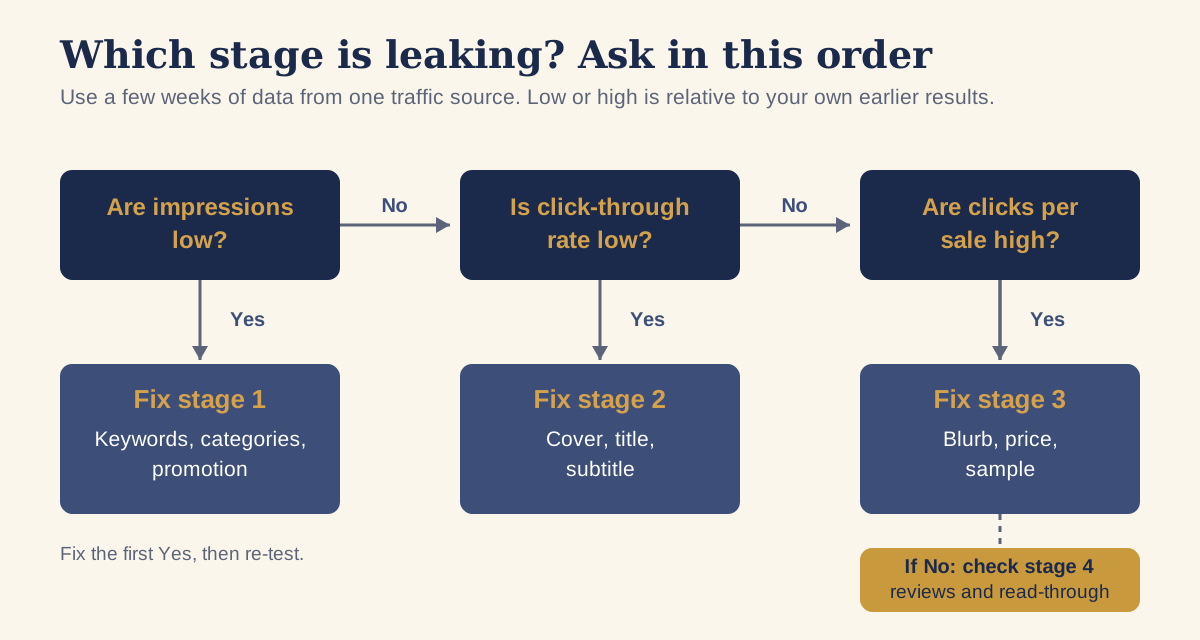
The data that tells you most is the click-through rate on an ad, which is clicks divided by impressions. A very low rate across several search terms points at the cover, the title or the price shown in results rather than at the search terms. One term performing badly proves little, because it may just be the wrong term.
What to change: the cover first, then the title or subtitle. A cover redesign is a large change, so make it only after you have compared your cover with the top sellers on your shelf.
Stage three: do readers who click then buy?
Once someone is on your product page, four things decide the sale: the description, the price, the reviews and the sample. Read your description as a stranger. Does the first line tell them who the book is for and what happens or what they will learn? Does the price sit within the range of similar books? Look at the first chapter in the Look Inside sample, because that is where many readers decide.
The signal is clicks without orders. If an ad gets plenty of clicks and almost no sales, the visitors are the right people in the wrong state of mind, or the right people being put off by the page. Our guide to pricing your book covers the price end of this.
What to change: the first two lines of the description, then the price, then the opening pages. Reviews take time to gather and cannot be forced, so do not pay for them or offer rewards in return, which Amazon does not allow.
Stage four: do readers finish and come back?
This stage is the slowest to show up. A reader who finishes a book may leave a review, buy the next book or mention it to a friend. A reader who stops at chapter three does none of those. You will see weak signals: few reviews relative to sales, little page-read activity if the book is in Kindle Unlimited, and no sales of book two after book one.
The check is to ask three readers outside your family to read the first three chapters and tell you where they stopped. Their answers tell you more than any dashboard. The usual changes are the opening chapters, the pacing of the middle and a clear way to the next book, such as a link to a free ebook in return for an email address.
What data you can actually see
The data is thinner than most authors expect. KDP Help lists these reports: Dashboard, Orders, KENP, Promotions, Pre-Order, Month-to-Date, Prior Months' Royalties, Royalties Estimator and Payments (KDP Help on ads and reports, read 13 November 2026). None of them shows how many people viewed your product page. They show what happened after the purchase, not the decision before it.
| Source | What it tells you | What it cannot tell you |
|---|---|---|
| KDP reports | Orders, units, pages read and royalties | Page views, who saw your book, why they did not buy |
| Amazon Ads console | Sales and KENP attributed to clicks within 14 days, plus the cost of those clicks | Sales that were not clicks on your ads |
| Amazon product page | Best Sellers Rank, categories, review count | How many copies each rank means |
| Your own email list or site | Opens, clicks and sign-ups you generate yourself | Anything that happens on Amazon |
The two KDP help pages on ads give different details about what appears in ad reports. One says the Ads account estimates KENP pages from borrowers, and the other says campaign metrics do not include Kindle Unlimited royalties generated by the ad. Check what your own console shows before you rely on it. The Amazon Ads search term report, described in a Vappingo guide, lists the queries that triggered your ads, with impressions, clicks, spend and orders for each.
How long to wait before you judge a change
Some waits come from the platforms and are documented. Others are working rules of mine that depend on volume, and you should treat them as judgement rather than fact.
| Change | Documented delay | Sensible wait before judging |
|---|---|---|
| Categories | Up to 72 hours to appear (KDP Help) | Check it appeared, then give it at least 2 weeks |
| Keywords, description | Changed whenever you like, then republished | 2 to 4 weeks of normal traffic |
| Amazon Ads campaign | Sales can take up to 14 days to appear; edits take 3 to 14 days to show | 2 to 3 weeks of spend, then read it all at once |
| Cover or title | Changes to book details can take up to 3 days to show | 2 to 4 weeks, with a similar traffic source throughout |
| Royalties and payments | Payments arrive 60 days after the end of the sales month | Judge on sales reports, not on money received |
The documented delays come from KDP Help on advertising reports, the reports page and the categories page. Amazon's own guide to Sponsored Products advises waiting about two weeks after launch before moving to more advanced bidding. If a book sells a handful of copies a month, even four weeks may be too short to see a pattern, so a lack of movement is not proof that the change failed.
A worked example with illustrative numbers
These numbers are invented to show the reasoning. They are not averages and they are not targets. Two authors run a test campaign for three weeks on an ebook priced at £3.99.
| Illustrative figure | Author A | Author B |
|---|---|---|
| Ad impressions | 20,000 | 6,000 |
| Clicks | 14 | 90 |
| Click-through rate (clicks divided by impressions) | 0.07% | 1.5% |
| Sales from those clicks | 2 | 1 |
| Clicks per sale | 7 | 90 |
Author A is seen a lot, clicked rarely and converts the few who click. The leak is stage two, so the cover and title are the first thing to change. Author B is seen less, clicked often and converts almost nobody. The leak is stage three, so the description, price and sample are the first thing to change. Two authors with the same sales total need opposite fixes, which is why guessing at a fix is so expensive.
Change one thing at a time and keep a log
If you change the cover, the price and the keywords in one week, you cannot tell which one moved the numbers. Change one thing, write it down with the date, note the figure you expect it to move, wait the period in the table above, then record what happened. A plain table in a spreadsheet is enough.
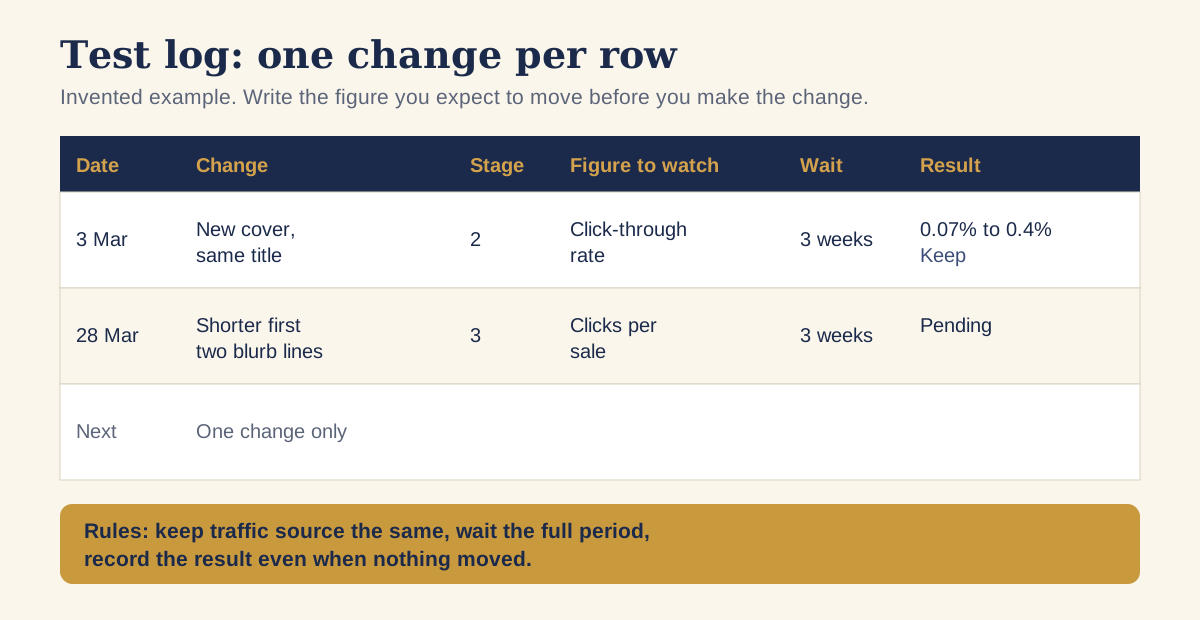
A pause is also an acceptable result. If a change makes no difference after a fair wait, the log tells you that stage is probably not the problem, and you can move to the next one without wondering whether you gave it enough time. Keep the same traffic source while you test, because a burst of readers from an email send will make any change look better than it was.
Finally, accept that some books are simply in a crowded or small market. Our guide to researching your book's market covers how to judge that before you spend more, and tracking your sales and return on investment shows how to tell whether the next change is worth paying for.
Questions, answered
Why isn't my book selling even though I have good reviews?
Reviews help at the buying stage, but they cannot help if readers never see the book or never click it. Check whether the problem is visibility or the cover and title first, then look at the description, price and sample.
How long should I wait before changing my book's cover or price?
Give a change two to four weeks of normal traffic if the book sells steadily, and longer if it sells only a few copies a month. Amazon Ads data alone can take up to 14 days to appear, so judge a campaign on a few weeks of spend read at once.
Does a new book get extra visibility on Amazon?
Amazon runs New Releases lists, but the KDP and Amazon help pages checked on 13 November 2026 do not state how long a book qualifies. Some third-party guides say 30 days, and others say no such rule is published, so treat any fixed window as unconfirmed.
Can KDP show me how many people viewed my book page?
The reports KDP Help lists show orders, pages read and royalties, not page views. Ad impressions and clicks come from the Amazon Ads console, and only for traffic your ads generated.
Should I stop writing and just market the book?
Nobody can say that for your book. If your diagnosis points to a stage you can fix cheaply, such as categories, keywords or a description, fix it first, then decide whether further marketing spend is likely to pay back.
Run it all from one place
Author page, direct sales, reader list, review copies and press kit, built from one ASIN. Free for 14 days, no card.
Start your free trial