
Indie Author Academy / Lessons
EU VAT one stop shop ebooks: a UK author's guide
EU VAT one stop shop ebooks guide: how a UK author sells direct to EU readers, with non-Union registration, returns, records and a worked example.
EU VAT one stop shop ebooks sales work like this for a UK-based author: the One Stop Shop (OSS) lets you register in one EU country, charge each reader their own country's VAT rate, and file one quarterly return instead of registering in every country. If you sell direct to EU readers, a UK seller uses the non-Union scheme. The EUR 10,000 distance-sales threshold does not help you, and sales through Amazon, Kobo or Apple need none of this.
This is guidance and not tax advice. The rules and rates below were read on the European Commission's and GOV.UK's pages on 13 November 2026, and they change. Check the official pages before you register, and ask an accountant who handles EU VAT if your sales are more than occasional.
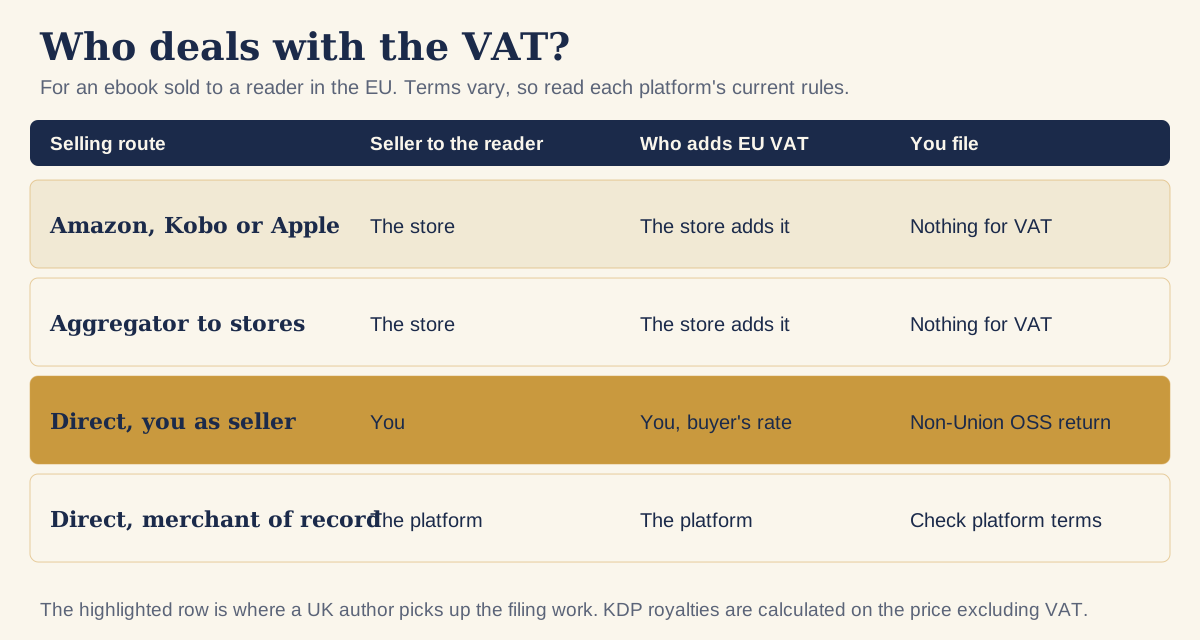
EU VAT one stop shop ebooks: when VAT follows the buyer
VAT on an ebook follows the reader. GOV.UK says the place of supply of digital services to a consumer is where the consumer is located, and its list of electronically supplied services names e-books and digitised documents such as PDFs. Physical books are excluded. So a download bought by a reader in Dublin is taxed under Irish rules, and one bought in Dortmund under German rules, whatever your own location.
The UK is different. UK ebooks are zero-rated, as our article on VAT and sales tax on ebooks you sell from your own site explains, so a UK reader pays no VAT on your ebook. EU readers are a separate matter, and zero-rated UK sales still count towards the UK registration threshold. That article covers the UK and US sides, so this one stays on the EU.
What are the Union and non-Union OSS schemes?
The Commission's OSS pages describe three optional schemes: the Union scheme, the non-Union scheme and the import scheme. They let a business declare and pay VAT through one member state instead of registering in each country of consumption.
- The Union scheme is for businesses established in the EU.
- The non-Union scheme is for businesses established outside the EU with no fixed establishment there. A UK-based author falls here.
- The import scheme covers distance sales of low-value goods, up to EUR 150 a consignment, and does not apply to ebooks.
Being VAT-registered somewhere in the EU for other reasons does not stop you using the non-Union scheme, per the Commission's page. The scheme is optional, but the alternative is registering for VAT in every EU country where you make a sale. GOV.UK states the same two options for UK businesses: register for the non-Union scheme in an EU member state, or register in each state where you supply consumers. Its page still uses the older name VAT MOSS, which the OSS replaced in July 2021.
Does the EUR 10,000 threshold help a UK seller?
No. The Commission's OSS page says the old distance-sales thresholds were replaced by a single EU-wide threshold of EUR 10,000. Below it, supplies of electronic services and distance sales of goods may remain subject to VAT in the member state where the taxable person is established. That wording refers to a seller established in the EU, so it covers an author based in France or Ireland and not one based in Manchester.
The Commission's page does not spell out the position for a non-EU seller in one sentence, so I am drawing the conclusion from its wording and from third-party VAT sources that say non-EU suppliers have no such threshold. That matches the earlier Academy article, which says UK sellers face a liability from the first sale. Confirm this with an adviser if you are close to the line.
How do you register for the non-Union scheme?
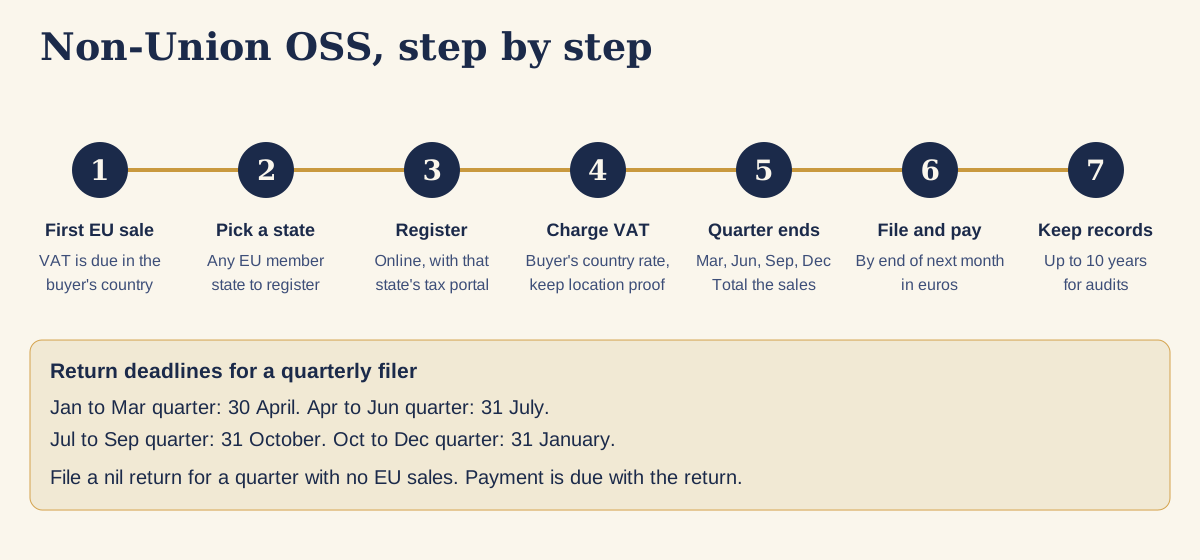
You register in one member state of your choice, called the member state of identification. The Commission's registration page says a non-EU business can choose any member state, applies electronically through that state's portal, and receives an individual VAT number in the format EUxxxyyyyyz, which only works for non-Union scheme supplies.
The timing rule matters for a first sale. Registration normally starts on the first day of the calendar quarter after you tell the member state you want to use the scheme. If you have already made an EU sale, the scheme can start on the date of that first supply, but only if you notify the member state by the tenth day of the following month. If you miss that, you must register and account for VAT directly in each country where you sold. A non-Union business can change its member state of identification, effective at the end of a calendar quarter.
What are the return deadlines and how do you pay?
The non-Union scheme return is quarterly. The Commission's page says returns are due by the end of the month following the tax period, which gives 30 April, 31 July, 31 October and 31 January. Pay when you submit the return, and no later than the deadline. The OSS return is in addition to your normal UK VAT returns if you are registered here, and does not replace them.
Returns are made in a single currency, which is the euro unless the member state of identification requires its own. Sales in other currencies are converted at the European Central Bank rate on the last day of the period. If you made no EU sales in a quarter, you must still file a nil return. The member state sends a reminder ten days after a missed deadline, and three consecutive reminders that go unanswered for ten days each can lead to exclusion from the scheme. Penalties for late filing are set by the country of consumption under its own rules.
How long must you keep records?
Your Europe, the EU's business portal, says you will need to keep your records for up to 10 years in case of audits. For each sale, keep the date, the buyer's country, the rate applied, the amount and the evidence of where the reader is, such as the billing country and the IP address your checkout recorded. The detailed OSS record-keeping page returned an error when I tried to open it, so confirm the exact list of required fields there before you rely on this one.
A spreadsheet export from your checkout is enough for most small sellers, as long as it carries the buyer's country and the VAT charged on every row.
Worked example: a 9.99 euro ebook
This is arithmetic, not advice. The rate you apply is the buyer's country rate for ebooks, and you must check it. Eurofiscalis lists Germany's standard rate at 19% and its reduced rate at 7% as of 28 September 2026, but says national book classifications vary too much for a single table to stay reliable. Our earlier article reports 7% for German ebooks, so confirm that with the German tax authority.
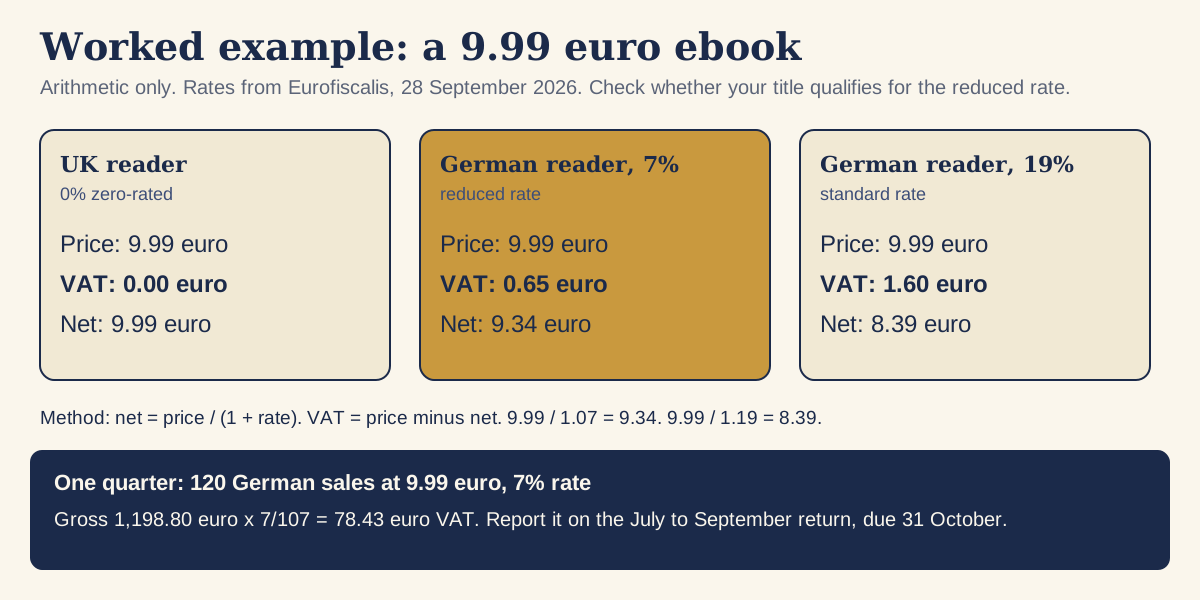
If your price of 9.99 euro includes VAT, the net price is the price divided by one plus the rate. At 7% that is 9.99 divided by 1.07, which is 9.34 euro, so the VAT is 0.65 euro. At 19% it is 9.99 divided by 1.19, which is 8.39 euro, so the VAT is 1.60 euro. The gap between those two rates is 0.95 euro per sale, which is why you must not assume the rate.
Now take 120 German sales in the July to September quarter at 9.99 euro each, taxed at 7%. Gross sales are 1,198.80 euro. VAT is 1,198.80 times 7 over 107, which is 78.43 euro. You would report that on the quarterly return and pay it by 31 October. Real returns break sales down by country and rate, so you would run the same sum for each country.
What do KDP and other marketplaces handle for you?
When a reader buys through a store, the store is the seller, and VAT is part of the price they pay. KDP Help says the customer's price includes VAT at the rate for their country of residence, and that your royalty is calculated on the list price exclusive of VAT. You do not file VAT for those sales, which is why our guide to KDP royalties lists no tax step. The same logic applies when an aggregator sends your book to stores, as in the comparison of IngramSpark, KDP and the ebook platforms. Check each vendor's terms for the exact wording, because I read only KDP's.
Direct sales are the exception. On a site you run yourself, you are the seller. On Indie Author Toolchest, for example, the author is the seller of record for ebooks, so the tax position is the author's own. The article on what you keep on a $4.99 ebook sold direct shows the fee side, and getting a direct-sold ebook onto Kindle covers the delivery side.
What changes with a merchant of record?
A merchant of record is a payment platform that becomes the seller to your reader. It charges the VAT, files it and pays it, and you receive a payout. Payhip's help page, for example, says it takes care of EU VAT issues for customers in the EU, and its example charges a 5% fee on the price. Payhip's current fees and scope may differ from that page, so read its tax help before choosing. This removes your OSS registration for those sales, which is the trade for the higher percentage. It does not remove your own income tax reporting, and it does not help with sales you make outside that platform.
A checklist before your first EU sale
- Decide whether you will sell direct to EU readers at all, or let stores handle it.
- If direct, choose a checkout that applies the buyer's country rate and records the country.
- Register for the non-Union scheme in one EU state before or as you make the first sale, and note the tenth-of-the-month rule.
- Diarise 30 April, 31 July, 31 October and 31 January.
- Keep sales records for up to 10 years.
Read the Commission's pages on the One Stop Shop, registration and declaring and paying, and GOV.UK's guidance on VAT rules for digital services to consumers, before you act.
Questions, answered
Do I need to charge EU VAT on ebooks I sell from my own site?
Yes, if you sell to consumers in the EU. VAT on digital services follows the buyer's location, and as a UK seller the EUR 10,000 threshold does not apply to you. Sales through Amazon, Kobo or Apple are handled by the store.
Which OSS scheme should a UK author use?
The non-Union scheme, which the European Commission describes as being for businesses established outside the EU with no fixed establishment there. You register in one EU member state of your choice and file quarterly. GOV.UK gives the alternative as registering in each country you sell to.
When are OSS returns due?
Quarterly returns are due by the end of the month after the quarter, so 30 April, 31 July, 31 October and 31 January. Payment is due with the return, in euro. File a nil return if you had no EU sales.
How long do I keep EU VAT records?
Your Europe, the EU business portal, says up to 10 years in case of audits. Keep the date, buyer's country, rate and VAT charged for each sale, with evidence of the buyer's location.
Does a merchant of record remove my EU VAT work?
For sales through it, yes, because the platform becomes the seller, charges the VAT and files it. You pay for that through its fee, and it does not cover sales you make elsewhere. Read the platform's current tax terms before relying on it.
Run it all from one place
Author page, direct sales, reader list, review copies and press kit, built from one ASIN. Free for 14 days, no card.
Start your free trial