
Indie Author Academy / Lessons
Book market research: how to find your readers before launch
Book market research in five steps: pick ten comparison books, read reviews, choose categories and keywords, judge demand honestly, find where readers gather.
Book market research means finding out who already buys books like yours, what they praise and complain about, and which words they use to look for them. You do it by reading ten comparison books closely, not by counting how many copies a genre sells. The result is a shortlist of categories and keywords, a one-sentence promise for your book and a list of places where your readers already gather.
It works before you write, when it shapes the book, and after you write, when it shapes the cover, description and launch. No research can tell you what will sell, and this guide does not claim to. It shows you what to look at, what the evidence can and cannot tell you, and where to stop.
The book market research method in five steps
The method moves from broad to specific, and each step produces something you write down. If a step produces nothing, you have not finished it.
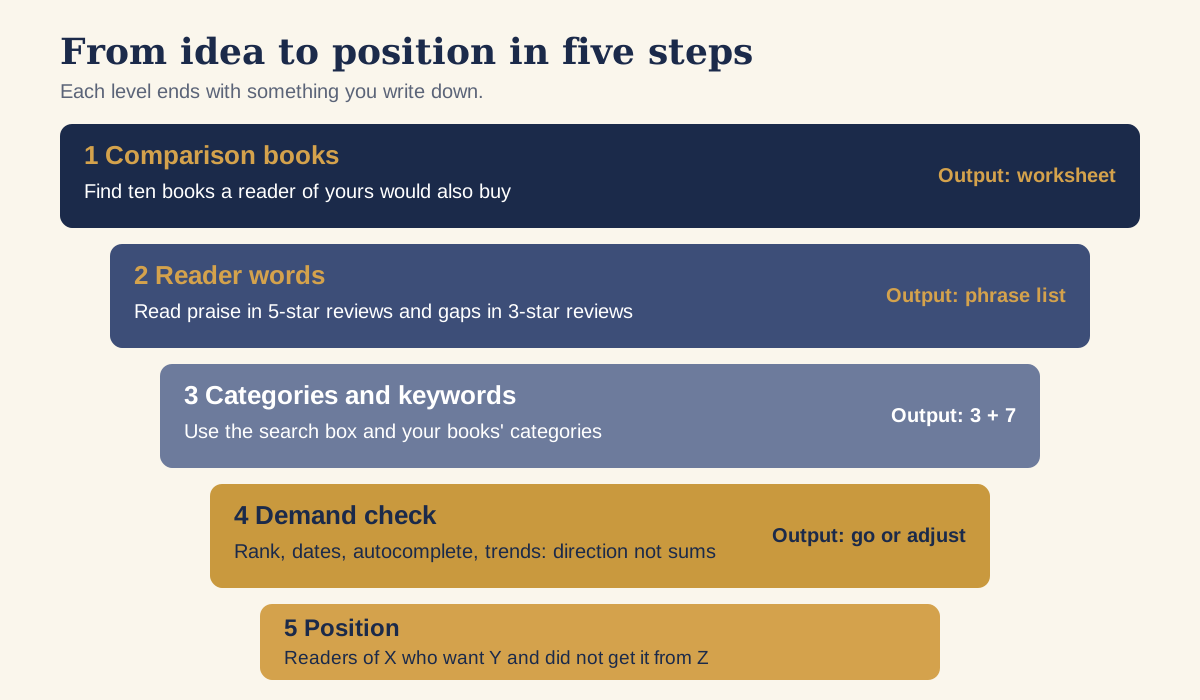
- Find ten comparison books and fill in a worksheet.
- Read what readers praise and criticise in their reviews.
- Choose categories and keywords from the books and the search box.
- Judge demand with the evidence you can see.
- Find where those readers gather.
How to find comparison books
A comparison book is one a reader of yours would also buy. Start with books you have read yourself in your genre or topic, then widen. Search the Kindle Store for the phrase a reader would type, look at the related books Amazon shows on each good match, and note the books that keep appearing. Look at the Best Sellers lists of the categories those books sit in, and at Goodreads lists for the same genre.
Aim for ten books and mix three types: two or three recent successes, a few steady performers from the last several years, and a couple of books that came out in the last year. Recent books show what readers want now. Older steady books show what lasts.
Avoid comparison books that are far outside your reach, such as a household-name author's latest release. A reader of that book is not necessarily looking for yours. Pick books by authors who were not famous before the book came out, because those show a path a new author could follow.
The comparison-book worksheet
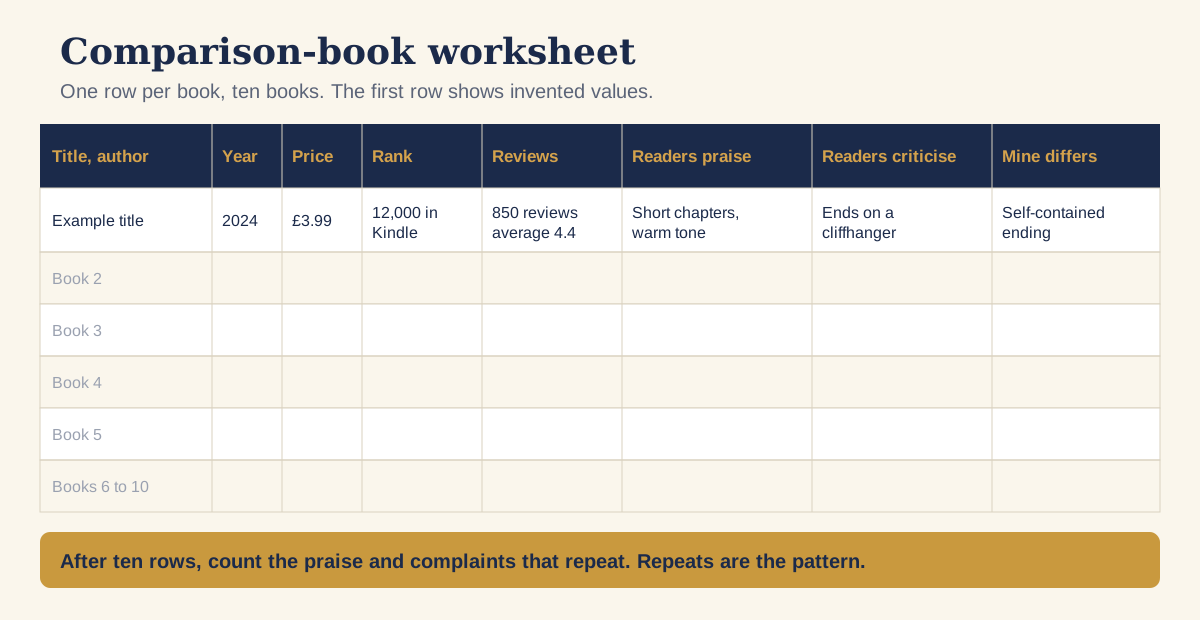
Copy this into a spreadsheet and fill in one row per book. The example row below is invented.
| Title and author | Published | Price | Best Sellers Rank | Review count and average | Readers praise | Readers criticise | Where mine differs |
|---|---|---|---|---|---|---|---|
| Example title, example author | 2024 | £3.99 | 12,000 in Kindle Store | 850 reviews, 4.4 | Short chapters, warm tone | Ends on a cliffhanger | Self-contained ending |
What readers praise and criticise
Reviews are the cheapest research available, because they are readers describing the book in their own words. Read the five-star reviews of each comparison book for what readers say they loved. Read the three-star and two-star reviews for what they wanted and did not get, since these often name a gap you can fill.
Copy phrases verbatim into a "reader words" column. If four readers write "a cosy read I could not put down" and none write "an immersive literary experience", you now know which language belongs in your description. These phrases also become keyword candidates in the next step.
Treat each review as one person's view, and read enough to see a pattern. A complaint that appears once is a taste. A complaint that appears in a fifth of the three-star reviews across several books is a pattern, which is a gap in the market. Count roughly, write the count, and be honest about how small the sample is.
How to choose categories and keywords from your research
KDP currently lets you choose three categories and enter up to seven keywords, and you can change keywords as often as you like (KDP categories help and KDP keywords help, both read on 13 November 2026). Category changes can take up to 72 hours to appear. KDP Support will not recommend categories for you, and KDP says keywords should describe the book and match the words customers use when searching, which is exactly what your reader-words column holds.
KDP advises typing your planned keywords into the Amazon search box and reading the drop-down suggestions before you publish. It also says keywords, along with sales history and Best Sellers Rank, can improve where your book appears in search. Your worksheet already shows which categories your comparison books rank in, because those appear in each product page's Product details. Pick the ones where your cover and description would look at home.
The full selection method, with a worked example, is in our guide to choosing KDP keywords and categories. Do not put another author's name in a keyword: the KDP Metadata Guidelines list references to other authors as prohibited keywords.
How to judge demand honestly
Demand is the hardest part to judge and the easiest to fool yourself about. The product page shows a Best Sellers Rank and a review count. It does not show copies sold, and Amazon does not publish how a rank converts into sales, so any copies-per-day figure you see quoted is an estimate from someone's model. Use the evidence for direction, not for arithmetic.
| What you can see | What it suggests | What it cannot tell you |
|---|---|---|
| Several comparison books by non-famous authors, ranked well in their categories | Readers are buying this kind of book from authors like you | How many copies, or whether they would buy yours |
| Recent publication dates among the top books in a category | New entrants can get in | How hard each one worked to get there |
| Autocomplete suggestions in the Amazon search box | People type these phrases | How many people, or how often |
| Rising or steady interest on Google Trends | Relative search interest in a topic over time | Whether those searchers want a book |
| Only famous authors in every top slot | New authors may find it harder to get seen | That nobody else could break in |
Google Trends, at trends.google.com, shows relative search interest over time and in different regions, not absolute numbers. Use it to compare two topic phrases, or to see whether a subject is seasonal. A topic with no obvious demand is not automatically a bad idea, but it means the book will need more effort to reach readers, which you should know before you commit.
A paid tool, and what it costs
Publisher Rocket is a desktop tool that suggests Amazon keywords and categories and shows competition data. On its own website on 13 November 2026 it was listed at $199 as a one-time payment, marked down from $299, with a note that it may become an annual subscription. Prices drift, so check the page. You can do the same research for nothing with the Amazon search box and the product pages, only more slowly. Estimates from such tools are models, so treat them as one more input.
Where your readers gather
Readers cluster in a handful of places, and the aim is to find the two or three that fit your genre, not to be everywhere. Your comparison books are the best guide. Look up each author and see where they talk to readers, and where readers talk about them.
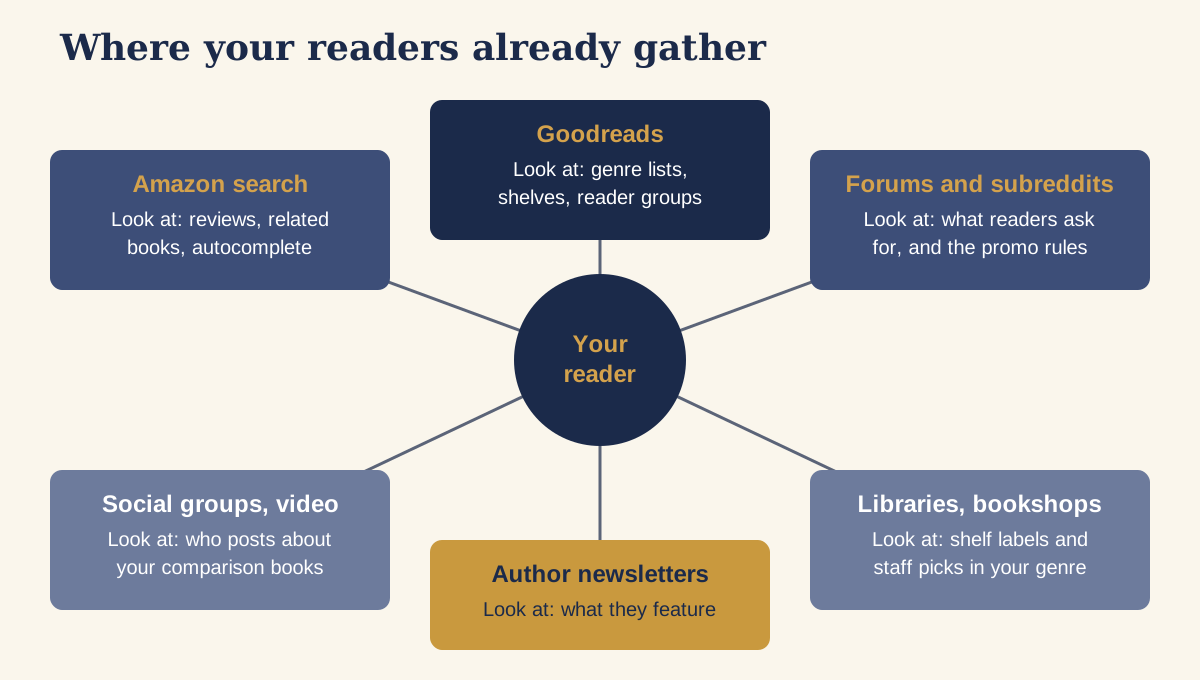
For each place, ask three questions. Are readers of books like yours talking there? Are they asking for recommendations? And do the existing members tolerate authors who join in, or do the rules ban promotion? Read the rules of any group before you post. Spend a few weeks reading and replying as a reader before you mention your own book, and never post a link to your book where self-promotion is banned.
Do you need an author platform before you publish?
No rule says you need one. KDP does not require a following, and plenty of books are published by authors with no list. The honest reason to build one is that a list of readers who asked to hear from you is the one launch audience you control, and it does not depend on a store's algorithm.
Whether it is worth doing first depends on how long before you publish. If the book is a year away, starting a list now costs little and you can follow the plan in getting your first 100 email subscribers with no ad budget. If the book is finished, build only the minimum, which is a simple page and a sign-up form. Our guide to an author website with one book out lists the six pages worth building.
Research before you write and after you write
Before you write, use the research to decide the promise of the book, its length, its tone and the questions it must answer. After you write, use it for the cover brief, the description, the price, the categories and keywords and the launch plan. Do both rounds. Markets move, and a comparison list from two years ago is out of date.
Keep the worksheet, because you will return to it when a book is not selling. The diagnosis guide, why isn't my book selling and how long to wait, uses the same comparison books to test whether your cover, price and blurb sit in the right place. Write one sentence at the end: "My book is for readers of X who want Y and did not get it from Z." If you cannot complete it, do another pass through the reviews.
Questions, answered
How do I do book market research as a self-published author?
Pick ten comparison books, read their five-star and three-star reviews for reader language and gaps, then choose categories and keywords from what you find. Finish with a one-sentence position for your book.
How do I know if there is demand for my book?
You can see direction, not sums. Look for comparison books by non-famous authors ranking well, recent books in the top lists and relevant autocomplete suggestions. Amazon does not publish copies sold, so treat any copies-per-day figure as an estimate.
How many comparison books should I use?
About ten is a workable number: a few recent successes, some steady performers from earlier years and one or two new releases. More than that rarely changes the pattern.
Do I need an author platform before I publish?
No rule says so and KDP does not require a following. A list of readers who asked to hear from you is a launch audience you control, so build one early if the book is months away.
Do I need to buy a research tool?
No. The Amazon search box, product pages and Goodreads lists cover the basics for free. Paid tools such as Publisher Rocket, listed at $199 one time on 13 November 2026, save time but give estimates.
Run it all from one place
Author page, direct sales, reader list, review copies and press kit, built from one ASIN. Free for 14 days, no card.
Start your free trial