
Indie Author Academy / Lessons
Self-publishing vs traditional publishing: how to choose
Self-publishing vs traditional publishing compared: money, rights, price, timing, agents, hybrids and reversion, with questions to pick your route.
Self-publishing vs traditional publishing comes down to what you want to trade. Self-publishing gives you control of the rights, the price, the cover and the timetable, and asks you to pay for the work and do the selling. Traditional publishing pays you an advance and brings a team and a route into bookshops, and in return you license your rights, accept the publisher's decisions and wait, usually for a year or more.
Neither route is better in general. The right one depends on your book, your budget and how much of the work you want to do. This guide compares them point by point, explains how the money moves, covers the agent route in the UK and the US, and ends with questions that point you to a route. Facts and sources were checked on 13 November 2026.
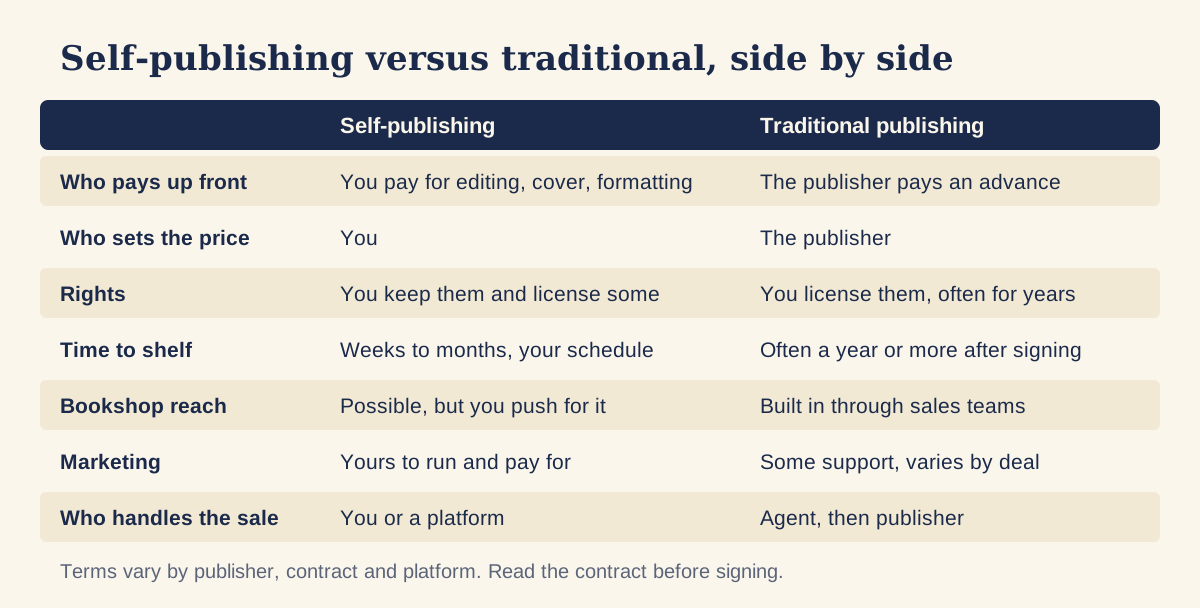
Self-publishing vs traditional publishing: how do they compare?
The table above is the short version. The longer version is that each row hides a trade. Control costs you money and time. A publisher's money and reach cost you control. Our article on the benefits of self-publishing and what each one costs goes through the self-publishing side in detail, so this guide concentrates on the choice between the two.
| Question | Self-publishing | Traditional publishing |
|---|---|---|
| What do you hand over? | Nothing. You license rights only if you choose. | Rights, for a term set in the contract. |
| What do you pay for? | Editing, cover, formatting, proofing and promotion. | Normally nothing up front. An agent takes commission on deals. |
| Who decides the title, cover and price? | You. | The publisher, usually after consulting you. |
| How long to publication? | As long as your own schedule takes. | Often a year or more after signing, plus the time to find an agent and a deal. |
| Who gets paid first? | The retailer or platform, then you. | The retailer, then the publisher. Royalties earn back your advance before you receive more. |
| Can you get the rights back? | You never gave them up. | Only through the reversion clause in your contract. |
How does the money flow on each route?
On a self-published sale, the reader pays the retailer, the retailer keeps its share, the print or delivery costs come off, and you receive the rest. You carry the up-front costs yourself, and our guide to what it costs to self-publish sets out what those costs are. On a traditional sale, the same retailer share comes off, then the publisher takes its share, then your royalties count against the advance you were paid, and an agent takes commission on what you receive.
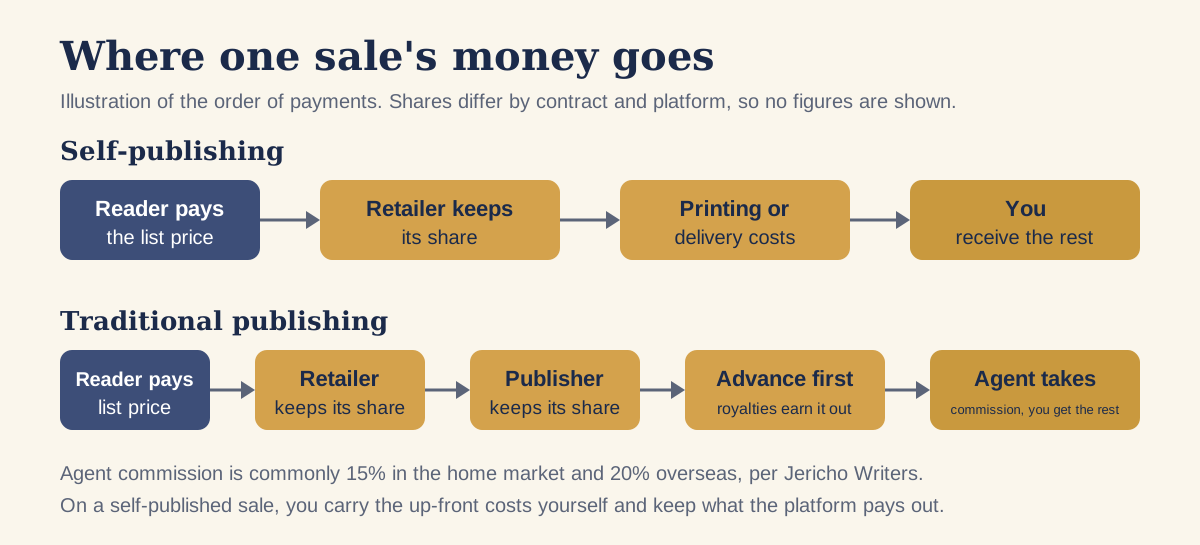
Agents are paid by commission only. Jericho Writers, a UK writers' organisation, says in its guide to literary agent fees that agents charge nothing up front and typically take 15% of sales in their home market, 20% on overseas sales and 20% on film and TV rights. It calls those rates "increasingly standard", not compulsory. A US agent's home market is the US and a British agent's is the UK, so the same percentages apply on each side of the Atlantic.
What do authors earn on each route?
The published figures are patchy, and we could not find one that compares the two routes cleanly. The Authors Guild's 2023 author income survey (5,699 published authors, covering income in 2022) reports a median book income of $10,000 for full-time authors and $12,800 for full-time self-published authors. The page we read does not give a figure for traditionally published authors alone, so we cannot compare them from that source.
Medians describe the middle of a group that already works full time at writing, and they say little about what any one new author will earn. Our article on what a self-published author makes explains why survey figures disagree and how to build an estimate for your own books. No honest source can promise an income on either route.
Who controls rights, price and timetable?
With self-publishing, you do. You choose the title and cover, set the price and change it the same day, and pick the publication date. You can license audio, translation or other rights to different companies, or keep them. The cost is that nobody else will do the selling or the chasing for you.
With a traditional deal, the contract decides. The publisher usually sets the list price, the schedule and the cover, and you will be consulted on some of these and not others. Read the grant of rights carefully: it lists which formats, territories and languages you are licensing, and for how long.
How does rights reversion work?
Reversion lets you take your rights back when a book stops selling. The Authors Guild's guide to out-of-print clauses explains how it works in US contracts, and the same ideas appear in UK ones:
- An out-of-print clause lets you regain your rights and end the contract when the book is no longer selling or is no longer "in print" as the contract defines it.
- Older definitions required a physical edition. Newer ones count ebooks and print-on-demand, which lets a publisher keep a book technically in print with almost no effort.
- The Guild recommends a royalty threshold, for example earnings under a set amount for two consecutive royalty periods, rather than a sales-based test.
- Reversion usually cannot be requested until two or three years after publication, and the Guild considers three years a reasonable outer limit for trade books.
- You normally send a formal written demand. Automatic reversion if the publisher fails to act is better than a clause that needs the publisher to respond.
Check the clause before you sign, because it decides whether a book that fails to sell can ever come back to you. A reversion letter also helps if you republish yourself, as platforms such as Amazon may ask for proof that you hold the rights.
How does the agent route work in the UK and the US?
Most larger publishers read submissions through agents, so for a trade deal the first job is to find one. The steps are much the same in both countries. You write the book, polish a sample and a synopsis, and send a query to agents who represent your genre. An agent who takes you on sells the book to a publisher and negotiates the contract.
A legitimate agent earns commission only when the book sells, at the rates described above. Jericho Writers states that agents do not charge fees up front or later, so a request for money to read or represent your book is a warning sign. If an agent offers representation, you can still ask questions about which publishers they plan to approach and what happens to rights that the deal does not use.
Some good books find no agent because they are hard to categorise or aimed at a niche too small for a large publisher. That is a reason to consider self-publishing, not a verdict on the book.
What about hybrid and paid-for publishers?
Between the two routes sit publishers that ask the author to pay. Some call themselves hybrid, partnership or contributory publishers. The Society of Authors and the Writers' Guild of Great Britain opened a joint investigation into vanity publishing in March 2021 after a rise in complaints, and in April 2022 called for reform of the sector, saying such firms often use aggressive marketing and unclear contracts. We could not open the full report, so read it before you judge an offer.
A simple test applies to any offer: does the company make its money from readers or from you? Warning signs include large up-front fees, a requirement to buy copies of your own book, vague costs, flattering unsolicited offers and exclusive rights for a long term. A company that sells services and leaves you the rights and the royalties is a different proposition from one that charges you and then keeps the rights. Have a contract checked by a solicitor or an authors' organisation before you sign anything.
Which route should you choose? Questions to ask yourself
Work through these in order. The picture below follows the same logic.
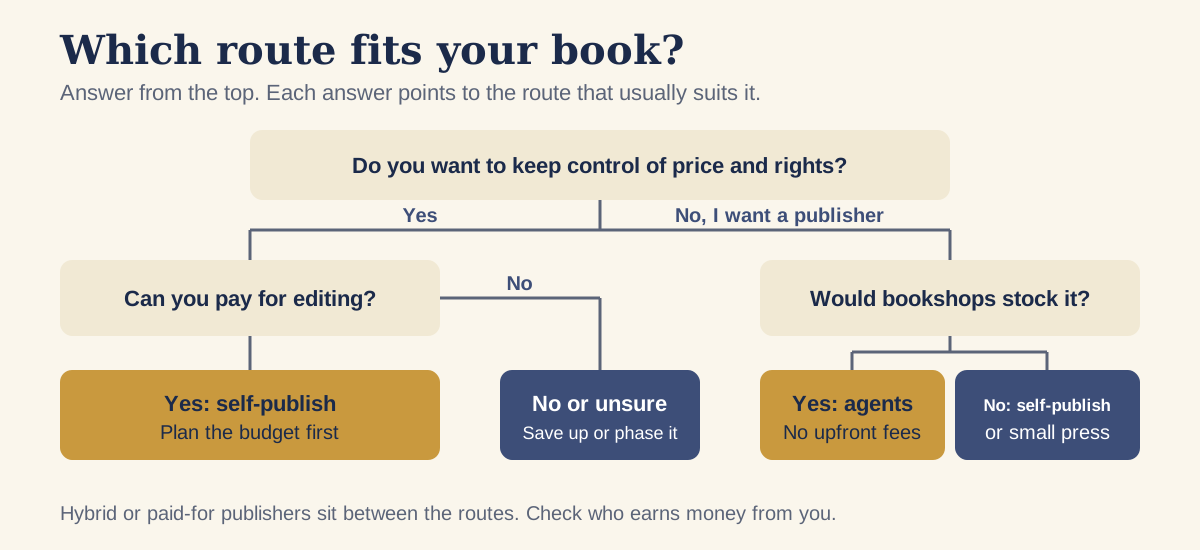
- Do you want to decide the price, cover and release date? If so, self-publishing fits. If you would rather hand those decisions over, a publisher fits better.
- Can you pay for editing and a cover? If not yet, build the budget first or phase the spending, as in our steps to self-publishing in order.
- Would bookshops and libraries stock the book? Print distribution through shops is the clearest thing a large publisher offers. If your book suits shop shelves, try agents first.
- Is it a series, or does it suit fast publishing? Series fiction often does well when you can release at your own pace, since readers who finish one book want the next.
- Do you need an advance? A traditional advance pays you before the book sells, which self-publishing cannot do.
- How much of the marketing will you do? Both routes ask for work, and in neither case should you expect a publisher to do all of it.
Can you use both routes?
Yes. Some authors self-publish one series and sign a traditional deal for another book. Others publish with a house first and use reversion later to republish a backlist title themselves. If you plan to do both, watch the contract for clauses that give a publisher first refusal on your next book or limit your right to publish similar work elsewhere.
Once you decide to publish yourself, the next job is choosing where to sell. Our article on KDP Select or going wide covers that choice, and the pricing of a series is in our guide to series pricing and box sets.
Questions, answered
Is self-publishing or traditional publishing better?
Neither is better in general. Self-publishing gives you control of rights, price and timing and asks you to pay for the work and do the selling. Traditional publishing pays an advance and brings a publisher's team and distribution, and you license your rights in return.
Do literary agents charge fees?
Jericho Writers says agents charge nothing up front and take commission only when they sell your work, typically 15% in their home market and 20% overseas and on film and TV rights. Those rates are common but not compulsory, and a request for money to read or represent your book is a warning sign.
Can you get your rights back from a traditional publisher?
Only if your contract allows it, usually through an out-of-print or reversion clause. The Authors Guild says reversion often cannot be requested until two or three years after publication, and recommends a royalty threshold in place of a sales count. You normally have to send formal written notice.
Is a hybrid publisher a good choice?
It depends on the contract. The Society of Authors and the Writers' Guild of Great Britain have criticised paid-for publishers for aggressive marketing and unclear contracts. Check who earns money, from readers or from you, and have a contract reviewed before you pay or sign.
What do self-published and traditionally published authors earn?
No source we found compares them cleanly. The Authors Guild's 2023 survey, covering income in 2022, reports a median book income of $10,000 for full-time authors and $12,800 for full-time self-published authors. It does not give a traditional-only figure on the page we read, so treat any single number with care.
Run it all from one place
Author page, direct sales, reader list, review copies and press kit, built from one ASIN. Free for 14 days, no card.
Start your free trial