
Indie Author Academy / Lessons
Translate your book: rights, costs and which stores sell it
Should you translate your book? Who owns the rights, what a translator costs, how KDP's Kindle Translate works, and a cheap way to test a new language.
You can translate your book into another language, and for most indie authors the cheap way to find out whether it is worth it is to test one language on one ebook before paying for a full translation. A paid human translation of a novel costs thousands, Amazon's Kindle Translate is free but invite-only, and the quality of the result decides whether readers in that language leave good reviews or bad ones.
Everything below was read on 13 November 2026. Where a page was out of reach or a rate had no current source, I say so instead of guessing.
Should you translate your book at all?
Translate when you can name the reader and the store. A book that already sells steadily in English, in a genre that readers in your target language buy, is a better candidate than a slow seller you hope a translation will rescue. A translation does not fix weak positioning, and it adds a second book to market in a language you may not read.
It helps to ask three practical questions. Do you hold the translation rights, or did you sign them to a publisher? Can you check the finished text, or pay someone who can? Is there a store and a marketing route in that language? If any answer is no, pause. Our guide to audiobook rights for indie authors shows the same habit of checking what you have licensed before you sell it again.
Who owns the rights to a translation?
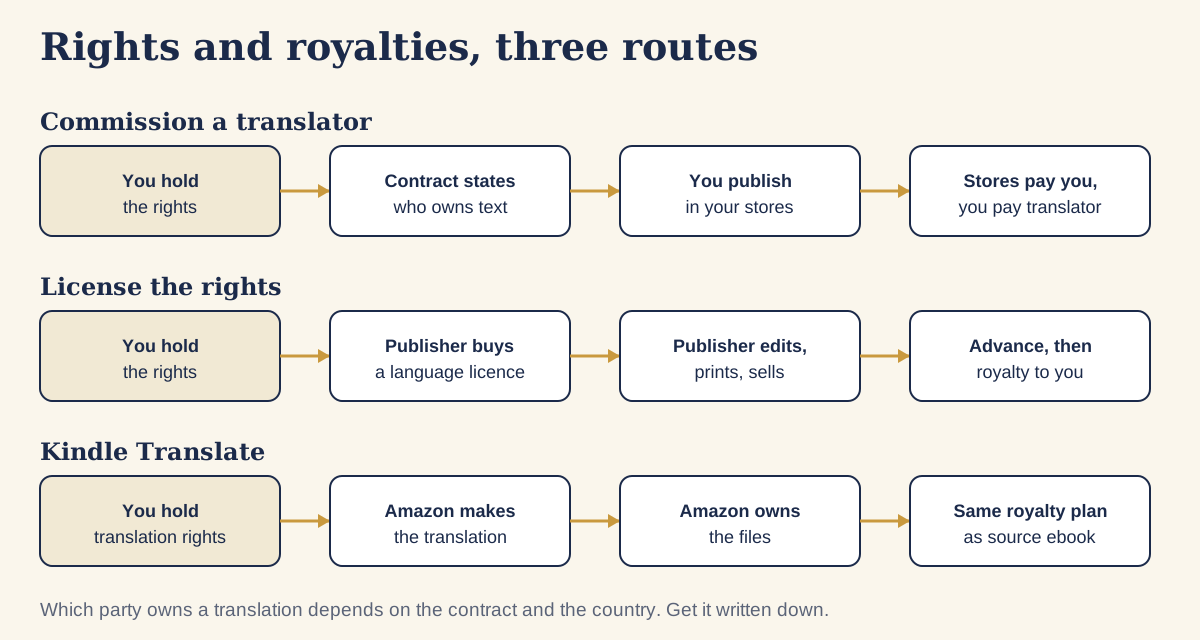
You own your book, and a translation is a derived work, so you need to hold the translation rights before anyone translates it. If you sold those rights to a publisher, they are not yours to use. Self-published authors who never granted them usually hold all of them, which is why a translation project can start without anyone's permission but yours.
The translation itself is a separate piece of writing. In many countries the translator is the author of the translated text unless a contract says otherwise, and a licence from you limits what they can do with it. I did not find an official UK or US page that settles this for every country, so treat the point as a reason to write the answer into the contract. State who owns the translated text, which stores and formats it may be sold in, and what happens if either side wants to end the deal. This is general information and not legal advice, so have a contract adviser read anything with a revenue share.
What does a human translator cost?
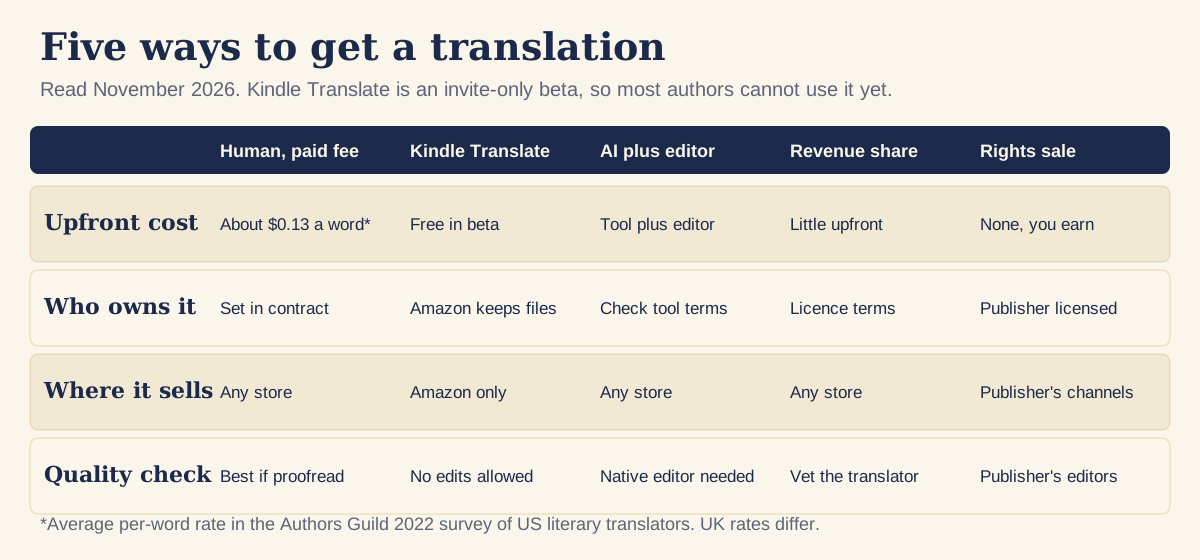
A named source for current rates is hard to find, and it is better to say so than to quote a blog's number. The Authors Guild published a survey of literary translators in 2022 with 279 responses. Its report says prose translators charged from $0.01 to more than $0.40 a word, with the largest group at $0.10 or less and $0.12 next. The average was $0.13 a word. Those are US figures for literary work, and the survey does not separate the source word count from the target word count.
Here is that average as arithmetic, not a quote. An 80,000-word novel at $0.13 a word comes to $10,400. At $0.10 it comes to $8,000, and at $0.40 it comes to $32,000. A UK page on English PEN lists a Translators Association recommended minimum of £90 per 1,000 words for prose, which would give £7,200 for the same book, but that page dates from 2004 and gives no current year. I did not find a current UK rate card from the Society of Authors or the Translators Association, so ask a translator for a written quote and compare two or three.
Before you hire, ask for a paid sample of about 1,000 words and have a native reader of the target language judge it. That sample costs a small fraction of the full job and tells you whether the style matches yours.
Does KDP have a translation service?
Yes, but it is closed to most authors. KDP's help page says Kindle Translate is an invite-only beta for eligible ebooks on kdp.amazon.com, and it is not available on kdp.amazon.co.jp. You can join an interest list, and a Translate your eBook option appears on your Bookshelf if your book qualifies.
The source language must be English, French, German, Italian, Portuguese or Spanish, and Japanese books are not eligible. KDP's languages page lists French, German, Italian, Portuguese (Brazil) and Spanish (Spain) as targets for English books, and says it is updated as options are added. Check it before you plan around a language, because I could only read its table in a garbled form.
- It is described as a free service in beta, and the same KDP royalty options apply to translations as to the source ebook.
- It creates ebooks only. You cannot make an audiobook or print book with it.
- You cannot edit the translated text directly, though you can preview it before publishing.
- Translations are held to the same content quality guidelines as your source ebook and pass a quality check, and KDP can decline or remove them.
The beta terms matter more than the features. They say the book must be one for which you hold the translation rights, that Amazon keeps ownership of Kindle Translate Edition files, and that you cannot sell those editions outside the program. Unless your book is in KDP Select, you can publish your own translation in the same language elsewhere. KDP also asks beta participants not to share specifics of the experience. So the cheap route fits an Amazon-only test and is a poor base for a wider translation strategy.
Can I use AI or translation platforms instead?
You can, and the main risk is unchecked text. Machine translation produces readable sentences, but dialogue, idiom, jokes and names are where it goes wrong, and a reader will not forgive them. If you use any tool, pay a native speaker who reads that genre to edit the result, and check the tool's terms for who owns the output and where it may be sold. I could not find a neutral source that prices an editor for a full novel, so get quotes.
Another route is a revenue share with a translator who takes little or nothing upfront in return for a percentage of sales. It lowers your risk and raises theirs, so expect them to be choosy about the book. Put the percentage, the length of the deal and the ownership of the text in writing. Draft2Digital does not translate. Its FAQ says it does not directly offer editing or other author services and refers authors to endorsed freelancers on its Partners page.
What about selling the translation rights?
A foreign publisher pays an advance and a royalty and handles translation, editing, printing and marketing, so you carry no translation cost. The trade-off is that you grant them a language licence and lose control over price and timing in that market. An Alliance of Independent Authors article from December 2012 notes that translation can cost many thousands of euros, which is why publishers weigh the financial risk. That article is old, so read it as background and not as a current route.
Which stores sell translated ebooks?
KDP's supported-languages page says it supports 47 languages, with some limited to certain formats, so you can sell a translated ebook on Amazon directly. I could not verify a complete language list for Apple Books, Kobo or Draft2Digital, so check each one. Draft2Digital's blog says Apple Books operates in 51 countries, and Kobo's reach is described differently by different sources, from about 40 local storefronts to a claim of over 190 countries that I could not confirm.
Use the store's own help pages to confirm that your language and your reader's country are both supported. Our guide to getting your book on Apple Books, Kobo, Google Play and Barnes & Noble covers account set-up, and the comparison in IngramSpark vs KDP and the other platforms shows which route adds print. If the ebook stays in KDP Select, the per-book decision on KDP Select applies to the translation as well.
What are the quality risks?
The main risk is publishing text nobody who reads the language has checked. Readers who buy in their own language leave reviews in that language, and a few that say the translation is awkward can sink a new title. Other risks are smaller but real: names and place names that read oddly, formatting that breaks with longer words, and a blurb that sells the wrong promise.
Ask the reviewer to mark every line that sounds stiff, every term used inconsistently and every culture-specific reference. Fix those before you publish, and have a second person check the cover text, title and blurb, which are the first thing a browsing reader sees.
How do you test a new language market cheaply?
Treat the first translation as a test and spend in stages. The plan in the illustration fits most authors.
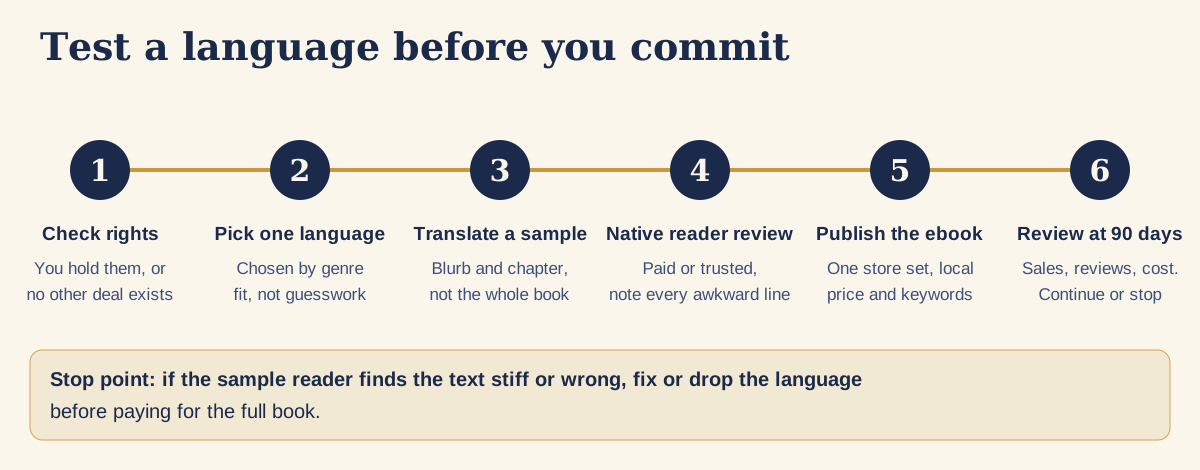
- Confirm you hold the translation rights.
- Choose one language where your genre already sells, instead of translating into several at once.
- Have the blurb and one chapter translated for a fixed fee.
- Pay a native reader to review the sample and mark problems.
- Translate and publish the whole ebook only if the sample passes, and set the price in local terms using our pricing guide.
- Review sales and reviews after 90 days and stop, continue or add print.
If you later sell translated ebooks from your own site to EU readers, read the guide to EU VAT and the One Stop Shop for ebooks before the first order. For the sources, see KDP's pages on Kindle Translate and its beta terms, and the Authors Guild 2022 translators survey.
Questions, answered
Does KDP have a translation service?
Yes, Kindle Translate, but KDP's help page calls it an invite-only beta for eligible ebooks on kdp.amazon.com. It is described as free in beta and covers ebooks only. Amazon keeps ownership of the translated files and you cannot sell them outside the program.
How much does it cost to translate a book?
The Authors Guild's 2022 survey of US literary translators found an average of $0.13 a word, with prose rates from $0.01 to over $0.40. At that average, an 80,000-word novel is about $10,400. Ask for written quotes, because rates vary by language and translator.
Who owns the copyright in a translation?
It depends on the country and the contract, so write it into the agreement. In many countries the translator is the author of the translated text unless the contract says otherwise. You need to hold the translation rights of your own book before anyone translates it.
Can I use the same ebook files in every store?
A translated ebook is a new book in a new language, so it needs its own file, cover text, blurb and metadata. If you use Kindle Translate, Amazon says you cannot sell those editions outside the program. A translator you hire can supply files for any store if your contract allows it.
How can I test a language market without paying for the whole book?
Pay for a translated blurb and one chapter, have a native reader review it, and publish the full ebook only if it passes. Then review sales and reviews after 90 days. This keeps the first spend to a small fixed fee.
Run it all from one place
Author page, direct sales, reader list, review copies and press kit, built from one ASIN. Free for 14 days, no card.
Start your free trial